The landscape of proprietary trading firms is undergoing a significant transformation, driven by the advent of blockchain technology. This shift, which sees the traditional "prop firm" model migrating onto decentralized ledgers, promises enhanced transparency and verifiability, directly addressing many of the opaque practices that have plagued the sector. This evolution is particularly stark when viewed through the lens of past regulatory actions, such as the high-profile case involving MyForexFunds.
In August 2023, the U.S. Commodity Futures Trading Commission (CFTC) initiated legal proceedings against MyForexFunds, a Toronto-based prop-trading firm that had amassed over $310 million in fees from more than 135,000 customers. The core of the CFTC’s complaint was not the legality of prop firms themselves, but rather the firm’s alleged misrepresentation of its operations. MyForexFunds explicitly informed its clientele that their trades were being executed against third-party liquidity providers. However, the CFTC contended that the firm itself acted as the counterparty for substantially all trades. Furthermore, the regulatory body alleged that MyForexFunds deployed software designed to manipulate customer fills, pushing them to less favorable prices, and frequently closed winning accounts on spurious technicalities. Essentially, the firm was accused of operating as a "bucket shop" – a broker that trades against its own customers – disguised as a legitimate prop firm. This legal action highlighted a critical vulnerability within the traditional prop trading model: the inherent conflict of interest between the firm and its traders, often shrouded in secrecy.
The Traditional Prop Firm Model: Business & Pitfalls
To fully grasp the significance of onchain prop firms, it’s essential to understand the fundamental business model they aim to disrupt. Stripped of its aspirational marketing rhetoric about "funding the next generation of traders," a modern prop firm primarily sells a paid examination with a potential payout. Aspiring traders pay a one-time fee, ranging from approximately $50 to several thousand dollars depending on the desired account size, to gain the right to trade a simulated account under a predefined set of rules. The objective is typically to achieve a profit target, often around 10%, without exceeding a specified drawdown limit. Successful completion of this challenge results in the trader being declared "funded," after which they receive a share of their profits, commonly 80%, with the firm retaining the remainder.
The revenue generated from these evaluation fees constitutes the visible bedrock of the industry. Industry leader FTMO, based in Prague, reported an impressive $329 million in revenue in 2024, managing 2.3 million open accounts. Over its decade-long existence, FTMO has distributed more than $450 million to successful traders. Similarly, FundedNext, a challenger from the UAE, is estimated to have cleared over $100 million in 2024. The total addressable market for these evaluation fees is estimated to be in the low billions annually, underscoring the scale and profitability of this sector.
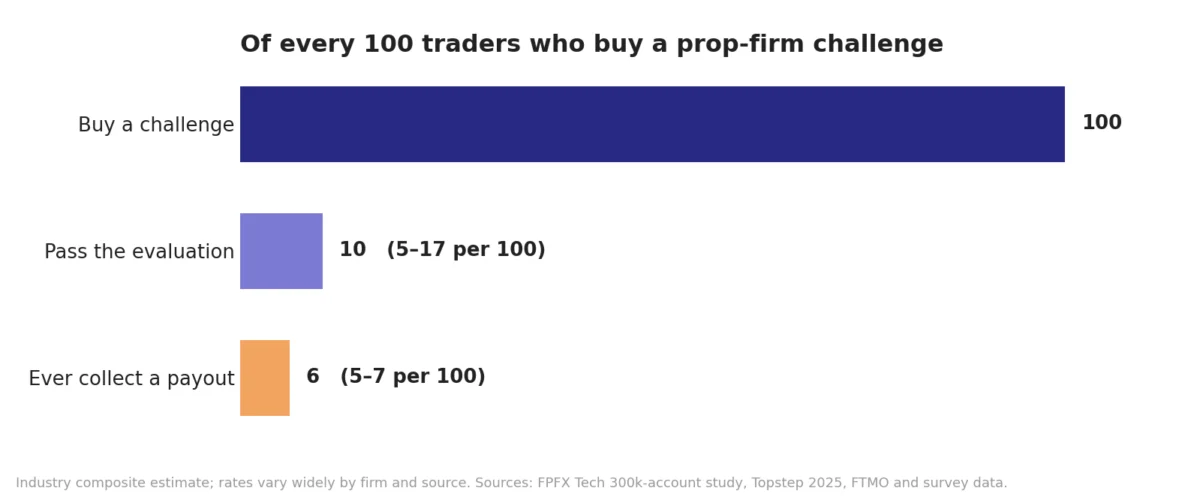
However, this lucrative funnel operates on a crucial, often unspoken, premise: the vast majority of participants fail. While audited data is scarce due to the private nature of most firms, credible estimates consistently show low success rates. These estimates differentiate between two distinct milestones: passing the initial evaluation and actually collecting a payout. For every 100 traders who embark on a prop-firm challenge, roughly 10 are estimated to pass the evaluation phase, and an even smaller fraction, around 6, ever collect a payout.
Data from various sources corroborates this challenging reality:
- FTMO: Community estimates suggest approximately 8% pass Phase 1 of their evaluation, with about 7% of all entrants ever collecting a payout.
- Topstep: Firm-published data for its 2025 Combine indicated a 16.8% pass rate, with 33% of funded traders ultimately receiving payouts.
- FPFX Tech study: A third-party analysis of 300,000 accounts found that only 7% ever collected a payout.
- The Funded Trader: The CEO publicly stated that 1-2% of all clients ever receive payouts.
- Industry Composite: General surveys and aggregated data suggest 5-10% pass evaluation (slightly higher in futures markets due to more structured rules) and approximately 5-7% of entrants ever collect a payout.
The stark reality for buyers is that the odds are overwhelmingly stacked against them. The economics are straightforward: most customers fail, their fees become gross margin for the firm, and the small minority who succeed are paid from the much larger pool of fees generated by those who didn’t. This fee-driven funnel, rather than any exceptional trading prowess, is the fundamental engine of the business.
The Hidden Layer: A-Book vs. B-Book
Beyond the evaluation fees, a second, often concealed, layer of profit exists: the "B-book." The challenge phase is, by design, a simulation; no real orders enter the market. The critical question arises once a trader becomes "funded." Even then, their orders frequently do not reach a live market. Instead, the firm internalizes these trades, a practice known as B-booking. If the trader loses – which is the statistical norm – the firm directly pockets these losses, effectively amplifying its profits beyond the initial evaluation fees. This B-book mechanism, a long-standing practice among retail forex brokers, is profitable precisely because most accounts ultimately lose. It serves as an additional revenue stream, an "icing on the cake" rather than the sole foundation of the business.
Conversely, an "A-book" operation involves the firm passing a trader’s order directly to a real market venue, earning only a spread or commission. Firms typically A-book traders they believe will be consistently profitable, thereby avoiding liability for their gains. They B-book traders