At 16:49:48 UTC on Friday, August 28, 2026, a Solana wallet—funded just three hours prior with 1.79 SOL derived from $190 in USDC bridged from Ethereum—initiated a series of transactions that would systematically drain the card-balance accounts of users on Avici, a prominent Solana-based neobank. This breach, which ultimately compromised the funds of 1,685 users, totaling over $500,000, exposed the fragile architecture underpinning the rapidly expanding market of non-custodial crypto debit cards. While Avici’s terms of service, last updated in June 2025, explicitly assured users that neither the company nor its issuer would hold custody of collateral, the reality of the smart contract design proved far more vulnerable than the legal disclaimers suggested.
The breach was not a traditional theft of private keys, nor was it a compromise of user-held wallets. Instead, it was an exploit of the "program manager" layer—a central point of failure in many contemporary self-custodial card designs. The affected funds were stored in smart contracts that, while technically accessible by the user, remained under the control of a program manager who held the authority to upgrade the code using a single, plain signing key.
A Chronology of the August 28 Breach
The exploit occurred within a remarkably narrow window of time. Between 16:49:48 UTC and 19:18:52 UTC, the attacker’s wallet (FVNFzqAny8spWdPmYw6RQ9TkYa29ueFFiqCFD1gQnCEj) executed 21,405 transactions, of which approximately 17,500 were successful. The methodology involved exploiting an authorization bug within the Rain-controlled Solana card program. Specifically, the attacker leveraged a signature-verification flaw where a single Ed25519 signature could be reused to satisfy a dual-signature requirement for administrative actions. By doing so, the attacker granted themselves "collateral admin" status on over a thousand individual user accounts, subsequently draining them.
The impact was swift and severe. By 19:03 UTC, while the drain was still active, the attacker had already begun laundering the proceeds through deBridge, converting the stolen assets into 418.11 ETH and 90,925 USDC. By 19:49 UTC, these funds were funneled through Tornado Cash in a standardized ladder of deposits. The total amount bridged out was approximately 1.11 million USDC. Following the exploit, the value of the AVICI token plummeted by 49%.
The Role of Rain and the Third National Issuer
The incident brought intense scrutiny to Rain, the card-issuing infrastructure company that serves as the backbone for a vast portion of the self-custodial card market. Investigation revealed that the exploit impacted three distinct Rain program IDs. Rain’s infrastructure is not, as many users assume, a decentralized banking protocol. It is a sophisticated, centralized stablecoin-powered payment layer. Rain is the trade name for Signify Holdings, Inc., and its issuing entity, "Third National," is a licensed Money Transmitter in Puerto Rico—not a chartered bank or a regulated Electronic Money Institution (EMI).
Rain’s business model relies on a network of capital partners who borrow stablecoins to facilitate network settlement for credit card receivables. When a user swipes a "non-custodial" card, Rain pays Visa from these borrowed funds and is subsequently repaid from the user’s smart contract collateral. This structure means that even in "non-custodial" models, the card is essentially a charge card financed by Rain’s corporate treasury.
The Landscape of Crypto Card Custody
To understand the risks, one must categorize the five distinct custody models currently dominating the $1.1 billion monthly crypto card market:

- Sold to the Operator: Programs like KAST treat user deposits as a "sale" of assets to the company, effectively turning the user into an unsecured creditor. In the event of bankruptcy, users are relegated to the status of general creditors, often behind senior debt.
- Custodial Held for You: Platforms like RedotPay and Revolut act as custodians. While they claim to hold assets on behalf of the user, the legal reality is often obscured by general liens and affiliate relationships.
- Fiat Conversion at Licensed Issuers: Traditional exchange cards (Crypto.com, Kraken, Bybit) do not hold crypto on the card. They convert assets to fiat at the moment of sale. In the EU, these programs fall under EMI regulations, which provide statutory protections through "safeguarding" of fiat funds.
- Shared Pool Collateral: This category, which includes the Avici and Tria models, relies on user-funded smart contracts. While the user technically owns the collateral, the upgrade authority for the smart contract often rests with the operator, creating a single point of failure.
- Vault-Based Debits: Programs like Gnosis Pay and Ether.fi Cash utilize advanced smart account structures (e.g., Gnosis Safes) that limit the operator’s ability to move funds. Even here, however, reliance on "corporate signers" for recovery creates a nuanced security profile.
Market Data and Regulatory Headwinds
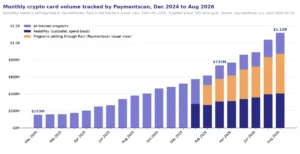
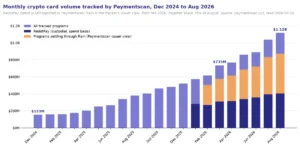
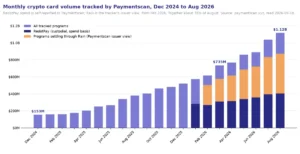
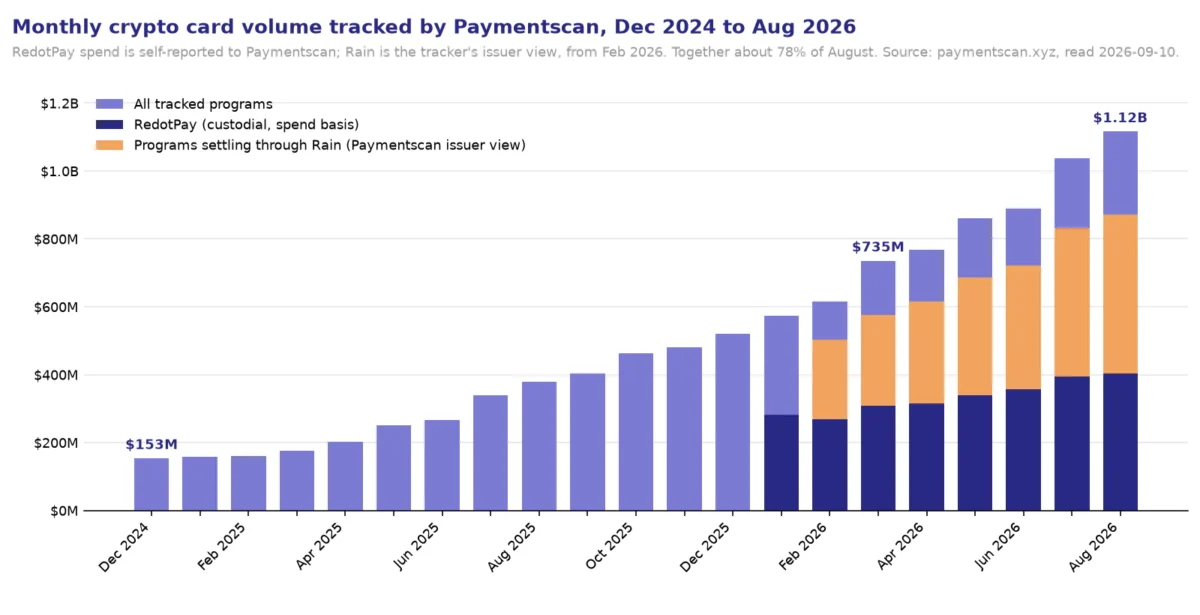
According to Paymentscan, the total volume for crypto-linked cards in August 2026 reached $1.116 billion, representing a 32% increase since March 2026. However, these figures come with significant caveats. Much of the "volume" is self-reported by operators like RedotPay, or represents proxy settlement batches rather than actual on-chain spend. The reliance on Rain-managed programs is particularly high, with roughly 42% of the market volume flowing through its infrastructure.
The regulatory environment is shifting rapidly. The European Union’s Anti-Money Laundering Regulation (EU) 2024/1624, effective in July 2027, will impose strict prohibitions on anonymous crypto-asset accounts and offshore anonymous prepaid cards. This will likely force a consolidation of the "no-KYC" card market, as issuers will no longer be able to hide behind the ambiguity of corporate-entity verification.
Response and Remediation
In the wake of the August 28 incident, the response from Rain and its partner brands was rapid, if somewhat opaque. By September 5, Rain had moved the upgrade authority for its affected programs to a Squads multisig vault, a significant security improvement that removed the single-key risk. Furthermore, all affected users were made whole within 24 hours, with Avici and Tria funding the refunds from their respective balance sheets.
While the financial loss was mitigated by the companies’ decision to cover the costs, the incident serves as a stark reminder that the term "non-custodial" in a cardholder agreement is a legal description of current state, not a guarantee of future security. It says nothing about the provenance of the deployed code, the rigor of audits, or the security of the upgrade keys.
Analysis: The "Non-Custodial" Fallacy
The fundamental lesson from the August 2026 crisis is that users often conflate "non-custodial" with "unhackable." In reality, when a user deposits funds into a card-linked smart contract, they are entering a trust relationship with the developer who wrote the contract and the program manager who controls the upgrade key.
The fact that Gnosis Pay, a pioneer in the space, is winding down its consumer interface while its underlying infrastructure persists, highlights the volatility of this sector. Companies are pivoting away from direct consumer interfaces toward white-label infrastructure, effectively shifting the burden of compliance and security further down the supply chain.
As the industry matures, the disparity between platforms will widen. Users should prioritize programs that:
- Clearly name their legal issuer (and verify if it is a licensed bank or EMI).
- Publicly disclose their smart contract addresses.
- Utilize multisig or timelock modules for contract upgrades.
- Maintain clear, unambiguous language regarding insolvency protection.
The resilience of the crypto-card market depends on whether these firms can move beyond the "move fast and break things" ethos that characterized the 2025-2026 growth spurt. As the market approaches $1.5 billion in monthly volume, the reliance on single-issuer infrastructure—like the Rain-Third National nexus—represents a systemic risk that regulators and users alike will increasingly demand be addressed through radical transparency and technical decentralization. For now, the "non-custodial" promise remains a work in progress, often held together more by venture-backed balance sheets than by the underlying code itself.