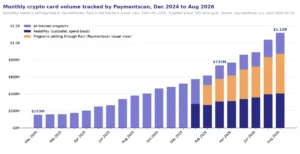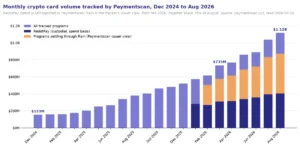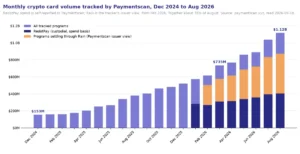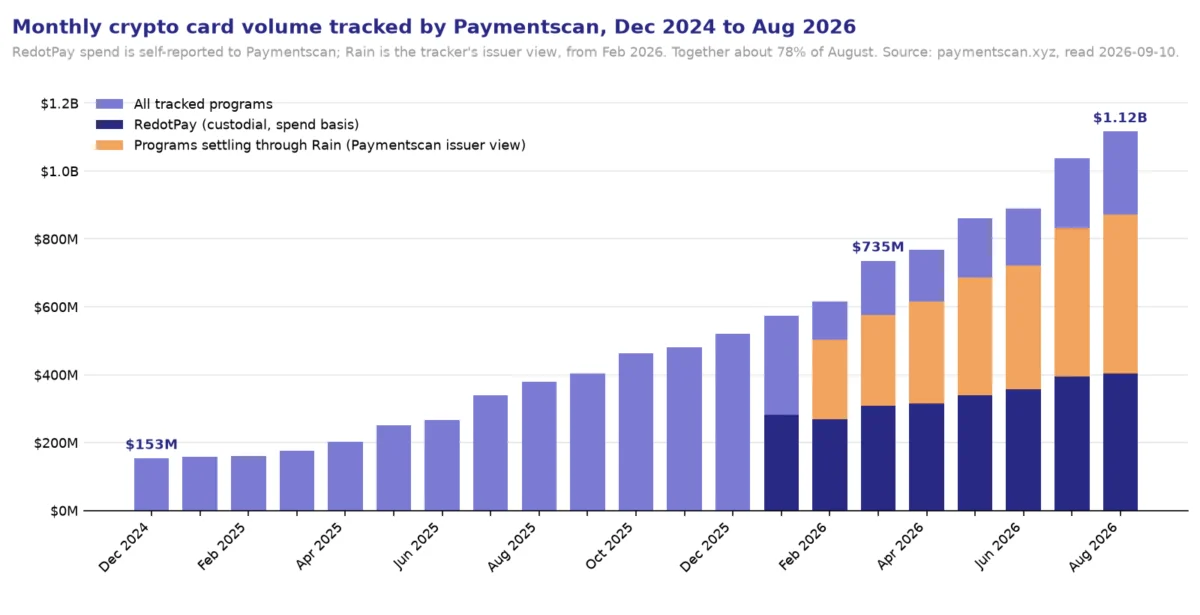
At 16:49:48 UTC on Friday, August 28, 2026, a Solana-based wallet—funded just three hours earlier with 1.79 SOL via a $190 USDC bridge from Ethereum—executed a sequence of transactions that exposed a critical vulnerability in the infrastructure of several prominent crypto-native neobanks. By the time the exploit concluded, 1,685 users of Avici, a Solana-based financial platform, had seen their card-balance accounts drained of a combined $500,859.22. This incident, while rapidly contained, has cast a harsh light on the "non-custodial" card industry, a sector that has seen its monthly volume swell to over $1.1 billion as of August 2026, according to data from Paymentscan.
The breach was not a result of compromised user keys or illicit wallet access. Instead, it targeted the core architecture of the card programs themselves. The funds were stored in smart contracts that, while billed as non-custodial, remained under the administrative control of the program manager—in this case, Rain, the infrastructure firm powering Avici and a host of other self-custodial card programs. This event serves as a stark reminder that in the nascent world of crypto-payments, the distance between marketing claims and technical reality can be measured in lines of code and upgrade keys.
The Anatomy of the August 28 Drain
The exploit followed a precise, automated cadence. The attacker’s address, identified as FVNFzqAny8spWdPmYw6RQ9TkYa29ueFFiqCFD1gQnCEj, initiated nearly 21,400 transactions against Rain-controlled Solana programs. The vulnerability relied on a flaw in the SubmitSignatures call within the smart contract’s native Ed25519 signature-verification instruction. By manipulating signature and key offsets, the attacker bypassed the requirement for two-factor approval, effectively granting themselves "collateral admin" privileges on over a thousand individual user accounts.
Once elevated to administrator status, the attacker systematically emptied the collateral balances, siphoning funds into a series of deBridge orders that ultimately funneled the stolen assets to Ethereum. By 19:49 UTC, approximately 456 ETH—valued at roughly $1.1 million—had been funneled through the Tornado Cash mixing service.
While the total impact reached approximately $1.1 million across Avici and Tria, the resolution was swift. Rain, the infrastructure provider, covered the full amount of the stolen funds, with Avici and Tria adding an additional 10% premium for affected users. Despite the rapid reimbursement, the incident highlighted a fundamental concentration risk: three distinct Rain-managed program IDs were using a single, plain keypair for upgrade authority. It was not until September 5, nearly a week after the incident, that Rain moved these administrative controls to a Squads multisig vault, a security standard that should have been in place at inception.
Market Growth and the Custody Conundrum
The rapid growth of the crypto-card market has outpaced the development of robust regulatory frameworks. Paymentscan data reveals that monthly volume surged from $153 million in December 2024 to $1.116 billion by August 2026. This trajectory is fueled by a mix of institutional interest and the promise of "borderless" spending. However, beneath the headline figures lies a complex web of custody models that dictate whether a user’s assets are truly their own or merely a debt claim against a private entity.
These models generally fall into five categories:

- Sale to Operator: Models like KAST, where assets are technically "sold" to the company in exchange for a ledger entry. In the event of bankruptcy, users become unsecured creditors.
- Standard Custody: Programs like RedotPay, where assets are held in a traditional custodial wallet, subject to the terms of the custodian.
- Fiat Conversion: Cards like Crypto.com and Kraken, which hold no crypto at the point of sale, converting assets to fiat via licensed partners.
- Program-Managed Collateral: The model utilized by Avici and Tria, where user assets sit in smart contracts managed by a third party.
- Self-Custodial Vaults: The most secure model, utilized by Gnosis Pay and Ether.fi Cash, where the user retains control over the underlying smart contract or vault, often with specific spending modules that limit the operator’s ability to move funds.
The reliance on "Third National," a Puerto Rico-based money transmitter, as the primary issuer for at least seven of the programs surveyed, further complicates the landscape. Unlike a chartered bank, Third National operates under money transmitter licensing, and its relationship with users is governed by specific contractual obligations rather than federal banking protections like FDIC insurance.
The Regulatory Horizon and Industry Consolidation
The regulatory environment is bracing for a significant shift. The European Union’s Anti-Money Laundering Regulation (EU) 2024/1624, set to apply from July 2027, is poised to effectively end the "no-KYC" (Know Your Customer) card model by prohibiting anonymous crypto-asset accounts and restricting the use of anonymous prepaid cards issued in third-party jurisdictions.
This regulatory pressure, combined with the technical failures seen throughout 2026, is driving a consolidation of the market. The collapse of institutions like Paytend, the closure of Kulipa’s operations, and the recent decision by Gnosis Pay to wind down its consumer interface demonstrate that the infrastructure behind these cards is fragile. The market is shifting away from the experimental, high-fee "no-KYC" services toward platforms that integrate directly with established financial institutions and utilize verified, audited smart-contract architectures.
Lessons from the August 2026 Breach
The incident in August was not a failure of self-custody as a concept, but a failure of operational security within a shared infrastructure. The fact that Ether.fi users were unaffected—despite using similar technology—is a testament to the importance of the specific smart-contract implementation. Ether.fi’s use of a "Turnkey" signer inside an AWS Nitro enclave, combined with an operator-shaped backstop, provides a different security profile than the Rain-managed contracts.
For the end user, the lesson is clear: the term "non-custodial" in a cardholder agreement is a legal description of who owns the assets, not a technical guarantee of security. Users must look beyond the marketing and evaluate the following:
- Upgrade Authority: Who holds the keys to change the smart contract code?
- Issuer Identity: Is the issuer a regulated bank, or a money transmitter with opaque financial obligations?
- Insolvency Provisions: Does the legal language explicitly protect the user’s assets in the event of the company’s bankruptcy?
- Real-time Settlement: Does the platform rely on a third-party administrative layer that could be compromised?
As the industry matures, the promise of $1.1 billion in monthly volume must be backed by a corresponding maturity in security practices. The era of "move fast and break things" in financial infrastructure is colliding with the reality of millions of dollars in consumer assets. While the August 2026 exploit resulted in a full recovery for users, the industry may not be as fortunate during the next systemic vulnerability. Transparency, public audits of contract code, and the migration to decentralized upgrade authority are no longer optional features—they are the minimum requirements for a sustainable crypto-card ecosystem.
Looking ahead, the role of institutional players like Visa, which is increasingly sharing settlement data with on-chain lenders, suggests that the future of crypto-cards will be defined by integration rather than isolation. The challenge for these programs will be to maintain the "crypto-native" benefits of speed and global access while adopting the rigorous security and regulatory standards that have defined traditional banking for centuries. For now, the user must remain the final arbiter of risk, carefully vetting the underlying architecture of any platform that promises to turn their digital assets into spendable capital.