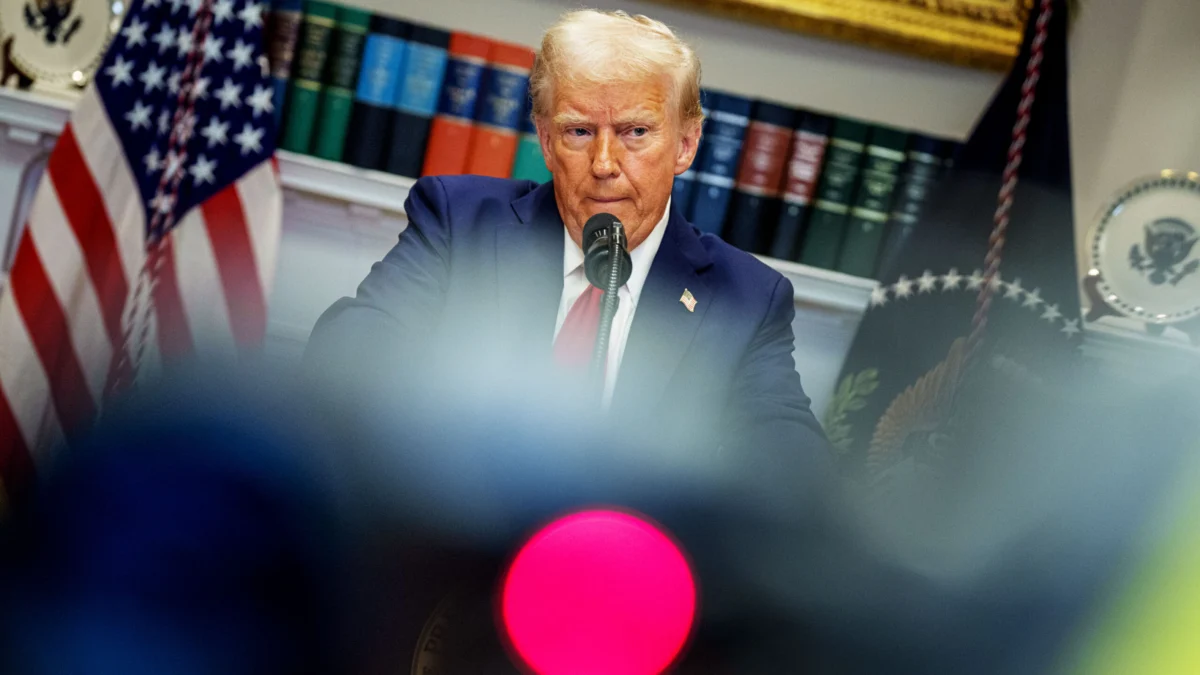
The recent public spat between former and current advisors to President Donald Trump regarding the nation’s leading artificial intelligence companies has illuminated a deepening strategic divide within the former president’s camp, driven by the rapid ascent of China’s open-source AI models. The exchange, characterized by sharp accusations and thinly veiled criticisms, underscores the complex interplay of economic competition, national security concerns, and ideological differences that are shaping the future of AI development and governance in the United States.
The controversy ignited over the weekend when prominent figures within Trump’s AI and technology advisory circles engaged in a public feud on social media platforms. David Sacks, who served as Trump’s AI and crypto "czar" until March, publicly lambasted the AI models developed by leading American companies, notably Anthropic, describing them as "lobotomized" and "woke." This critique appears to stem from a philosophical disagreement over the direction and control of AI development, with Sacks advocating for a more open and less regulated approach, contrasting with the perceived constraints imposed by these companies.
Simultaneously, Emil Michael, a senior official within the Pentagon’s AI strategy apparatus, directed strong criticism at a new head of strategic futures at OpenAI, labeling the individual a "supreme village idiot." This pointed remark suggests a significant divergence in perspectives on how to approach the evolving AI landscape and the challenges posed by international competitors.
H2 The Genesis of the Conflict: Kimi and the Open-Source Challenge
The immediate catalyst for this internal strife appears to be the recent launch of Kimi, a free and open-source AI model developed by the Chinese AI company Moonshot. Reports indicate that Kimi possesses capabilities rivaling those of proprietary, high-cost models from industry giants like OpenAI and Anthropic. This development presents a significant challenge to the business models of U.S. AI firms and, by extension, poses a complex problem for the Trump campaign and its technology policy agenda.
The emergence of powerful, accessible open-source models from China directly impacts the economic calculus for U.S. companies. As these free alternatives gain traction, the perceived value proposition for paying for access to models from OpenAI and Anthropic diminishes. Given that the growth and investment in these AI companies are considered by many to be a significant driver of current economic expansion, China’s AI advancements create both economic headwinds and political vulnerabilities for an administration seeking to project an image of technological and economic strength.
Anton Leicht, a fellow at the Carnegie Endowment, articulated this concern on social media, noting that Chinese AI models represent "a threat for an administration that really doesn’t want more economic bad news." The market has already reacted to this perceived threat, with reports indicating that Chinese AI models have "rattled U.S. stocks," suggesting investor unease about the competitive landscape.
H3 Navigating the AI Labyrinth: Factions and Philosophies
The internal debate within Trump’s advisory circles highlights a fundamental schism regarding the role of government in the AI sector and the appropriate response to foreign competition. Two prominent, albeit sometimes conflicting, viewpoints are emerging.
On one hand, there is a faction, represented by figures like David Sacks, that emphasizes a more laissez-faire approach. Sacks has publicly criticized "top AI companies that want the government to eliminate their open source competition," arguing that the popularity of Chinese AI models is a direct result of their fewer restrictions on user access. While acknowledging the existence of state censorship within China, his core argument centers on the principle of open innovation and the potential for government intervention to stifle competition. This perspective aligns with a broader sentiment of distrust towards large tech companies, a sentiment that has been amplified by recent developments such as New York’s imposition of the state’s first ban on new data centers. A significant portion of the American public may view attempts by AI giants to secure government protection against cheaper competitors with skepticism, questioning whether it is the government’s role to safeguard the commercial interests of private corporations.
On the other hand, a growing consensus within the administration, particularly among national security-focused advisors, advocates for increased government oversight and intervention. This viewpoint is predicated on the argument that advanced AI models, due to their potential capabilities and dual-use nature, pose significant national security risks. Consequently, the government, it is argued, must play a more active role in controlling their development and deployment. This perspective has directly influenced the White House’s current review process, which aims to vet AI models for security implications prior to their release.
H4 The White House Review and its Critics
This new White House review process, designed to assess the security of AI models before their deployment, has drawn sharp criticism from within the AI community. Dean Ball, a former Trump AI advisor who has since joined OpenAI, derided the process as a "de facto licensing regime for frontier AI." Ball suggested that Trump might attempt to address the challenge posed by Chinese open-source models through indirect means, such as leveraging "soft power" to make U.S. companies hesitant to adopt models like Kimi.
Emil Michael’s public rebuke of Ball suggests a strong disagreement with this approach. Michael, alongside Secretary of Defense Pete Hegseth, has been a key liaison between the Pentagon and AI firms. His dismissal of Ball as the AI industry’s "supreme village idiot" highlights a rejection of the idea that the government should resort to covert influence campaigns. Instead, Michael appears to favor a more transparent and "democratic process," explicitly distancing himself from what he perceives as "Deep State schemes." This indicates a preference for overt policy mechanisms rather than subtle maneuvering.
H5 Unpacking the Supply Chain: Chips, Distillation, and Export Controls
A critical, yet often overlooked, aspect of this unfolding AI narrative is the origin and development process of models like Kimi. For a significant period, both the Biden administration and the early stages of Trump’s second term prioritized preventing China from acquiring advanced semiconductor chips, essential for training sophisticated AI models. However, export controls have seen some relaxation. Notably, President Trump made a controversial decision to permit Nvidia to increase its chip sales to China, a move reportedly negotiated in exchange for a share of the revenue for the U.S. government. Despite these measures, the U.S. government has also alleged instances of chip smuggling, suggesting ongoing challenges in controlling the flow of critical technology.
The precise hardware utilized by the company behind Kimi to train its model remains unclear, adding another layer of complexity to the supply chain analysis. One plausible scenario involves "distillation," a technique where an AI model is trained on the outputs generated by other, more established AI models. This practice has been a recurring point of contention, with OpenAI and Anthropic frequently complaining that Chinese AI companies employ it to rapidly advance their own models. They have appealed to the U.S. government for assistance in curbing this practice. In April, the Trump administration responded by announcing a series of measures aimed at restricting this method.
H6 National Security Implications and Strategic Divergences
The fact that Kimi is now available, free of charge, and exhibits performance nearly on par with Anthropic’s models—models that the U.S. government itself deemed so potent that one was temporarily shut down due to national security concerns—serves as a stark illustration of the accelerating pace of AI development in China. The weekend’s heated exchanges among Trump’s advisors suggest a shared recognition of this emergent challenge. However, the fundamental disagreement lies in the proposed solutions.
The debate over how to respond to China’s AI advancements, particularly its open-source initiatives, is far from settled. It pits those who prioritize open innovation and market forces against those who advocate for a more interventionist, security-focused approach. This internal division within the former president’s circle reflects a broader national conversation about how the United States can maintain its technological edge, protect its economic interests, and safeguard its national security in an increasingly competitive global AI landscape. The conflicting strategies proposed—ranging from deregulation and open competition to stringent government oversight and potential trade restrictions—underscore the significant policy challenges ahead, regardless of who occupies the Oval Office. The effectiveness of any proposed solution will likely depend on the ability to navigate these deeply entrenched ideological differences and forge a coherent, actionable strategy.