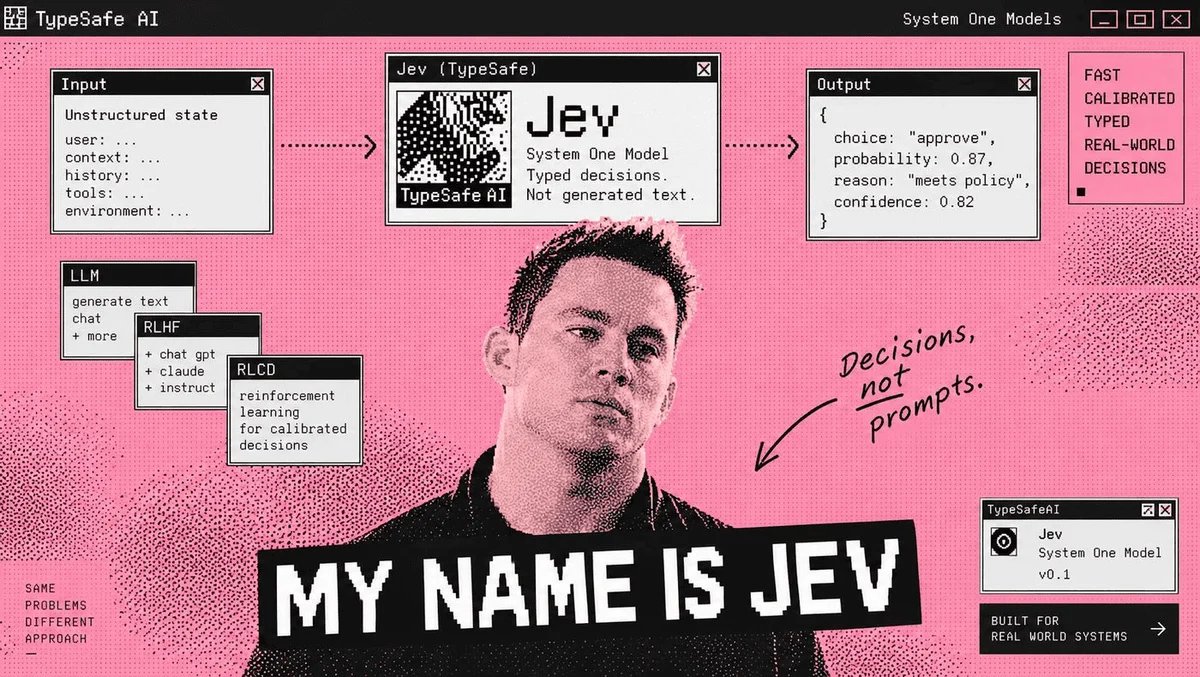
The emergence of Jev, a specialized model developed by TypeSafe AI, has triggered a significant discourse within the machine learning community. Positioned as a "System One" model designed for rapid, structured decision-making, Jev represents a departure from the open-ended text generation capabilities synonymous with modern Large Language Models (LLMs) such as GPT-4, Claude, or Gemini. While social media discourse often frames Jev as a revolutionary breakthrough in artificial intelligence, a technical analysis reveals a more nuanced reality: Jev is a highly optimized architecture focused on the long-standing challenges of classification, intent detection, and probabilistic scoring.
The Architectural Shift: From Generative to Decisive
To understand the position Jev occupies in the current AI ecosystem, one must first distinguish between generative reasoning and discriminative decision-making. Conventional LLMs are designed as general-purpose engines, utilizing complex transformer architectures to predict the next token in a sequence. This process is inherently resource-intensive, requiring significant computational power to synthesize context and generate human-like prose.
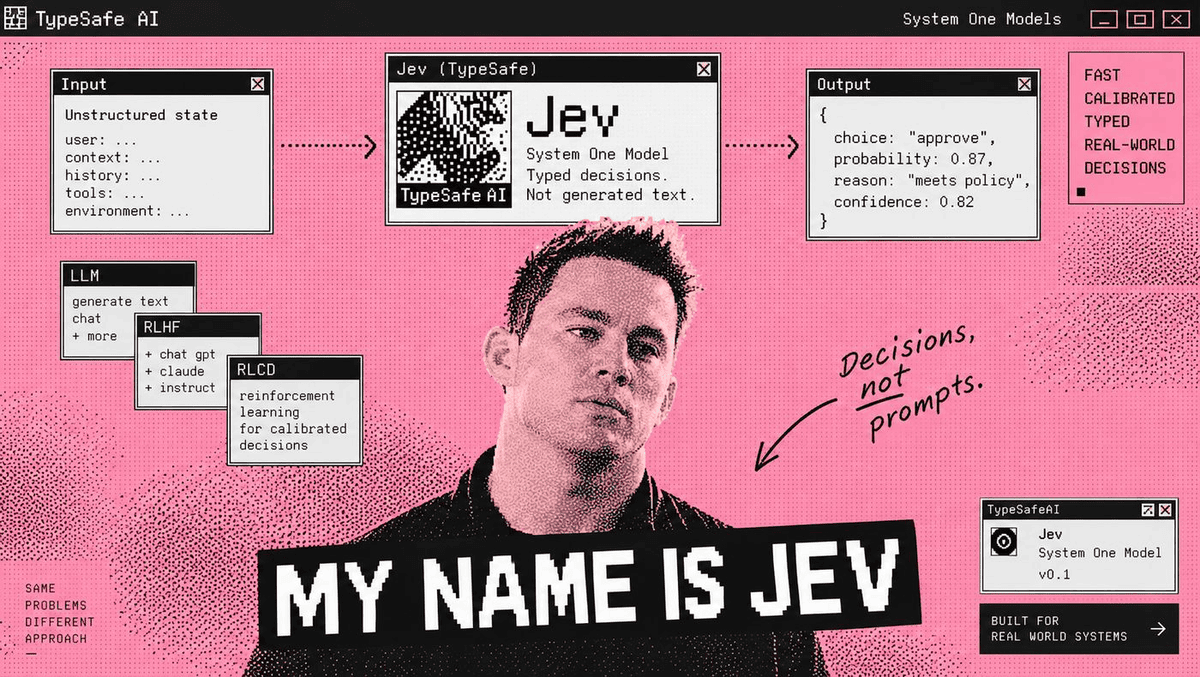
In contrast, TypeSafe AI’s Jev is engineered for "System One" operations. The nomenclature, derived from the psychological framework of Daniel Kahneman, refers to fast, instinctive, and automatic cognitive processing. In the context of software, Jev operates by evaluating input against a pre-defined schema and outputting a probability distribution. For instance, when provided with a customer support query such as "I upgraded yesterday but now I can’t access the features I paid for," the model does not attempt to compose a reply. Instead, it categorizes the intent into buckets like "Technical," "Sales," or "Billing," assigning a confidence score to each. This shift from generative output to structured classification allows for substantial reductions in latency and operational expenditure.
Chronology and Technical Evolution
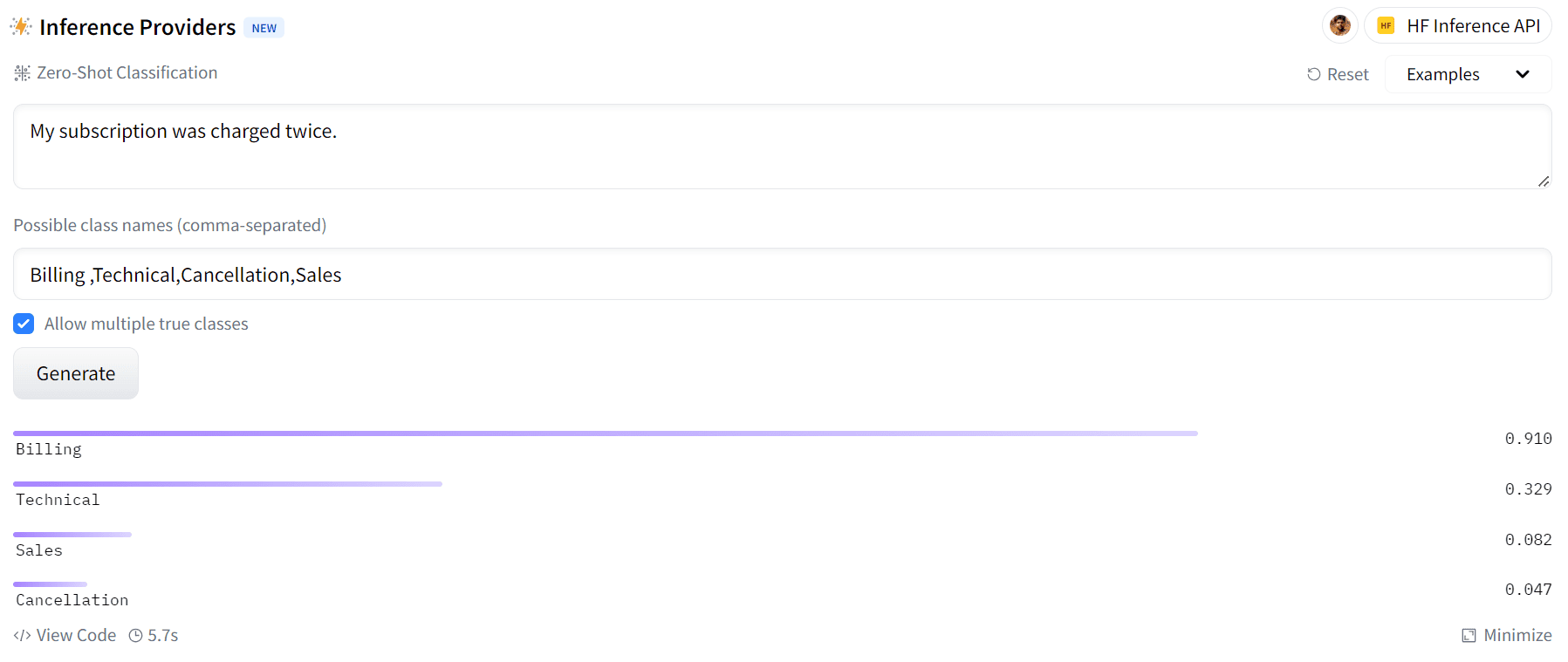
The fundamental task Jev addresses—classification—is not novel. Since the late 2010s, Natural Language Processing (NLP) has relied on zero-shot classifiers, which utilize Natural Language Inference (NLI) to categorize text without requiring specific training on every possible label. Models like Facebook’s BART-large-MNLI established the groundwork for this approach, demonstrating that neural networks could map input text to arbitrary labels with relative accuracy.
Jev builds upon this lineage but integrates a proprietary training methodology known as Reinforcement Learning for Calibrated Decisions (RLCD). While standard Reinforcement Learning from Human Feedback (RLHF) focuses on aligning model behavior with human stylistic preferences, RLCD targets the alignment of a model’s internal probability distribution with real-world outcomes. This ensures that when Jev reports a 64% confidence level for a "Technical" classification, that figure serves as a statistically reliable indicator of the model’s objective certainty.
Supporting Data and Performance Metrics
The performance evaluation of Jev remains a subject of ongoing investigation. TypeSafe AI has reported an internal accuracy benchmark of approximately 68% for its specific workflow evaluation. However, industry analysts caution that these figures are derived from comparisons against other frontier LLMs, which serve as the "ground truth" for the test, rather than independent, verified datasets.
Early-stage independent testing has yielded mixed but promising results. A limited-scale fact-checking evaluation reported an accuracy of 96.3%, and a broader test involving 275 documents showed consistent alignment with manual classification benchmarks. Despite these indicators, the industry consensus remains that comprehensive, independent third-party audits are necessary to validate the model’s efficacy across diverse, high-stakes enterprise environments. The reliance on internal benchmarking is a common, albeit debated, practice among AI startups attempting to demonstrate the utility of their proprietary models against established incumbents.

Addressing the "Hallucination" Misconception
A significant point of confusion surrounding Jev involves the claim that the model does not "hallucinate." In the context of generative AI, hallucinations refer to the production of plausible-sounding but factually incorrect information. Because Jev is a classification engine restricted by a rigid schema, it is physically incapable of outputting data outside of its defined labels.
However, the industry distinguishes between "out-of-schema errors" and "incorrect decisions." If a user provides a list of options limited to "Billing" and "Sales," Jev will never output "Technical." It will, however, inevitably misclassify an input if the linguistic cues are sufficiently ambiguous. Therefore, the "zero hallucination" label is technically accurate in a functional sense, but it does not equate to a 100% success rate in decision-making. The model is constrained by the design of its schema, which remains a human-led responsibility.
Strategic Implications for Enterprise AI
The integration of Jev into enterprise workflows suggests a broader trend toward the modularization of AI. Rather than relying on a single, expensive "monolithic" LLM to handle all tasks—from drafting emails to complex decision routing—organizations are increasingly moving toward a "best-of-breed" architecture. In this scenario, a frontier model handles complex reasoning and creative generation, while a specialized "System One" model like Jev manages high-frequency, low-latency classification tasks.
This approach offers three primary advantages for enterprises:
- Cost Efficiency: By offloading classification tasks to a model optimized for that specific purpose, companies can significantly reduce the token-usage costs associated with calling large, general-purpose LLMs.
- Increased Throughput: Specialized architectures facilitate parallel inference, allowing for faster processing speeds that are essential for real-time customer support routing and automated ticketing systems.
- Enhanced Reliability: The use of RLCD allows developers to implement "confidence thresholds." For example, an application could automatically route a request if the model’s confidence score is above 90%, while escalating queries with lower confidence scores to a human operator.
Industry Perspectives and Future Outlook
The excitement surrounding Jev highlights the industry’s hunger for reliable, cost-effective AI tooling that moves beyond the novelty of chatbots. While proponents argue that Jev represents a superior way to integrate AI into existing software stacks, skeptics argue that its capabilities are largely achievable through fine-tuned, smaller-scale versions of existing open-source models.
The success of TypeSafe AI will likely depend not on whether they have "invented" a new form of AI, but on their ability to refine the developer experience and deliver consistent, measurable performance. If Jev can prove that its calibration-focused training produces consistently superior decision-making compared to existing zero-shot classification techniques, it could become a standard utility in the machine learning engineer’s toolkit.
Ultimately, the discourse around Jev serves as a case study for the current state of the AI hype cycle. While the technology is not a "black box" miracle that renders existing methods obsolete, it represents a sophisticated evolution of existing NLP principles. By focusing on the narrow but vital domain of structured, probabilistic decision-making, TypeSafe AI is addressing a practical pain point that is often overlooked in the race to build increasingly large generative models. As the technology matures and independent benchmarking data becomes available, the industry will gain a clearer picture of whether Jev is a foundational shift or a specialized optimization tool. For now, it stands as a testament to the fact that, in the world of artificial intelligence, the most impactful innovations are often those that solve old problems with greater precision, rather than those that simply promise to solve everything at once.