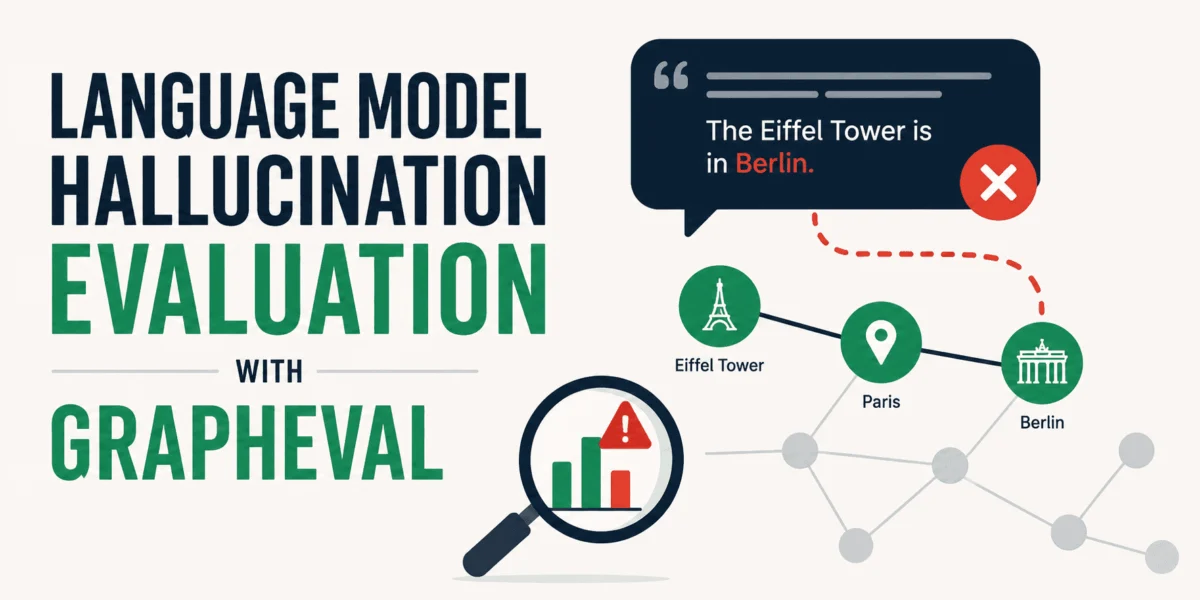
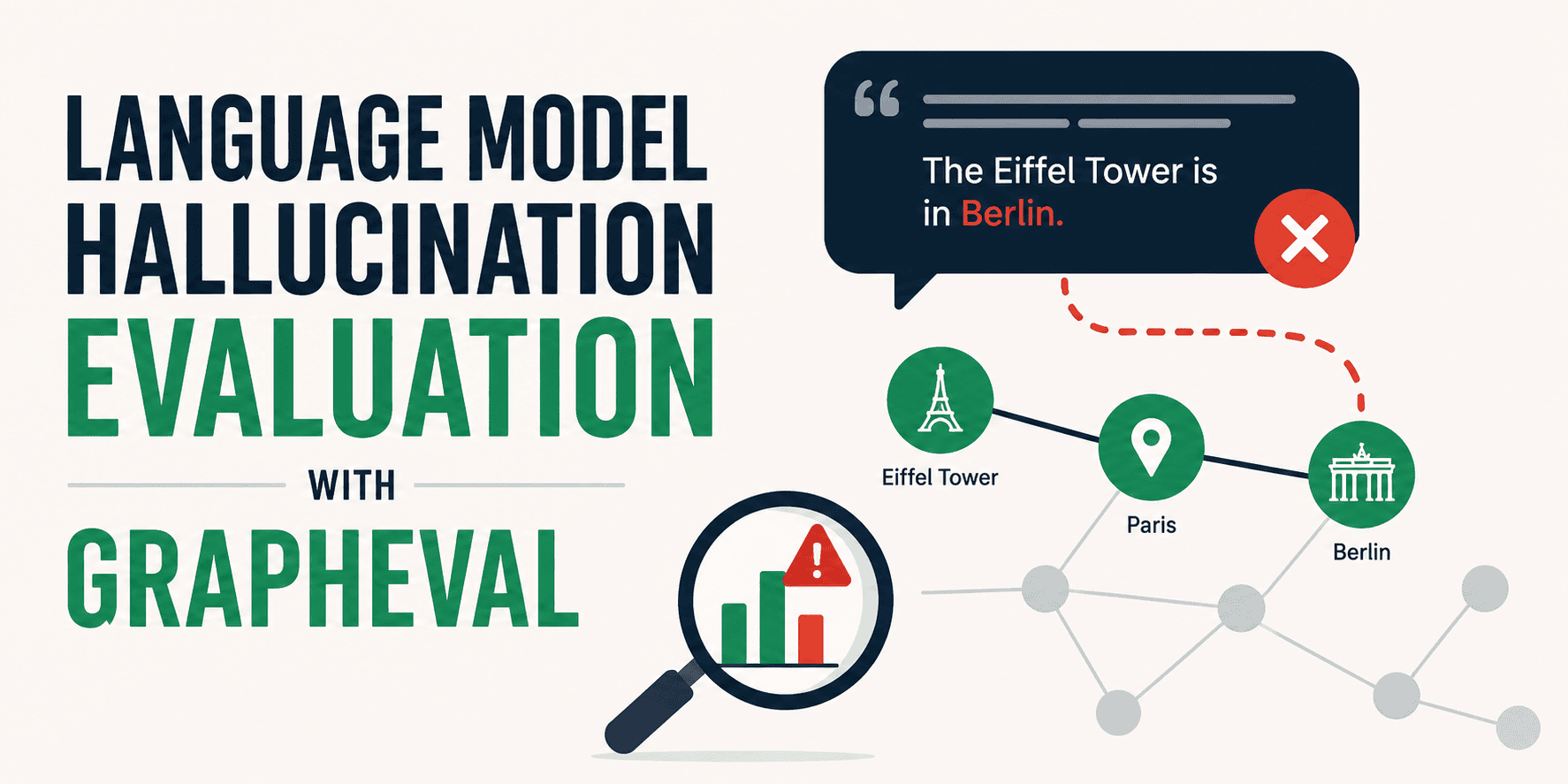
Large Language Models (LLMs) have revolutionized natural language processing, demonstrating remarkable capabilities in generating human-like text, answering complex questions, and even creating content. However, a persistent and significant challenge in their deployment is the phenomenon of "hallucination," where models produce outputs that are factually incorrect, nonsensical, or fabricated, often stemming from a lack of deep internal knowledge or an overreliance on pattern matching. While numerous strategies have been developed to mitigate LLM hallucinations, the systematic evaluation frameworks designed for internal diagnosis have lagged behind. Addressing this gap, a recent pioneering study by Amazon researchers introduces GraphEval, an innovative framework that leverages knowledge graphs to analyze and detect these elusive inaccuracies within LLM-generated responses. This article delves into the conceptual underpinnings of GraphEval, illustrating its practical application through a simulation-based code example, and exploring its broader implications for the responsible development and deployment of artificial intelligence.
The Growing Challenge of LLM Hallucinations
The proliferation of LLMs like GPT-3, Bard, and Llama has ushered in an era of unprecedented AI-driven communication and content creation. These models, trained on vast datasets, can perform an array of tasks with impressive fluency. However, their inherent probabilistic nature means they do not "understand" information in the human sense. Instead, they predict the most likely sequence of words based on their training data. This can lead to scenarios where the model confidently asserts falsehoods, a problem acutely felt across industries from healthcare and finance to journalism and education.
The consequences of LLM hallucinations can range from minor inconveniences, such as providing slightly inaccurate information, to severe repercussions, including the spread of misinformation, flawed decision-making based on erroneous AI outputs, and erosion of trust in AI systems. For instance, a medical LLM hallucinating a treatment protocol could have life-threatening consequences, while a financial LLM providing incorrect market analysis could lead to significant economic losses. The need for robust mechanisms to identify and rectify these errors is therefore paramount.
Introducing GraphEval: A Paradigm Shift in Hallucination Detection
GraphEval represents a significant advancement in the field by shifting the focus from monolithic performance metrics to a more granular, explainable evaluation process. Unlike traditional methods that might yield a single score for accuracy or confidence, GraphEval adopts a two-stage approach designed to pinpoint the exact locations of hallucinations within an LLM’s output. This emphasis on explainability is crucial for understanding why a hallucination occurred, enabling more targeted interventions and improvements to the model.
The core of GraphEval lies in its innovative use of knowledge graphs (KGs). KGs are structured representations of information, comprising entities (nodes) and the relationships (edges) between them. By converting LLM-generated text into a KG, GraphEval can more effectively scrutinize the factual integrity of the statements made.
The Two-Stage Evaluation Process of GraphEval
GraphEval operates through a two-stage methodology:
- Knowledge Graph Extraction: The first stage involves taking the LLM’s generated output and using another language model, often a smaller or specialized one, to extract factual information. This extracted information is then structured into a knowledge graph, represented as a collection of subject-predicate-object (SPO) triples. The goal here is to capture the asserted facts within the LLM’s response in a machine-readable format.
- Factual Verification via Natural Language Inference (NLI): The second stage is where the actual hallucination detection takes place. Each triple extracted in the first stage is treated as a hypothesis. This hypothesis is then rigorously compared against a ground-truth knowledge base or context. This comparison is facilitated by a Natural Language Inference (NLI) model. NLI models are trained to determine the relationship between two pieces of text: whether one entails the other, contradicts it, or is neutral. In GraphEval, if the NLI model determines that the ground-truth context does not entail the hypothesis (i.e., it’s neutral or contradictory), the triple is flagged as a hallucination.
This two-stage process ensures that hallucinations are not only identified but also contextualized within the extracted knowledge graph, providing a clear visual and structural understanding of where the factual inaccuracies lie.
Practical Application: A Simulated GraphEval Workflow
To demystify GraphEval’s mechanics, let’s walk through a simplified, simulation-based code example. This example will bypass computationally intensive steps like running large LLMs for graph extraction by simulating the outputs, allowing us to focus on the core logic of the framework.
First, we need to install the necessary Python libraries:
!pip install -q transformers networkx matplotlib torchIn a real-world scenario, the source_context would be dynamically retrieved from a robust knowledge base, perhaps by querying a vector database within a Retrieval-Augmented Generation (RAG) system. For our demonstration, we will define a static ground-truth context:
# The ground-truth context provided to the LLM
source_context = (
    "GraphEval is a hallucination evaluation framework based on representing information "
    "in Knowledge Graph (KG) structures. It acts as a pre-processing step and utilizes "
    "out-of-the-box NLI models to detect factual inconsistencies."
)
Now, let’s consider an LLM output that we want to evaluate. This output has been deliberately crafted to contain a hallucination:
# The generated response we want to evaluate (contains a hallucination)
llm_output = (
    "GraphEval is an evaluation framework that uses Knowledge Graphs. "
    "It requires a highly expensive, enterprise-level server farm to operate."
)

# Prompt template that would theoretically be passed to a local/free LLM (e.g. Mistral-7B)
KG_EXTRACTION_PROMPT = f"""
You are an expert information extractor. Extract the core information from the following text as a Knowledge Graph.
Return the output strictly as a Python list of tuples in the format: (Subject, Relationship, Object).

Text: llm_output
"""
For the purpose of this simulation, we will bypass the computationally demanding process of using an LLM to extract knowledge graph triples. Instead, we will directly provide the simulated extracted triples, including the intentional hallucination:
# Simulated extraction to bypass the heavy computational load of running a massive LLM locally
extracted_triples = [
    ("GraphEval", "is", "evaluation framework"),
    ("GraphEval", "uses", "Knowledge Graphs"),
    ("GraphEval", "requires", "expensive enterprise server farm")
]

print("Extracted Triples:")
for t in extracted_triples:
    print(t)
The output of this simulation clearly shows the extracted triples, with the third triple containing the fabricated claim about server farm requirements:
Extracted Triples:
('GraphEval', 'is', 'evaluation framework')
('GraphEval', 'uses', 'Knowledge Graphs')
('GraphEval', 'requires', 'expensive enterprise server farm')
The crucial next step involves the Natural Language Inference (NLI) process. Here, we leverage a pre-trained NLI model from Hugging Face. This model will compare each extracted triple against our source_context to determine if it is factually supported.
from transformers import pipeline

# Loading the open-source NLI model
print("Loading DeBERTa NLI model...")
nli_evaluator = pipeline("text-classification", model="cross-encoder/nli-deberta-v3-small")

def evaluate_triple(context, triple):
    subject, relation, obj = triple
    hypothesis = f"subject relation obj"

    # Checking if the context entails the hypothesis
    result = nli_evaluator("text": context, "text_pair": hypothesis)

    # NLI models normally output: 'entailment', 'neutral', or 'contradiction'
    label = result['label'].lower()

    # In GraphEval, anything other than 'entailment' is flagged as a hallucination
    is_hallucinated = label != 'entailment'

    return is_hallucinated, label, hypothesis

# Running the evaluation pipeline
evaluation_results = []

print("n--- GraphEval Results ---")
for t in extracted_triples:
    is_hallucinated, nli_label, hypothesis = evaluate_triple(source_context, t)
    evaluation_results.append((is_hallucinated, nli_label))

    status = "❌ HALLUCINATION" if is_hallucinated else "✅ GROUNDED"
    print(f"status | Triple: t | NLI Output: nli_label")
The output of this evaluation pipeline demonstrates GraphEval’s effectiveness:
Loading DeBERTa NLI model...

--- GraphEval Results ---
✅ GROUNDED | Triple: ('GraphEval', 'is', 'evaluation framework') | NLI Output: entailment
✅ GROUNDED | Triple: ('GraphEval', 'uses', 'Knowledge Graphs') | NLI Output: entailment
❌ HALLUCINATION | Triple: ('GraphEval', 'requires', 'expensive enterprise server farm') | NLI Output: neutral
As anticipated, the first two triples are correctly identified as "GROUNDED" (entailed by the context), while the third triple, the fabricated claim about the server farm, is flagged as a "HALLUCINATION" because the NLI model returned a "neutral" classification, indicating it is not supported by the provided ground truth.
To provide a more intuitive understanding of these results, we can visualize the extracted knowledge graph, color-coding the edges to highlight the detected hallucinations.
import networkx as nx
import matplotlib.pyplot as plt
import matplotlib.patches as mpatches

def visualize_grapheval(triples, eval_results):
    G = nx.DiGraph()
    edge_colors = []

    for (triple, res) in zip(triples, eval_results):
        sub, rel, obj = triple
        is_hallucinated = res[0]

        G.add_node(sub)
        G.add_node(obj)
        G.add_edge(sub, obj, label=rel)

        # Color-code the edges based on the NLI evaluation
        edge_colors.append('red' if is_hallucinated else 'green')

    # Set up the plot
    plt.figure(figsize=(10, 6))
    pos = nx.spring_layout(G, seed=42)

    # Draw nodes
    nx.draw_networkx_nodes(G, pos, node_color='lightblue', node_size=2500)
    nx.draw_networkx_labels(G, pos, font_size=10, font_weight='bold')

    # Draw edges and labels
    nx.draw_networkx_edges(G, pos, edge_color=edge_colors, width=2.5, arrowsize=20)
    edge_labels = nx.get_edge_attributes(G, 'label')
    nx.draw_networkx_edge_labels(G, pos, edge_labels=edge_labels, font_color='black')

    # Add legend
    green_patch = mpatches.Patch(color='green', label='Grounded (Entailment)')
    red_patch = mpatches.Patch(color='red', label='Hallucination (Neutral/Contradiction)')
    plt.legend(handles=[green_patch, red_patch], loc='lower right')

    plt.title("GraphEval Hallucination Map", fontsize=14, fontweight='bold')
    plt.axis('off')
    plt.tight_layout()
    plt.show()

# Render the knowledge graph
visualize_grapheval(extracted_triples, evaluation_results)
The resulting visualization clearly depicts the knowledge graph, with the edge representing the hallucinated statement highlighted in red, providing an immediate and intuitive understanding of the factual discrepancy.
Implications and Broader Impact
The GraphEval framework offers several significant advantages for the development and deployment of LLMs:
- Enhanced Reliability: By providing a systematic method for detecting hallucinations, GraphEval contributes to building more reliable AI systems. This is critical for applications where factual accuracy is paramount.
- Improved Explainability: The visual and structural nature of knowledge graphs makes it easier to understand where and why a hallucination occurred. This explainability is invaluable for debugging and improving LLM performance.
- Targeted Mitigation: Pinpointing specific factual errors allows developers to implement more targeted mitigation strategies, such as improving the LLM’s training data, refining its retrieval mechanisms in RAG systems, or adjusting its generation parameters.
- Foundation for Auditing: GraphEval can serve as a foundational tool for auditing AI outputs, ensuring compliance with factual accuracy standards, especially in regulated industries.
The Amazon study, by proposing GraphEval, not only addresses a pressing technical challenge but also sets a precedent for future research into more robust and interpretable LLM evaluation methods. As LLMs become increasingly integrated into our daily lives, frameworks like GraphEval will play a crucial role in fostering trust and ensuring the responsible advancement of artificial intelligence. The transition from single-score metrics to explainable, graph-based analysis signifies a maturing approach to AI safety and reliability, paving the way for AI systems that are not only powerful but also trustworthy.
The author of the original study, Iván Palomares Carrascosa, is recognized as a leader, writer, speaker, and advisor in AI, machine learning, deep learning, and LLMs, dedicated to guiding others in harnessing AI in real-world applications. His work on GraphEval exemplifies a commitment to practical solutions for the complex challenges posed by cutting-edge AI technologies.