In the modern corporate landscape, the traditional markers of professional status—corner offices, reserved parking spots, or headcounts—are increasingly being superseded by a more digital metric: the size of one’s artificial intelligence budget. As enterprises grapple with the staggering operational costs of large language models (LLMs) and advanced AI tooling, they have begun to implement rigid tiered access systems. This shift is not merely a logistical necessity but a fundamental restructuring of workplace power, where access to state-of-the-art AI is becoming the primary lever for productivity, promotion, and professional leverage.
The Rise of Tokenomics as a Corporate Strategy
The transition from experimental AI adoption to industrial-scale integration has brought the financial reality of "tokenomics" to the forefront of executive decision-making. Companies are no longer asking whether they should use AI, but rather how to ration it effectively. Because the usage of sophisticated AI models is metered in "tokens"—the granular units of data that AI processes—managers are imposing strict spending caps on employees, effectively creating a divide between the "haves" and the "have-nots."
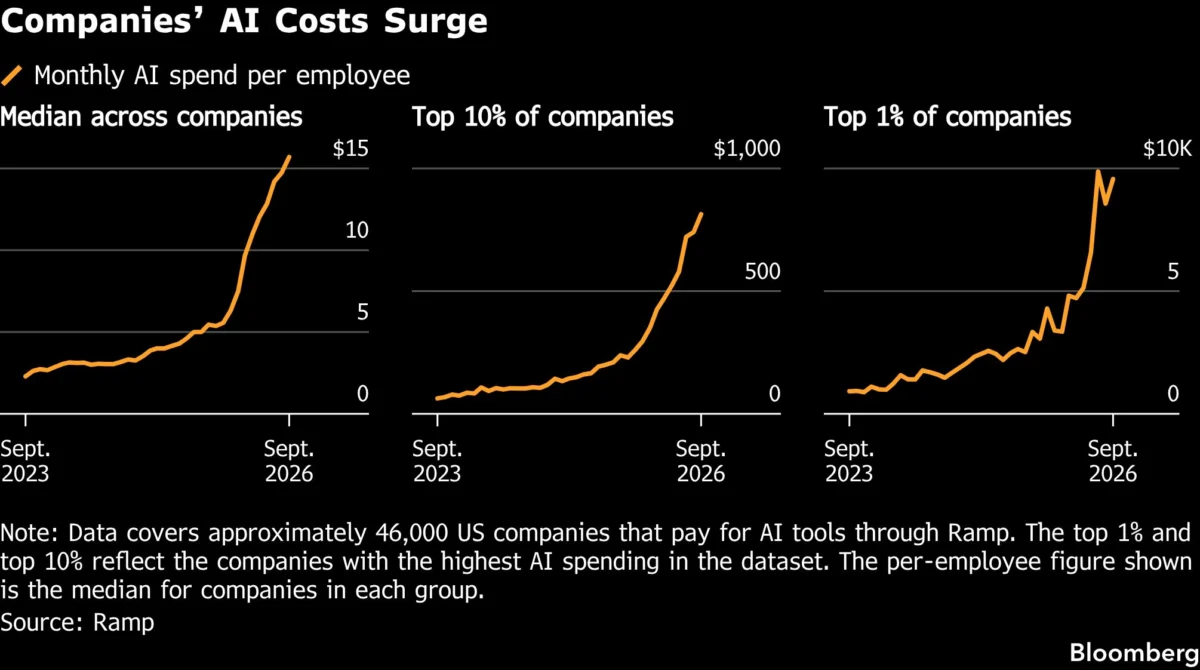
Data from the expense-management platform Ramp underscores the rapid escalation of these costs. Between September 2025 and September 2026, the median AI expenditure per employee tripled, rising from $5 to $15 per month. More striking is the disparity among the top tier of spenders: the most aggressive 1% of AI users saw their budgets balloon from an average of $2,500 to over $9,500 monthly. This data suggests that for a small cohort of high-value employees, AI is becoming a core infrastructure cost comparable to, or exceeding, the cost of traditional enterprise software suites.
Chronology of a Growing Divide
The current state of AI rationing is the culmination of a year-long trend that began when the novelty of ChatGPT gave way to the reality of enterprise-wide deployment.
- Early 2025: Organizations adopted a "try-anything" approach, allowing broad access to various LLMs to foster innovation and identify use cases.
- Mid-2025: As billing cycles arrived, companies discovered that uncontrolled access to high-end models was creating unsustainable operational overhead.
- Late 2025 – Early 2026: Firms began implementing "soft caps," using dashboards to monitor usage and warn employees as they approached their limits.
- Mid-2026 to Present: The emergence of strict, role-based tiering. Companies like Apple and Goldman Sachs have publicly or semi-publicly tightened the reins, restricting high-end tools to specific departments, most notably engineering and R&D.
At Apple, this trend is clearly visible. The company recently reduced daily spending caps for certain engineering teams from $300 to $200, with further reductions planned. For staff outside of engineering, the contrast is stark: their caps are set at $100, with internal discussions surfacing regarding potential cuts to as low as $25 per day.
The Institutional Rationale: ROI and Resource Allocation
Corporate leaders defend these tiered systems as a necessary application of capitalist logic. Amit Koren, who leads AI product strategy at JLL, argues that resources must follow the path of highest return on investment (ROI). "We are a capitalist enterprise; we allocate resources where there is the most ROI—it’s what our shareholders expect of us," Koren stated. In this view, restricting access is not an act of workplace discrimination, but a fiduciary duty to shareholders.
This rationale is reflected in the internal policies of firms like Match Group. According to CFO Steven Bailey, the company’s approach involves allocating budgets disproportionately toward technical staff, with engineers receiving four times the AI budget of non-technical personnel. While the company increased its overall AI budget from $5 million to $10 million in May 2026, the distribution remains heavily skewed toward the roles directly responsible for product development.
The Hidden Infrastructure of Workplace Inequality
Beyond the explicit budgets, there is a "hidden" layer of stratification. As Lydia Wu, a senior director analyst at Gartner, points out, many employees may not even realize they are working with inferior tools. "There are 10 layers of Copilot license add-ons," Wu explains. "As an everyday employee, you’re not necessarily going to dig into what level of access you have."
This creates a scenario where two employees with the same job title might have vastly different capabilities depending on their department’s internal funding. Some companies now utilize "light," "standard," and "power" tiers to manage access, a system recommended by providers like Anthropic. For the average employee, this means their ability to complete tasks—and by extension, their performance reviews—is tethered to a backend configuration they cannot see and likely cannot influence.
Case Study: Productivity vs. Excess at Sonar
At software firm Sonar, the philosophy toward AI access is empirical. CEO Tariq Shaukat notes that while they have "super-users" capable of generating 5 million lines of code in six months—essentially replacing the need for several full-time hires—they have also identified a cohort of employees who burn through tokens without showing measurable improvement in output.
Sonar’s strategy is to treat unlimited tokens as a performance-based reward. "Step one for us is just who is using the tokens productively versus who is not," Shaukat says. By utilizing internal dashboards to track shipping rates and code quality, the company has effectively gamified AI access. This meritocratic model, while efficient, inherently favors those who can immediately translate compute cycles into tangible shipping output, potentially disadvantaging roles where the value of AI is more qualitative or long-term.
The Emergence of AI in Talent Negotiations
The influence of these budgets has permeated the hiring process, evolving from an internal policy matter to a key bargaining chip for top-tier talent. Headhunters and executives report that high-level candidates are now asking about AI budgets with the same scrutiny previously reserved for salary, equity, and direct reports.
At Microsoft, executives have encountered candidates who refuse to join a team unless they are guaranteed a specific, significant AI budget. "It’s becoming a hard requirement for top-class engineers to confirm that they can work with the tools of choice," says Marcus Bergstrom of Insight Global. This creates a feedback loop: elite talent demands the best tools, companies grant them, and these employees produce the best work, further cementing their status as the "haves" in the corporate hierarchy.
Implications for the Future of Work
The broader implications of this trend are profound. Management professors like Peter Cappelli of the Wharton School warn that this stratification could create deep-seated resentment and institutional rigidity. "You’re starving the resources from people who haven’t made the big moves yet," Cappelli notes. If AI access is only granted to those who have already proven their value, the "next generation" of innovators may be stifled by a lack of access to the very tools required to prove their worth.
Furthermore, companies are struggling with the equity implications of these disparities. As JLL’s Koren noted, there is a risk that different performance outcomes between employees could be unfairly attributed to talent rather than the quality of the AI tools at their disposal. Consequently, some firms are beginning to issue formal guidance to managers, instructing them not to penalize employees for lower performance if that performance is a direct result of restricted AI access.
As organizations continue to refine their "tokenomics," the challenge will be to balance the fiscal necessity of controlling costs with the need to foster an equitable, innovative, and transparent workplace culture. For now, however, the trend is clear: in the age of AI, the ability to compute is the new currency of professional power, and it is being distributed with increasing selectivity. The "haves" will continue to push the boundaries of productivity, while the "have-nots" find themselves increasingly reliant on legacy tools, creating a new and enduring divide in the modern office.