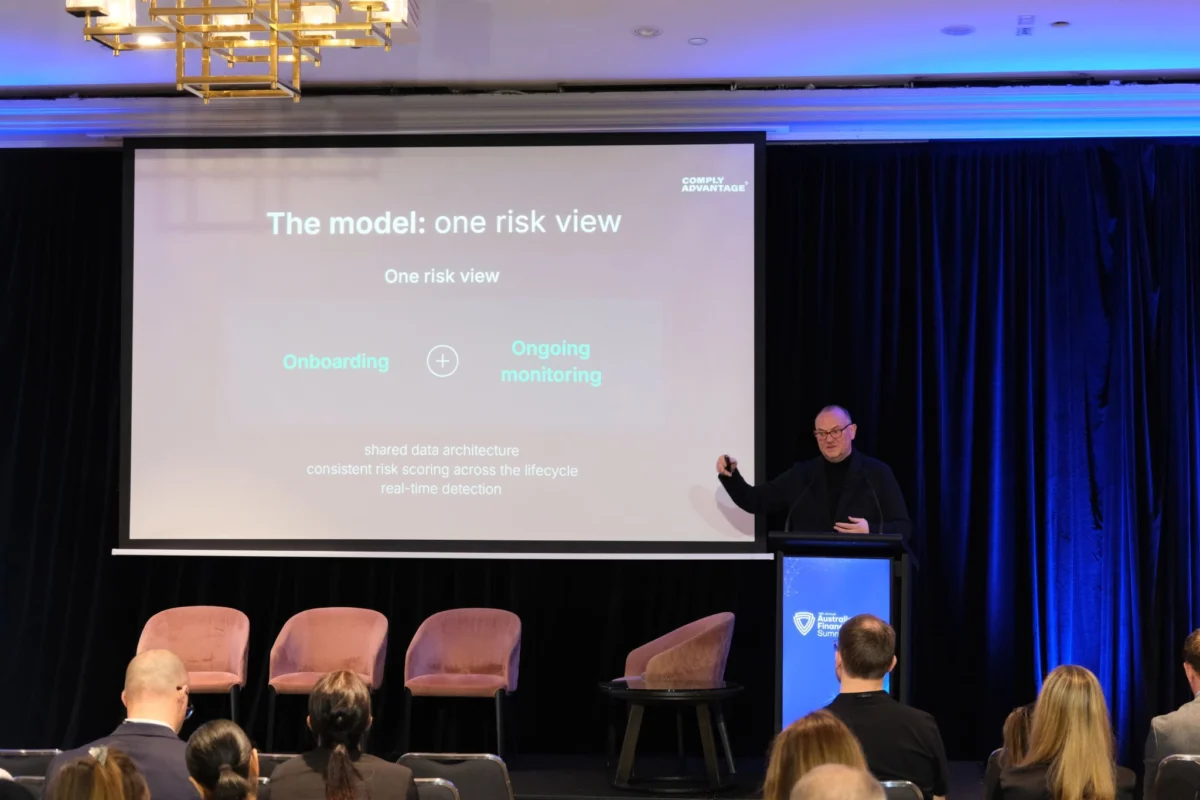
Effectiveness has become the singular, non-negotiable benchmark for global financial regulators, shifting the goalposts for how institutions must approach financial crime compliance (FCC). At the Australian Financial Crime Summit (AFCS) held in Sydney on September 1, 2026, Andrew Davies, Global Head of Financial Crime Compliance Strategy at ComplyAdvantage, delivered a stark assessment of the current state of the industry: the traditional separation of onboarding and ongoing monitoring systems is no longer just an operational inefficiency—it is a fundamental regulatory liability. As financial institutions grapple with increasingly sophisticated threats, the inability to connect customer data in real-time has rendered many legacy compliance frameworks obsolete.
The Australian Regulatory Landscape and the Cost of Inaction
The urgency of this message is underscored by a sobering set of statistics. The Australian National Anti-Scam Centre reported that scam losses in 2025 reached $2.18 billion, a figure derived from over 274,000 loss-bearing reports. These numbers represent a growing, systemic crisis that regulators are no longer willing to tolerate. Furthermore, the Australian Transaction Reports and Analysis Centre (AUSTRAC) highlighted in its Money Laundering Update 2026 that criminals are rapidly adopting advanced technologies, including AI-generated document fraud, to bypass standard identity verification protocols.
The regulatory environment is shifting beneath the feet of financial institutions. The implementation of Tranche 2 AML/CTF obligations on July 1, 2026, has brought approximately 80,000 new businesses under the regulatory umbrella, significantly expanding the scope of compliance oversight. This is coupled with the impending Scams Prevention Framework, which imposes strict detection obligations on banking, telecommunications, and digital platforms, with a compliance deadline of March 31, 2027. Under this framework, firms are legally required to view their customers holistically; failure to do so will likely result in significant financial penalties and a loss of license to operate.
A Chronology of Compliance Evolution
To understand the current crisis, one must look at the historical trajectory of compliance technology. For decades, the industry grew in fragmented, sequential stages. It began with simple sanctions screening, followed by the introduction of anti-money laundering (AML) controls, and eventually, the adoption of transaction monitoring. This led to the emergence of "FRAML"—the practice of managing fraud and AML under a single umbrella.
However, as Davies noted at the AFCS, the "FRAML" era is effectively over. The modern threat landscape has evolved far beyond basic fraud and money laundering. Financial institutions now face complex, globalized threats that include human trafficking, bribery, corruption, and proliferation financing. According to data from the International Labour Organization (ILO), there are currently 50 million people living in modern slavery, with the illicit proceeds generated by this industry flowing through mainstream payment networks. Global Financial Integrity estimates that transnational crime accounts for between $1.6 trillion and $2.2 trillion annually, operating as sophisticated, cross-border supply chains that mirror legitimate corporate structures.
The Operational Gap: Where Detection Fails
The primary point of failure for most institutions remains the handoff between onboarding and ongoing monitoring. Currently, most firms treat onboarding as a static event: they calculate an initial risk score, verify identity documents, and then archive the data. This crucial context—the "DNA" of the customer’s risk profile—is rarely integrated into the ongoing monitoring systems that track transaction behavior.
Research from the State of Financial Crime 2026 report reveals a startling disconnect: more than 50% of compliance leaders manage their operations across eight to ten separate systems. While 99% of these leaders acknowledge that an integrated interface is essential for effective risk management, the reality remains a patchwork of disparate databases. Each siloed system represents a vulnerability, a blind spot where customer risk profiles fall out of date, and where suspicious patterns go undetected.
Davies argues that this is not a problem that can be solved by simply throwing more staff at the issue or by attempting a total, and likely catastrophic, replacement of legacy infrastructure. Instead, the solution lies in an orchestration layer—a technological overlay that can unify customer identity and risk signals across existing systems. This "single view of the customer" allows for the continuous, real-time assessment of risk, ensuring that a change in transactional behavior immediately triggers a reassessment of the initial onboarding profile.
Measuring Effectiveness: A Three-Dimensional Approach
For financial institutions looking to satisfy both their internal stakeholders and external regulators, the move toward a unified operating model is essential. Compliance teams should focus on measuring effectiveness across three key dimensions:
- Quantifiable Risk Exposure: Institutions must be able to articulate their specific risk appetite and how their current controls mitigate that exposure. This requires a single, accurate view of the customer that can be presented to executive boards and regulators alike.
- Operational Remediation Efficiency: Effectiveness is measured by how quickly and accurately a firm can respond to suspicious activity. By unifying onboarding and monitoring data, firms can reduce the volume of "false positives" that plague current systems, allowing analysts to focus on high-priority threats.
- Business Continuity and Trust: Finally, effectiveness must be tied to the protection of the customer relationship. Safety and security are the primary value propositions of the financial sector. When institutions effectively mitigate financial crime, they reinforce the trust that maintains the integrity of the broader financial system.
The Broader Implications for Global Finance
The transition toward a unified, network-based approach to compliance is not merely a technical upgrade; it is a fundamental shift in the role of the financial institution. As Davies emphasized, "Financial crime is a network problem. We have to solve this network problem with networks ourselves." This implies that institutions must stop acting as isolated entities and start sharing, where legally permissible, intelligence that tracks the movement of illicit funds across borders and platforms.
The implications for the industry are profound. First, firms that fail to integrate their systems will face increased regulatory scrutiny as the "effectiveness" standard becomes more rigid. Second, the cost of manual, siloed compliance will become economically unsustainable as the volume of transaction data continues to grow. Third, the "vanguard" role of the compliance professional will continue to evolve, moving away from simple box-ticking toward a role defined by data analysis, pattern recognition, and strategic risk management.
As the industry approaches the March 2027 deadline for the Scams Prevention Framework, the focus must be on creating a seamless flow of information. The technology to achieve this exists, but the organizational willpower to break down internal silos remains the primary hurdle. The evidence from the 2026 Australian Financial Crime Summit is clear: the era of fragmented compliance is coming to a close, and those who do not adapt to a unified, data-driven architecture risk being left behind in a rapidly tightening regulatory environment.
The path forward requires a re-evaluation of the "customer journey." If a customer is treated as a static entity at the point of onboarding, they are being viewed through a lens that no longer exists. A modern, effective compliance program must be dynamic, responsive, and, above all, integrated. By treating the customer as a living, breathing entity whose risk profile evolves alongside their activity, financial institutions can fulfill their role as the first line of defense against the global, and increasingly sophisticated, networks of financial crime.