Five and a half years after facing congressional scrutiny for restricting trading during the GameStop squeeze, Robinhood, the retail brokerage firm, has launched Robinhood Chain, a public blockchain platform prominently featuring the word "permissionless." This strategic move, which saw its mainnet go live on July 1, 2026, presents a striking contrast to its past, where the "buy button" became shorthand for a platform’s unilateral power over user trades. The central question surrounding Robinhood Chain isn’t merely its technological efficacy, which appears robust, but rather the implications of a company with Robinhood’s history and business model operating "open" rails, and whether its flagship asset truly embodies the permissionless ethos of the underlying chain.
The Genesis of Robinhood Chain: A Strategic Pivot Amidst Historical Scrutiny
The launch of Robinhood Chain represents a significant pivot for the company, which burst into public consciousness as a disruptor in traditional finance, democratizing access to stock trading for a new generation of investors. However, its meteoric rise was punctuated by a pivotal moment on January 28, 2021, at the height of the GameStop (GME) short squeeze. During this unprecedented market event, driven by a coordinated retail trading frenzy on platforms like Reddit’s r/WallStreetBets, Robinhood controversially halted buying of GME, AMC Entertainment (AMC), and several other "meme stocks." While users could still sell their positions, they were prevented from opening new ones.
Robinhood CEO Vlad Tenev and the company attributed this decision to surging clearinghouse collateral requirements, a legitimate and sudden financial constraint imposed by the National Securities Clearing Corporation (NSCC) to mitigate risk. The NSCC demanded billions in additional collateral due to heightened volatility and trading volumes. Despite the stated reasons, the action ignited widespread outrage among retail investors, accusations of market manipulation, and intense public backlash. Critics argued that the restrictions disproportionately harmed retail traders, preventing them from capitalizing on upward price movements, while potentially protecting institutional short-sellers, some of whom were Robinhood’s own counterparties or payment-for-order-flow partners. The incident led to multiple class-action lawsuits, federal investigations, and Tenev’s testimony before Congress, indelibly imprinting the "buy button" narrative into the public consciousness as a symbol of centralized control over financial markets.
Against this backdrop, Robinhood’s foray into a "permissionless" blockchain space is laden with irony and intent. The company aims to leverage blockchain technology to offer 24/7 trading, enhanced composability, and broader access to financial products, specifically tokenized equities, for a global audience. This move could be interpreted as a strategic effort to regain trust and redefine its image, positioning itself as a proponent of open and decentralized finance, even as it navigates the inherent complexities of integrating such a vision with its established business model and regulatory obligations.
Unpacking the Technology: A "Conservative, Sensible Design"
Technically, Robinhood Chain is built on a foundation of established and battle-tested blockchain infrastructure. It operates as a Layer 2 (L2) solution, specifically utilizing Arbitrum’s Orbit stack. Orbit is a framework designed to allow developers to launch custom, configurable Layer 2 chains that settle to Ethereum, leveraging Ethereum’s robust security guarantees. The chain employs Arbitrum’s Nitro-based technology, which underpins numerous other application-specific blockchains.
Crucially, Robinhood Chain settles its transactions to the Ethereum mainnet and uses Ethereum blobs for data availability. This design choice offloads computational burden from Ethereum while inheriting its security and decentralization. Gas fees on Robinhood Chain are paid in ETH, not a new proprietary token, and Robinhood has explicitly stated there is no native chain token planned at launch. The mainnet chain ID is 4663, with 46630 reserved for the testnet.
From a developer’s perspective, the chain is highly accessible. It supports standard Solidity and Vyper smart contracts without requiring modifications, ensuring compatibility with a vast ecosystem of existing decentralized applications (dApps) and developer tools. Furthermore, it incorporates ERC-4337 account abstraction, a significant feature that enhances user experience by enabling gas sponsorship (allowing third parties to pay transaction fees) and batched transactions, making DeFi interactions more seamless and akin to traditional web2 experiences. Transaction ordering on the chain is currently first-come, first-served, managed by a single sequencer, a common initial setup for new L2s before progressive decentralization.
The developer documentation and a Blockscout explorer were made publicly available concurrently with the mainnet launch, underscoring Robinhood’s commitment to transparency and developer engagement. Industry analysts have largely praised the technical architecture as "architecturally serious" and "conservative." Robinhood opted not to innovate on core blockchain primitives like virtual machines or consensus mechanisms, instead choosing a proven L2 stack, which minimizes technical risk and accelerates time to market.
A Network of Partners: Building a Robust Ecosystem
The success of any new blockchain hinges significantly on its ecosystem of partners and integrations. Robinhood Chain’s day-one integration list is remarkably comprehensive and signals serious institutional backing and strategic foresight.
-
Infrastructure: Key infrastructure providers include Alchemy as the primary RPC (Remote Procedure Call) endpoint, ensuring reliable access to the chain; Arbitrum, providing the core L2 technology; Chainlink for secure and decentralized oracle services, critical for price feeds of tokenized assets; BitGo and Fireblocks for institutional-grade custody solutions, addressing security concerns for digital assets; LayerZero for cross-chain interoperability, allowing assets to potentially move between different blockchains; and QuickNode, another robust RPC provider. This robust infrastructure stack suggests a serious intent to support high-volume, enterprise-grade operations.
-
Trading / DEX: For decentralized trading, Robinhood Chain has integrated with leading platforms. Uniswap, the dominant decentralized exchange (DEX), will feature a dedicated Automated Market Maker (AMM) pool for liquidity. Pleiades, a proprietary trading AMM, is also integrated, likely catering to professional market makers. Lighter, an order-book decentralized perpetual futures exchange (DEX), provides a contrasting market structure for derivatives. Additionally, 1inch, Rialto, and Arcus are listed as stock-token venues, implying broader routing and aggregation capabilities for tokenized equities.
-
Lending: Decentralized lending is a core component of the DeFi ecosystem, and Robinhood Chain has partnered with Morpho, a prominent lending protocol, to power its "Robinhood Earn" product. Ecosystem partners in the lending space include Steakhouse, Ethena, Spark, and Maple, indicating a diversified approach to on-chain credit and yield generation.
This extensive roster of day-one partners demonstrates a concerted effort to build a functional and liquid ecosystem from the outset, addressing many of the typical challenges faced by nascent blockchain networks. The depth of these integrations has largely quieted crypto-native skepticism about the technology itself, shifting the focus instead to the operator and the nature of the flagship assets.
The Core Offering: Tokenized Stocks and Their Nuances
The primary driver behind Robinhood Chain’s development is the facilitation of tokenized stocks. These assets are designed to offer round-the-clock exposure to major equities like Nvidia, Apple, and Alphabet, with the added benefits of being usable as collateral in DeFi protocols and tradable on-chain 24/7. However, the nature of these tokenized stocks introduces the "fine print" that defines the central tension of the platform.
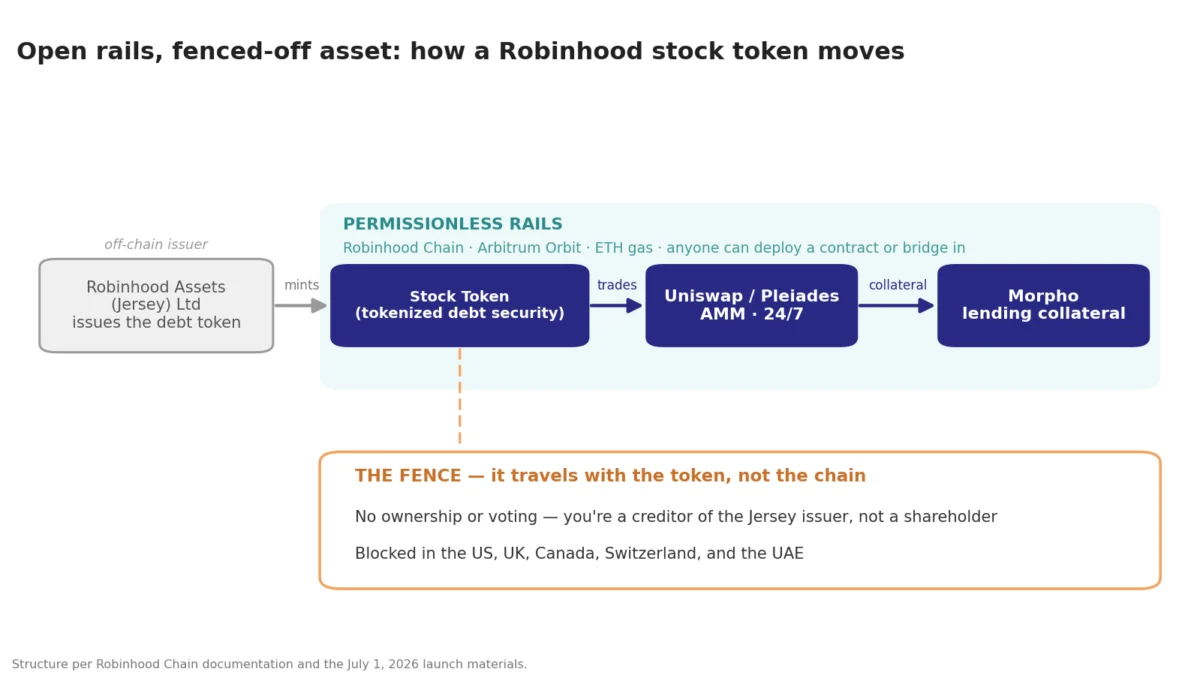
These tokens are explicitly not actual shares of the underlying companies. Instead, they are structured as tokenized debt securities issued by Robinhood Assets (Jersey) Limited, a subsidiary established in the Channel Islands. Holding one of these tokens grants price exposure to the underlying stock but confers no ownership rights, voting rights, or a direct claim on the company itself. What an investor holds is a liability of a Robinhood entity that tracks the price of the underlying equity. Redemption for cash is available through authorized participants, but direct redemption for the actual underlying securities is described as a "future plan" rather than a current feature. In the event of the issuer’s failure, token holders would be creditors of Robinhood Assets (Jersey) Limited, not shareholders of the underlying company.
This structural model has previously drawn criticism in the crypto space, notably when earlier tokenized equity efforts faced public pushback, such as OpenAI distancing itself from tokens claiming to represent its equity in 2025. The distinction between a tokenized debt security and actual equity ownership is crucial for understanding the risk profile and legal standing of these assets.
This is not Robinhood’s first venture into tokenized equities. In June 2025, the company launched over 200 tokenized US stocks and ETFs for users in the EU and EEA, unveiled at an event in Cannes. These earlier offerings are now rebranded as "Classic Stock Tokens" and remain within the Robinhood Europe app. The new Stock Tokens on Robinhood Chain represent a second generation, with the key differentiator being their composability within the broader DeFi ecosystem, allowing them to move beyond a single proprietary application.
Regulatory Labyrinth and Geographic Constraints
Perhaps the most significant limitation for Robinhood’s core audience is the geographic availability of these tokenized stocks. While accessible in over 120 countries, they are explicitly unavailable in the United States, the United Kingdom, Canada, Switzerland, the UAE, and sanctioned jurisdictions.
The exclusion of the US market is primarily a regulatory constraint. US securities law currently lacks a clear and streamlined pathway for retail-traded tokenized debt securities that wrap an equity. Robinhood, a highly regulated entity within the US, is understandably not eager to be the first to challenge this complex regulatory landscape. The effect, regardless of the cause, is that Robinhood’s foundational American retail investor base cannot directly access the flagship product of its new blockchain.
While US users are restricted from the tokenized equity component, Robinhood is rolling out an on-chain lending product, Robinhood Earn, for eligible American users. This provides a version of the DeFi experience but omits the tokenized stock aspect that forms the core justification for the chain’s existence.
This situation highlights the central paradox: the underlying blockchain rails are permissionless—anyone can deploy a contract, run a node via a public RPC, or bridge in ETH. However, the flagship asset designed to drive adoption to these rails is the antithesis of permissionless. It is a jurisdictionally gated, ownership-free debt instrument issued by a single offshore subsidiary of Robinhood. The chain is open, but the product that defines its purpose is fenced.
The "Distributed vs. Represented framework" offers a useful lens here. Robinhood’s stock tokens exhibit mobility and composability, pushing them towards the "Distributed" end of the spectrum in terms of their on-chain behavior. Yet, mobility is distinct from ownership. On the ownership axis, these tokens are as "thin" as tokenized Real World Assets (RWAs) can be, offering price exposure without direct equity claims.
Market Structure Debate: AMMs vs. Order Books for Equities
Even assuming the tokenized stocks function flawlessly, a significant market structure question looms, forming the basis of many bearish analyses. The initial spot venues for these tokens are Automated Market Makers (AMMs), specifically Uniswap’s dedicated pool and Pleiades, a proprietary AMM. While AMMs have proven highly effective for long-tail crypto assets and decentralized liquidity provision, their suitability for highly liquid equities, where price discovery has historically occurred on Central Limit Order Books (CLOBs) for centuries, is debatable.
CLOBs, common in traditional exchanges, match buy and sell orders based on price and time priority, providing continuous price discovery. AMMs, on the other hand, rely on mathematical formulas and liquidity pools. An AMM holding tokenized NVDA, for example, must be constantly arbitraged back to its real-world price quote, which updates continuously during market hours on traditional exchanges. Arbitrageurs profit by exploiting price discrepancies, but this profit comes at the expense of liquidity providers (LPs) in the AMM. Thin liquidity pools combined with a fast-moving external reference price create an environment where LPs are highly susceptible to "impermanent loss" and being "picked off" by sophisticated traders, which can, in turn, further thin liquidity.
Robinhood appears aware of this challenge, as evidenced by its choice of market structure for perpetual futures. Lighter, the integrated perpetual futures venue, operates as an order-book DEX, not an AMM. This inconsistency—a CLOB for perps but an AMM for spot tokenized stocks, where the argument for CLOBs is arguably stronger—is a key point of contention. Whether equities can trade efficiently and at scale on an AMM remains an open question, and Robinhood’s AMM-first approach for tokenized stocks is a significant, unproven bet. The evolution of liquidity on these tokenized stock AMMs over the coming weeks will be a critical metric to watch.
The Trust Factor: Centralization and Historical Precedent
The "buy button" incident of 2021 is not merely rhetorical; it frames the trust question surrounding Robinhood Chain. The marketing emphasizes "permissionless," yet at launch, a single sequencer, operated by or on behalf of Robinhood, orders transactions. This centralized sequencing is typical for nascent Arbitrum Orbit chains, with most L2s beginning with a centralized sequencer and only decentralizing later, if at all. However, the optics are stark: the same entity that once restricted trading now controls transaction ordering on a chain whose core asset is issued by its own subsidiary.
While the canonical bridge to Ethereum is trustless and the smart contracts are open, deserving credit, the standard Arbitrum caveat applies: canonical withdrawals back to Ethereum typically involve a roughly seven-day challenge period. This means bridging out is not instant unless users opt for third-party "fast bridges" that front liquidity, often for a fee. For now, the sequencer, the asset issuer, and the primary application interface are all consolidated under Robinhood.
Further feeding skepticism are two other factors. In mid-June 2026, just weeks before the chain’s launch, Robinhood announced layoffs impacting approximately 10% of its workforce, incurring roughly $28 million in restructuring charges. Management framed these cuts as coming "from a position of business strength," aiming for a leaner structure. However, the timing struck many as odd, given the immense execution demands of simultaneously launching a new blockchain, an asset issuer, a wallet integration, and a lending product.
Additionally, the launch incentives, including a confirmed 90 days of covered gas fees for eligible wallet users and no fees on Lighter perps during this window, are a common bootstrap strategy in crypto. While effective at spurring early adoption, such subsidies can inflate initial usage numbers, making it difficult to gauge organic traction once the incentives expire. None of these points are disqualifying in isolation, but collectively, they provide reasons to temper expectations regarding day-one metrics and carefully scrutinize long-term adoption.
Early Metrics and Ecosystem Dynamics
As of July 2, 2026, just hours after mainnet went live, confirmed on-chain data for Robinhood Chain is scarce. Available figures are a mix of testnet benchmarks, company launch claims, and unverified secondhand reports.
- Testnet Activity: In February 2026, the testnet reportedly saw approximately 4 million transactions in its first week, indicating early developer and user interest.
- Latent Distribution: Robinhood frequently cites its ~28 million user base as a significant onramp. However, this figure represents Robinhood’s total customer count, not direct chain adoption. Actual usage requires users to bridge assets and transact on the new chain, and most of these users cannot even access the flagship tokenized stocks.
- Gas Subsidy: Robinhood has confirmed a 90-day period of covered gas fees for eligible wallet users, a direct incentive for initial engagement.
- Lighter Incentives: The perpetuals venue, Lighter, is reportedly offering around $11 million in LIT tokens to incentivize liquidity provision, according to ecosystem project claims.
- Robinhood Earn Yield: The lending product offers approximately 7% APY on USDG (a stablecoin or similar asset) via Morpho, backed by insurance from Lloyd’s of London and RELM against cyber and smart-contract exploits, a significant offering confirmed by Robinhood.
- $HOOD Reaction: Robinhood’s stock ($HOOD) saw a modest ~2% increase pre-market following the announcement, reflecting a positive but not dramatic market response.
- Mainnet TVL / Volume: Crucially, there is no meaningfully published or widely cited Total Value Locked (TVL), transaction count, or active address figure for the mainnet as of writing. While tracking tools are live and some reports indicate "volume heating up" on DEX scanners, concrete data for building a robust thesis is absent.
The absence of a confirmed airdrop or governance token has not deterred the typical crypto phenomena of "point-farming" and "mainnet streak" guides circulating among speculative users, alongside the inevitable launch of reflexive memecoins on any new chain. While headline integrations like Uniswap, Lighter, Morpho, Chainlink, and BitGo are genuinely "live," the distinction between "live" and "liquid" is important; a deployed AMM with minimal depth is still a thin market.
Strategic Positioning in the L2 Landscape: Robinhood vs. Coinbase
Stripping away the launch fanfare, Robinhood Chain represents a significant strategic move by one of the world’s largest retail brokers to transition from renting on-chain rails to owning them. The most obvious comparison is Coinbase’s Base, an L2 launched in 2023. Both are large, regulated, US-listed consumer platforms establishing their own Layer 2s and directing their user bases towards them.
However, their approaches differ. Coinbase’s Base opted for a general-purpose chain built on the OP Stack, allowing the ecosystem to organically determine what applications and assets would thrive. Robinhood, in contrast, has chosen an Arbitrum-stack chain with a very specific, flagship use case—tokenized equities—baked in from day one. This presents a key strategic bet: whether a purpose-built chain with a defined product will outperform a general-purpose chain in attracting and retaining users.
Furthermore, Robinhood is not pioneering on-chain equities. The debt-security-wrapper approach has been tried by other issuers, with varying degrees of traction and persistent questions from the underlying companies regarding tokens that were never officially authorized or endorsed.
| Feature | Robinhood Chain | Coinbase’s Base |
|---|---|---|
| Stack | Arbitrum Orbit | OP Stack |
| Mainnet Launch | July 2026 | 2023 |
| Design Philosophy | Purpose-built for tokenized equities | General-purpose |
| Operator | Robinhood (single sequencer, for now) | Coinbase (single sequencer) |
| US Access | Flagship stock tokens blocked | Fully available |
Broader Implications and Future Outlook
Robinhood Chain’s launch carries significant implications for the broader financial landscape. For traditional finance, it signals a growing convergence with blockchain technology, as established players seek to leverage its benefits for efficiency, global reach, and 24/7 operations. The model of issuing tokenized debt securities could become a blueprint for other financial institutions looking to enter the digital asset space without direct equity transfer.
For DeFi, it brings a major retail brand into the ecosystem, potentially onboarding millions of new users, even if initially restricted. The emphasis on composability means that these tokenized assets, despite their caveats, could theoretically integrate with a wider array of DeFi protocols, fostering new use cases. However, the centralization of the issuer and sequencer poses questions about the true "decentralization" of the ecosystem, especially if the "permissionless" label is not fully realized in practice.
Regulatory bodies will undoubtedly be watching closely. The current jurisdictional restrictions highlight the ongoing challenges of fitting novel digital assets into existing legal frameworks. Robinhood’s cautious approach with US securities law indicates a recognition of this, but the global rollout will inevitably test the boundaries of international financial regulation. The success or failure of Robinhood Chain could influence how future tokenized assets are designed and regulated.
Ultimately, the honest assessment of Robinhood Chain presents a nuanced picture. The bull case rests on a battle-tested technical stack, deep day-one integrations, the genuine promise of 24/7 tokenized equity access for non-US users, and the immense retail distribution funnel that Robinhood commands. The bear case, however, points to the flagship asset being a synthetic debt security with counterparty and regulatory risk, blocked in Robinhood’s home market, and trading on an AMM model unproven for equities. Moreover, the "permissionless" chain is, for now, largely operated end-to-end by a company whose most infamous moment involved restricting trades.
For DeFi builders and users, the practical takeaway is clear: the chain is technically open, and standard tooling is available for deployment or bridging. However, the unique selling proposition of Robinhood Chain—its tokenized stock product—is precisely where the complexities lie. An offshore issuer, no direct ownership rights, hard jurisdictional walls, and untested on-chain liquidity represent the core risks. The infrastructure is the straightforward part; the asset’s nature and market dynamics are where the true challenges and opportunities will unfold in the weeks and months to come.