On Sunday, September 6, 2026, the Liquid Network—a prominent Bitcoin sidechain designed for institutional-grade asset transfers—suffered a significant security event that resulted in the unauthorized outflow of nearly 4,000 BTC. At 14:06:10 UTC, Liquid block 4,050,349 processed a peg-out transaction that facilitated the release of 3,996.01834922 BTC from the federation’s custody wallet to an external Bitcoin address. This incident, which bypassed the network’s multi-signature hardware security modules (HSMs), has raised urgent questions regarding the consensus mechanisms of sidechain technology and the transparency of confidential asset management.
The breach was not triggered by a compromise of private keys, according to preliminary statements from both the Liquid Federation and SideSwap, a primary peg-out partner. Instead, the consensus appears to have been subverted by a bug within the Elements software—the open-source codebase upon which Liquid is built. This flaw allowed for the creation of illegitimate L-BTC, which was subsequently redeemed for real Bitcoin through the network’s established peg-out mechanism. As of the time of reporting, approximately $320 million in value has been moved to an address currently held by an entity claiming to be a "whitehat" actor.
A Chronology of the Incident
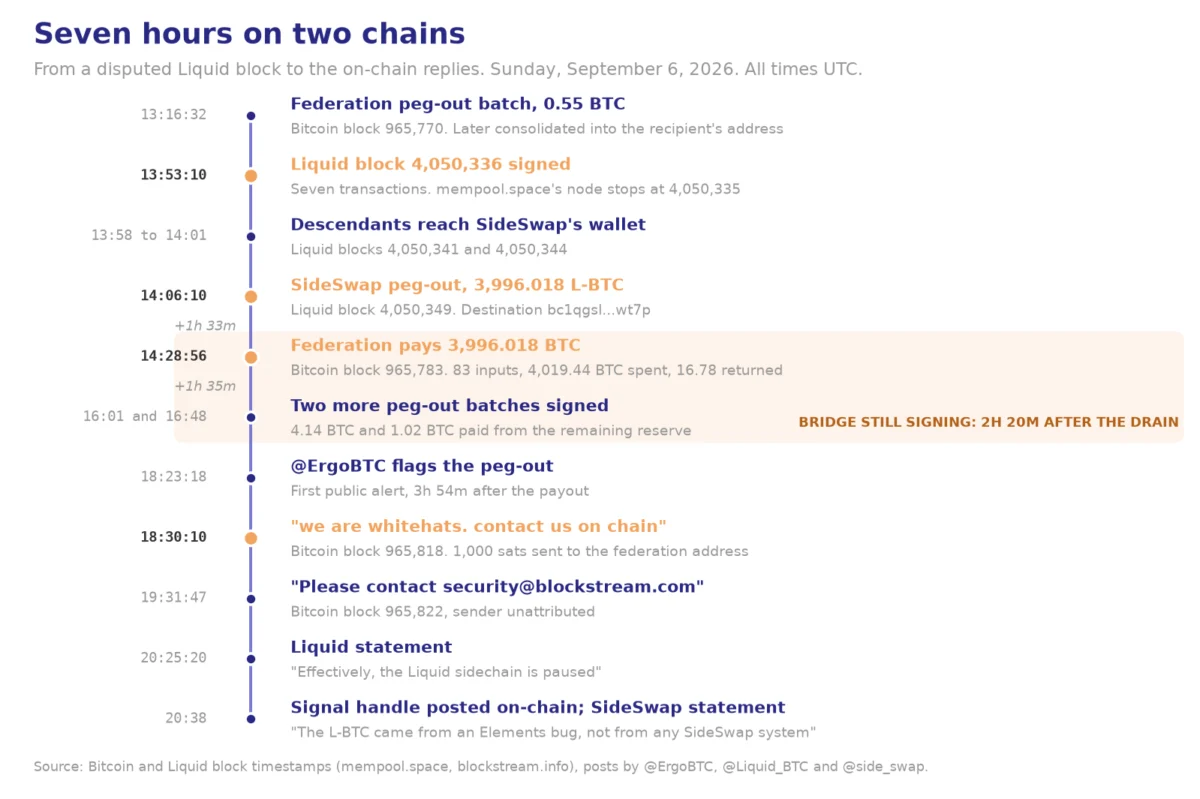
The sequence of events on September 6 highlights a period of intense network instability that went largely undetected by the broader market for several hours. The chain of events began at 13:53:10 UTC with the validation of Liquid block 4,050,336. While the Blockstream-maintained explorer accepted this block, independent nodes—most notably the mempool.space explorer—rejected it, signaling a critical consensus divergence.
Within this disputed block, a large-scale confidential transaction was processed, which appears to have served as the catalyst for the unauthorized minting of L-BTC. By 14:06:10 UTC, the SideSwap peg-out service initiated a transaction that converted the illegitimate L-BTC into native Bitcoin. The federation’s functionaries, operating under the assumption that the burning of L-BTC was valid, authorized the release of the funds. At 14:28:56 UTC, in Bitcoin block 965,783, eleven of the fifteen functionary hardware modules signed an 83-input transaction that finalized the transfer of 4,019.44 BTC from the federation’s reserves.
Despite the outflow representing the vast majority of the federation’s holdings, the network continued to operate. Two additional peg-out batches were processed at 16:01:28 UTC and 16:48:45 UTC, effectively draining the remaining liquidity. It was not until 18:23:18 UTC, nearly four hours after the initial payout, that independent researchers flagged the anomaly. The recipient of the funds eventually signaled their presence at 18:30:10 UTC, embedding an OP_RETURN message into a Bitcoin transaction that read, "we are whitehats. contact us on chain."
Technical Analysis: The Failure of the Perimeter
The Liquid Network operates on a "Strong Federation" model, where fifteen functionaries manage a multi-signature wallet. Security is bolstered by the Peg-out Authorization Key (PAK) system, which restricts withdrawals to whitelisted addresses. This design is robust against the theft of individual keys; however, the events of September 6 demonstrate that it is vulnerable to systematic consensus errors.
The HSMs are programmed to verify two specific conditions: that the destination address is whitelisted and that the amount of L-BTC being burned corresponds to the BTC requested. Because these conditions were technically met, the hardware functioned exactly as intended. The system failed because the underlying consensus rules—the "upstream" logic of the Elements codebase—had been compromised to accept fraudulent L-BTC as legitimate. Consequently, the multisig security was not bypassed; it was fed false information, causing the federation to authorize a withdrawal that, according to the network’s internal logic, appeared entirely lawful.
This incident also underscores the inherent risks of Confidential Transactions. While the privacy-preserving nature of the network allows for the obscuring of asset amounts and types, it simultaneously masks potential discrepancies in the total supply. Because L-BTC outputs are Pedersen commitments, observers cannot verify the aggregate supply in real-time. This lack of transparency prevented the early detection of the illegitimate minting, leaving the federation’s reserve depletion as the only visible metric of the breach.

Official Responses and Remediation Efforts
In the immediate aftermath of the exploit, the Liquid Federation announced that it had paused the sidechain. While block production continued on the Blockstream chain, the bridge nodes responsible for peg-ins and peg-outs were disabled, effectively freezing the movement of assets. Both Blockstream and SideSwap have confirmed that they are working to communicate with the holder of the funds.
"The Blockstream team is working on contacting them on-chain with a signed message," the federation stated in a formal release. Meanwhile, SideSwap emphasized that the flaw originated within the Elements software and that their own systems were not subject to an internal breach. As of September 7, the funds remain stationary in a single-signature address, with no further movement observed since the initial "whitehat" message.
Broader Implications for Sidechain Architecture
The event has sent shockwaves through the Bitcoin ecosystem, particularly among users of bridges and layer-two scaling solutions. The incident serves as a sobering reminder that even highly centralized, "federated" systems are not immune to the risks of software bugs. The fact that fifteen independent entities were running the same codebase meant that a single point of failure in the software logic resulted in a unanimous, albeit incorrect, consensus.
Furthermore, the ambiguity surrounding the "whitehat" status of the attacker leaves the future of the 3,998.5 BTC in limbo. Unlike decentralized autonomous organizations (DAOs) that might have an on-chain treasury or a clear protocol for governance-based recovery, the Liquid Network lacks a formal mechanism for resolving such massive losses. The burden of recovery now rests on private negotiations between the federation, the anonymous party, and the affected stakeholders.
The incident also highlights the potential for a "rehearsal" attack. Analysis of the transaction batches indicates that smaller, potentially test-run peg-outs occurred shortly before the main event. Such patterns suggest that attackers may be monitoring the responsiveness of bridge protocols to determine the threshold at which automated security alerts are triggered.
Conclusion and Outlook
The Liquid Network incident of 2026 will likely be cited as a seminal case study in the risks associated with confidential asset chains. The reliance on centralized software in a federated environment has proven to be a double-edged sword: while it allows for high-speed, institutional-grade throughput, it concentrates risk in the integrity of the codebase.
For the users of Liquid, the immediate concern remains the restoration of the peg. With the federation wallet currently holding only about 197 BTC—a fraction of the required backing for the estimated 4,200 L-BTC in circulation—the network faces a significant solvency challenge. Whether the situation is resolved through the return of the funds by the "whitehat" actor or through a recapitalization effort remains to be seen. In the interim, the freeze on the bridge serves as a necessary, if disruptive, measure to prevent further outflows while developers scramble to identify the specific vulnerability in the Elements software that made this breach possible.
As the industry moves forward, the scrutiny on code audit processes for sidechain infrastructure will inevitably intensify. The transparency of the blockchain, often touted as a primary security feature, is significantly diminished when the fundamental consensus rules are obscured by privacy-enhancing technology. Balancing the demand for financial privacy with the necessity of public auditability remains the central, unresolved challenge of the modern sidechain era.