At 14:06:10 UTC on Sunday, September 6, 2026, the Liquid Network experienced a critical security incident that resulted in the unauthorized removal of nearly 4,000 BTC from the Liquid Federation’s multisig wallet. The event, which originated from a consensus-level vulnerability within the Elements software, has raised profound questions regarding the security of pegged assets, the limitations of confidential transactions, and the operational risks inherent in federated sidechain architectures. While no private keys were compromised and the federation’s hardware security modules (HSMs) performed their duties as programmed, the integrity of the Liquid chain’s underlying ledger was fundamentally undermined, allowing for the creation and subsequent redemption of unbacked Liquid Bitcoin (L-BTC).
The Mechanics of the Incident
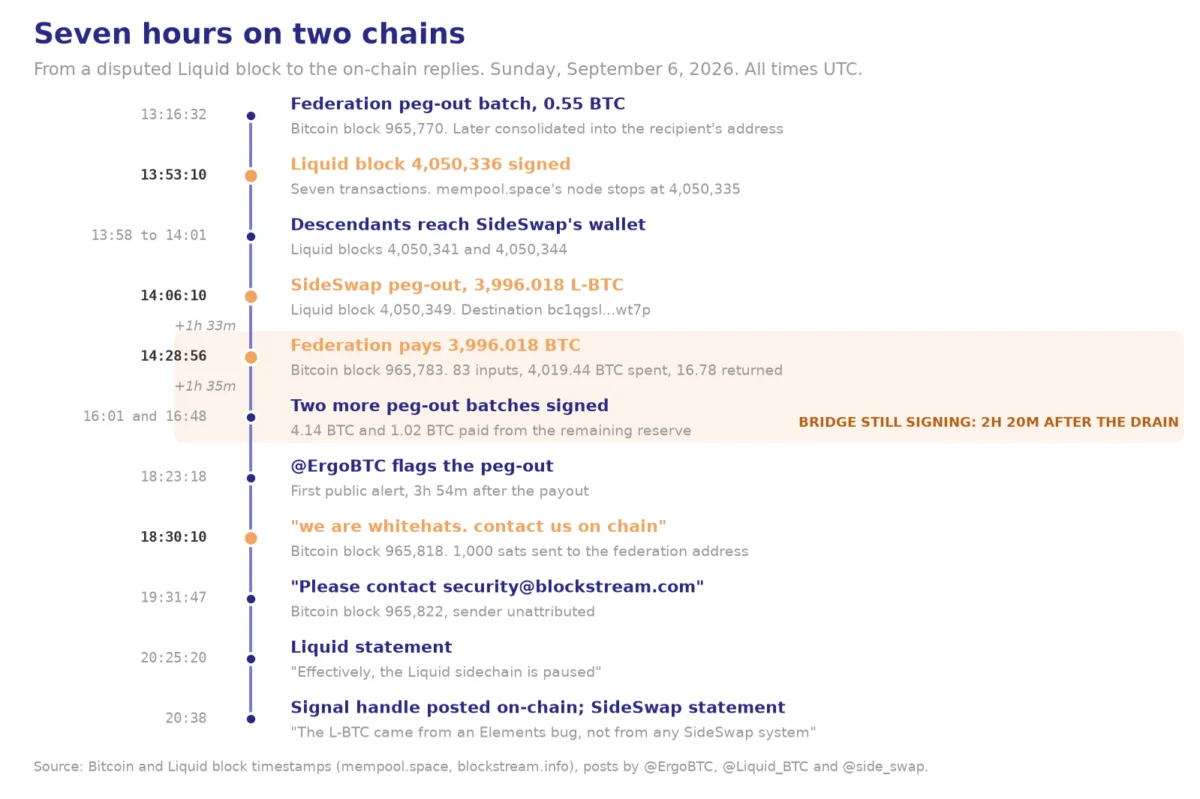
The incident unfolded through a sophisticated exploitation of the Liquid Network’s consensus rules. At 13:53:10 UTC, Liquid block 4,050,336 was produced. This block contained a large, opaque transaction involving multiple inputs, which functioned as the catalyst for the subsequent exploit. While the Blockstream explorer accepted this block as part of the canonical chain, other network participants—including the node infrastructure operated by mempool.space—rejected the block, citing a consensus discrepancy.
This rejection highlights a critical failure in the network’s validation uniformity. Because the Liquid Network utilizes Confidential Transactions (CT) to obfuscate asset amounts and types, it is impossible for external observers or even full nodes to determine the exact quantity of L-BTC being transacted in real-time. Consequently, the invalidation of the block by some nodes did not prevent the federation’s automated systems from processing subsequent peg-out requests that relied on the tainted outputs of that block.
At 14:06:10 UTC, a peg-out transaction was executed in block 4,050,349, requesting the release of 3,996.01834922 BTC. The request was facilitated through SideSwap, a registered peg-out partner. Because the transaction complied with all programmed requirements—namely, that the destination address was on the federation’s whitelist and the amount matched the L-BTC being burned—the federation’s functionaries signed the transaction. By 14:28:56 UTC, in Bitcoin block 965,783, the multisig wallet released the funds to the attacker, leaving the federation’s reserve with only 197 BTC, down from approximately 4,200 BTC earlier that morning.
Chronology of Events (September 6, 2026)
- 13:16 UTC: A smaller, unrelated peg-out of 0.55 BTC is processed, which later appears in the same consolidation wallet used by the attacker, suggesting potential testing or anomalous activity.
- 13:53 UTC: Liquid block 4,050,336 is produced. This block, containing the suspicious transaction, is rejected by certain network nodes, signaling a consensus-level bug.
- 14:05 UTC: SideSwap receives a customer order for 4,000 L-BTC.
- 14:06 UTC: The peg-out transaction for 3,996.018 BTC is included in block 4,050,349.
- 14:28 UTC: Bitcoin block 965,783 confirms the federation’s 83-input transaction, successfully moving the funds to the attacker’s destination.
- 18:30 UTC: The recipient broadcasts an OP_RETURN message on the Bitcoin network: "we are whitehats. contact us on chain."
- 20:25 UTC: Liquid publishes an official statement confirming the breach and the suspension of the peg-out service.
The Vulnerability: A Failure of Consensus
The root cause of the incident appears to be an Elements software bug that caused different nodes to reach different conclusions about the validity of the ledger. Investigations have pointed toward a potential issue in the range-proof verification cache. Specifically, prior to a recent code update, nodes might have cached proofs that did not adequately bind to specific scriptPubKey or asset commitments. If an attacker could craft a transaction that appeared valid under the flawed caching logic but was rejected by stricter nodes, they could effectively "mint" L-BTC out of thin air.
Crucially, the federation’s multisig and PAK (Peg-out Authorization Key) systems functioned exactly as designed. They are built to verify that a requested peg-out is authorized by a whitelisted partner and that the L-BTC being redeemed is "burned." However, the system assumes that the L-BTC being burned is legitimate. It lacks a secondary mechanism to verify the entire history of the L-BTC supply to ensure it was not minted through a consensus bug. Because all fifteen functionaries were running the same software version, they all shared the same blind spot, leading to a unanimous—and erroneous—validation of the illicit transaction.
Official Responses and Containment
In the immediate aftermath, the Liquid Federation moved to pause the bridge, effectively halting peg-outs and peg-ins. Blockstream issued a statement confirming that the Blockstream team was working to contact the party responsible via on-chain messaging. SideSwap, in its own communication, clarified that the exploit did not stem from their proprietary systems but rather from an underlying vulnerability in the Elements codebase.
As of this writing, the attacker remains in possession of approximately 3,998.5 BTC, valued at roughly $320 million at the time of the event. The attacker’s address has received several on-chain messages from the community and the federation requesting contact, but the funds have not moved since the initial consolidation.
Broader Implications for Sidechain Security
The incident serves as a sobering reminder of the trade-offs inherent in federated sidechain models. By design, Liquid aims to minimize trust by relying on a distributed set of known entities. However, as this event demonstrates, diversity of operation is only as robust as the software underlying it. If all participants run identical software, a single, critical bug can lead to a systemic failure that no amount of multisig decentralization can prevent.
Furthermore, the reliance on Confidential Transactions, while essential for the privacy-centric goals of the Liquid Network, complicates incident response. On a transparent ledger, a supply inflation bug would be immediately visible to all network participants, allowing for rapid detection and mitigation. In the case of Liquid, the lack of transparency meant that the inflation remained invisible to the public explorer for several hours, until the reserves were drained.
The question of recovery and restitution remains the most pressing concern for the L-BTC community. With the federation holding only a fraction of the reserves necessary to back the total supply of L-BTC, the economic impact is significant. Unlike decentralized protocols that might have governance tokens or insurance funds, the Liquid ecosystem relies on the reputation and financial stability of the federation members. Whether the lost funds are recovered through negotiation with the "whitehat" entity or if the federation members choose to cover the shortfall remains the defining uncertainty.
The incident also highlights a critical need for "circuit breaker" mechanisms in bridge architectures. While the federation did continue to process small, unrelated transactions for hours after the initial theft, a more sophisticated risk-management protocol—one that monitors reserve ratios in real-time and triggers automatic pauses when outflows exceed defined thresholds—could have limited the blast radius of the attack.
Ultimately, the 2026 Liquid Network exploit represents a turning point for Bitcoin sidechains. It underscores that while the "bridge" is often the focus of security audits, the "chain" itself—and the consensus rules that define the supply of its assets—is the true foundation of security. Moving forward, the industry is likely to demand more rigorous node diversity, increased transparency in supply auditing, and more robust, automated defense-in-depth mechanisms for all cross-chain infrastructure. As the network attempts to restart and resolve the lingering deficit, the focus will remain on the accountability of the federation and the technical resolution of the Elements vulnerability that allowed this historic loss to occur.