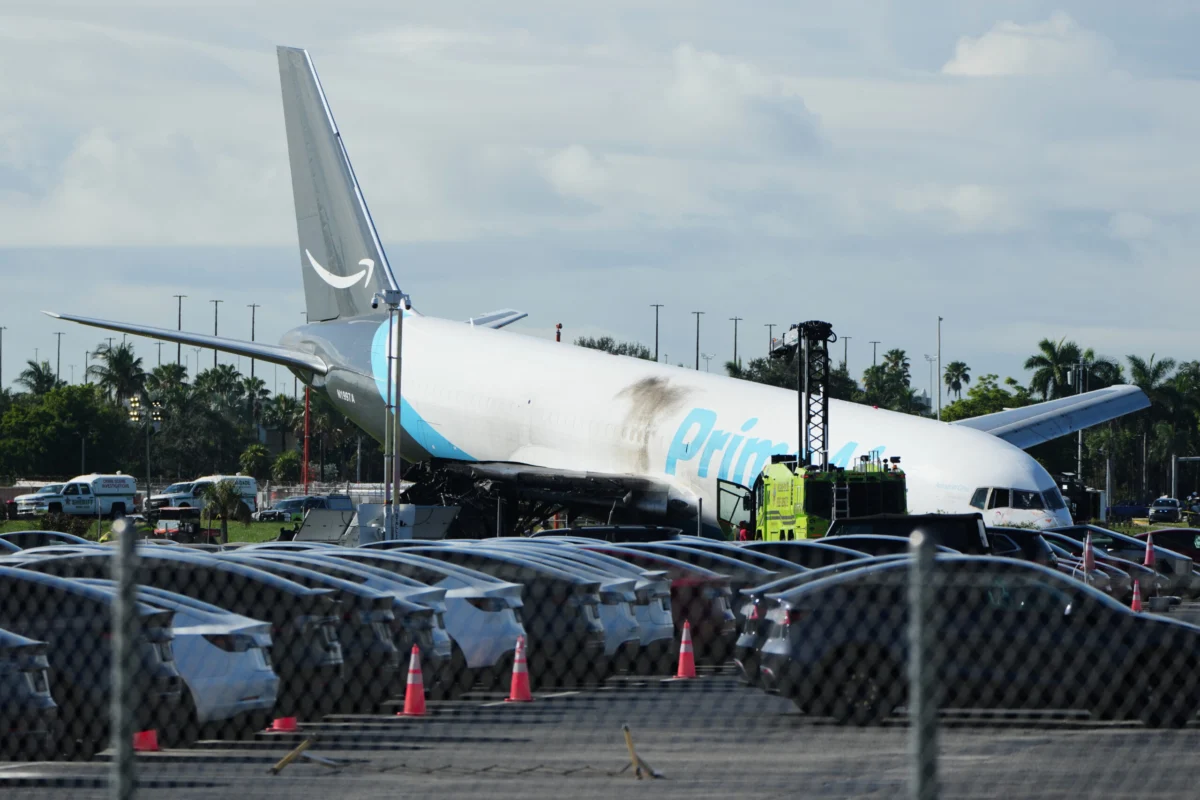
The aviation community and the city of Miami are reeling following a catastrophic runway excursion at Miami International Airport (MIA) on Sunday, which resulted in the deaths of five individuals and left several others injured. The incident involved an Amazon Prime Air cargo jet, operated by North Carolina-based carrier 21 Air, which veered off the runway during landing, plowed through airport perimeter fencing, and collided with vehicles on a nearby roadway. National Transportation Safety Board (NTSB) investigators are now working to piece together a chaotic final sequence of events that flight data suggests involved a failed attempt to abort an unstable landing.
As the recovery phase concludes, the focus has shifted toward the mechanical and human factors that contributed to the disaster. NTSB Chairwoman Jennifer Homendy, leading the federal investigation, confirmed Tuesday that preliminary data indicates the aircraft’s thrust reversers were never engaged, a critical step in decelerating a heavy jet on a wet or constrained runway.
Chronology of the Incident
The flight, which originated in Puerto Rico, arrived in the Miami area during a period of inclement weather, with reports indicating localized storm activity near the airport. The Boeing 767, a 32-year-old airframe originally manufactured for passenger transport before being converted for cargo operations in 2015, began its final approach under complex meteorological conditions.
Flight tracking data obtained by the NTSB suggests that the aircraft experienced an unstable landing, characterized by a premature touchdown on its nose and right landing gear. Approximately 1,300 feet (396 meters) past the end of the designated runway, the jet continued its momentum, failing to decelerate effectively. Witnesses and preliminary findings indicate that the flight crew may have initiated a last-minute attempt to execute a "go-around"—a standard procedure to abort a landing and climb back to a safe altitude—but abandoned the effort shortly thereafter.
The aircraft subsequently breached airport security fencing, striking a van occupied by five employees of Professional Ocean Service Corp., a maintenance firm responsible for cleaning aircraft cabins. The collision was fatal for all five occupants inside the vehicle. The plane continued its trajectory, ultimately smashing into a stationary SUV on a city street before coming to a rest in a nose-down configuration, marked by visible soot and structural damage to the fuselage.
The Human Cost and Emergency Response
The victims have been identified by the Miami-Dade County Sheriff’s Office as Rolando Aleman Leon, 55; Yoel Rodriguez Naranjo, 53; Julio C. Pineda, 75; Carlos Acosta Fajardo, 53; and Javierkys Reyes Quevedo, 47. In a statement, Professional Ocean Service Corp. expressed profound grief, noting that the victims were not merely colleagues but family members who worked in close proximity to the flight crews daily.
Emergency services were dispatched immediately to the site, which remained cordoned off well into the week. Sheriff Rosie Cordero-Stutz confirmed that five additional individuals sustained injuries. While the flight crew—the pilot and co-pilot—were transported to local hospitals for evaluation, they have since been released. Of the remaining injured, two individuals were reported to be in critical condition, with one remaining in stable condition as of Tuesday evening.
Expert Analysis of Landing Dynamics
The aviation industry is closely monitoring the NTSB’s probe, particularly regarding the decision-making process in the cockpit. Mike O’Donnell, a former Federal Aviation Administration (FAA) official, noted that the landing profile suggests significant hesitation. "A go-around probably should have been executed sooner than that," O’Donnell observed. "It seems like they hesitated, and by the time they attempted to abort, they may have run out of both runway and time."
Further complicating the analysis are the weather conditions. Experts have suggested that a strong tailwind may have pushed the aircraft beyond its intended touchdown point. A key question for investigators is why air traffic control did not mandate a change in the landing approach to allow the aircraft to land into a headwind, which would have provided more aerodynamic braking capability. Attorney Mary Schiavo, a former Inspector General for the U.S. Department of Transportation, suggested that the conflicting maneuvers observed in the flight data might point to a lack of consensus between the pilot and co-pilot regarding the safe execution of the landing.
Safety Infrastructure and Regulatory Oversight
The incident has reignited a debate regarding safety buffers at major U.S. airports. While Miami International Airport complies with FAA regulations by maintaining a 1,000-foot (305-meter) cleared safety area beyond the runway threshold, it lacks an Engineered Material Arresting System (EMAS).
EMAS technology utilizes lightweight, crushable concrete blocks designed to safely decelerate aircraft that overrun a runway. According to the FAA, these systems have been successfully utilized at over 120 airports nationwide and are credited with preventing approximately 500 potential fatalities since their introduction. NTSB Chairwoman Homendy stated that while the investigation is in its early stages, the absence of such a system at MIA will be a point of formal inquiry. However, critics of this focus note that the aircraft overran the runway by 1,300 feet, which would have exceeded the standard length of many existing EMAS installations.
Broader Implications and Next Steps
The logistical impact on Miami International Airport was immediate, with more than 225 flights canceled on Sunday and Monday, and hundreds more delayed. The reopening of a third runway on Tuesday provided some relief to the hub, but the NTSB continues to process the wreckage site, which remains a focal point for investigators collecting forensic data.
For Amazon, the incident marks a significant operational and reputational challenge. The company released a brief statement affirming its full cooperation with federal authorities and expressing condolences to the families of the deceased. As the investigation progresses, the NTSB will conduct formal interviews with the flight crew to reconcile the cockpit voice recordings with the flight data.
While a final report from the NTSB is not expected for at least 12 to 18 months, the findings will likely lead to industry-wide recommendations regarding pilot training, communication during high-stress landing scenarios, and the necessity of enhanced runway safety infrastructure at major commercial airports. For now, the tragedy serves as a somber reminder of the vulnerabilities inherent in the intersection of ground operations and heavy aviation. The community, the victims’ families, and the aviation sector wait for definitive answers to explain how a routine cargo transport resulted in such a devastating loss of life.