For decades, the field of robotics existed in a peculiar paradox: engineers harbored grand ambitions of replicating the intricate marvel of the human body, yet their practical output was often confined to the limited scope of industrial automation. The aspiration was to create sophisticated, human-like machines capable of navigating complex environments and interacting seamlessly with people, akin to the iconic C-3PO from science fiction. However, the reality frequently manifested in more utilitarian, less ambitious creations, such as automated arms for car manufacturing or the ubiquitous, albeit simpler, Roomba vacuum cleaner. This persistent gap between vision and execution led to a prolonged period of skepticism within Silicon Valley, a reluctance to invest heavily in the promise of truly helpful, general-purpose robots.
This landscape has undergone a dramatic transformation. While the fully realized, adaptable robots of science fiction remain on the horizon, the financial commitment to their development has surged. In 2025 alone, investments in humanoid robotics reached an astounding $6.1 billion, a fourfold increase compared to the $1.5 billion invested in 2024. This dramatic influx of capital signals a renewed confidence in the sector, driven by a fundamental paradigm shift in how machines are learning to perceive, interact with, and operate within the physical world.
The historical approach to robot programming was rooted in meticulous, rule-based systems. Consider the task of teaching a robotic arm to fold clothes. This would necessitate the creation of an exhaustive set of instructions: defining material tolerances to prevent tearing, precisely locating a shirt’s collar, specifying the exact angles and distances for folding sleeves, and then developing contingency plans for every conceivable variation – rotated shirts, twisted sleeves, different fabric types. This method, while capable of producing reliable results for highly specific tasks, quickly became unmanageable due to the sheer complexity and the astronomical number of rules required to account for even a fraction of real-world unpredictability. The craft of robotics, in essence, was about anticipating every possible scenario and pre-encoding it into the machine’s logic.
The advent of machine learning, particularly around 2015, began to offer an alternative. Instead of explicit programming, researchers started exploring the power of simulation. By creating digital twins of robotic systems and their environments, coupled with sophisticated reward mechanisms, machines could learn through millions of iterative attempts. This trial-and-error learning process, mirroring how artificial intelligence achieved mastery in complex games like Go, proved remarkably effective in enabling robots to develop nuanced motor skills and problem-solving capabilities.

The true catalyst for the current investment boom, however, can be traced to the widespread impact of Large Language Models (LLMs) like ChatGPT, which emerged in late 2022. LLMs operate not by predefined rules or direct trial and error, but by learning to predict the most probable sequence of words in a given context, drawing upon vast datasets of text. This principle was rapidly adapted to robotics. By training similar models on diverse inputs – including visual data from cameras, sensor readings, and the precise joint configurations of a robot – these systems could now predict and execute a sequence of actions, issuing dozens of motor commands per second. This conceptual leap, from explicit programming to data-driven learning, has proven to be remarkably versatile, enabling robots to perform tasks ranging from sophisticated object manipulation to natural language interaction. This shift is further bolstered by strategies such as deploying robots in real-world environments even before they are fully perfected, allowing them to learn and adapt from their operational experiences.
The Precursors to the AI Revolution in Robotics
While the current wave of investment is fueled by advanced AI, earlier attempts at creating socially engaging robots laid crucial groundwork and highlighted the challenges that modern techniques have begun to overcome.
Jibo: The Early Social Robot Attempt
In 2014, Cynthia Breazeal, an MIT robotics researcher, introduced Jibo, a distinctive, armless, legless, and faceless robot that resembled a stylized lamp. Breazeal’s vision was to create a social robot for families, a concept that resonated strongly, leading to a successful crowdfunding campaign that raised $3.7 million. Early pre-orders for Jibo were priced at $749.
Jibo’s initial capabilities were limited to introducing itself and performing simple entertainment routines, such as dancing. The overarching ambition, however, was for Jibo to evolve into an embodied assistant capable of managing schedules, handling emails, and even storytelling. While Jibo garnered a dedicated user base, the company ultimately ceased operations in 2019.
A critical limitation of Jibo, viewed in retrospect, was its rudimentary language processing capabilities. It competed in an era dominated by voice assistants like Apple’s Siri and Amazon’s Alexa, which relied heavily on scripted interactions. These systems would translate speech to text, attempt to parse user intent, and then retrieve pre-written responses. While these snippets could be charming, they were often repetitive and lacked genuine conversational flow, a significant drawback for a robot designed for social interaction within a family setting. The inherent "robotic" nature of these scripted conversations contrasted sharply with the envisioned role of Jibo as a companion.

The subsequent advancements in AI-driven language generation have dramatically altered the landscape. Modern voice interfaces from leading AI providers now offer engaging and impressively natural conversations. This progress has spurred numerous hardware startups aiming to capitalize on these enhanced capabilities. However, this also introduces new risks. Unlike the predictable nature of scripted interactions, AI-generated conversations can veer into unpredictable territory. Instances of AI-powered toys engaging children in inappropriate discussions, such as providing advice on locating dangerous items, underscore the need for robust safety protocols and ethical considerations in the development of conversational robots.
OpenAI’s Dactyl: Mastering Manipulation Through Simulation
By 2018, the robotics research community widely recognized the limitations of traditional rule-based programming. OpenAI embarked on an ambitious project to train a robotic hand, codenamed Dactyl, using purely virtual methods. The objective was to manipulate palm-sized cubes with letters and numbers on their faces, with tasks like "Rotate the cube so the red side with the letter O faces upward" serving as benchmarks.
The core challenge lay in the "sim-to-real" gap. A robotic hand might achieve exceptional proficiency in a perfectly rendered digital simulation, but translating that learned behavior to the physical world often resulted in failure. Subtle discrepancies, such as minor variations in color, lighting, or the elasticity of the robot’s gripper materials, could render the simulated policies ineffective.
The breakthrough solution for this problem was "domain randomization." This technique involves creating an immense number of simulated environments, each with slightly randomized parameters. Variations in friction, lighting conditions, and object colors were systematically introduced. By exposing the learning algorithm to this wide spectrum of simulated conditions, the resulting policies became more robust and adaptable to the inherent unpredictability of the real world. Dactyl demonstrated the efficacy of this approach, and a year later, OpenAI leveraged similar techniques for a more complex task: solving Rubik’s Cubes. While successful, the system achieved a 60% success rate, dropping to 20% for particularly difficult cube scrambles.
Despite its advancements, the inherent limitations of simulation meant that domain randomization played a less dominant role in subsequent years. OpenAI eventually paused its robotics efforts in 2021, only to revive the division with a reported focus on humanoid robots. This cycle of exploration and re-evaluation highlights the ongoing quest for effective and scalable training methodologies in robotics.

The Era of Foundation Models and Generalization
The most significant advancements driving the current robotics renaissance stem from the application of "foundation models" – AI systems trained on massive, diverse datasets that can be adapted to a wide range of tasks.
Google DeepMind’s RT-2: Bridging Vision and Action
Around 2022, Google’s robotics team engaged in an extensive data collection effort, filming humans using robot controllers to perform tasks such as picking up chip bags and opening jars. Over 17 months, they cataloged approximately 700 distinct tasks. The goal was to develop one of the first large-scale foundation models specifically for robotics.
The initial iteration, RT-1, processed inputs related to visual observations and the robot’s joint configurations, along with task instructions, to generate motor commands. When presented with tasks it had previously encountered, RT-1 achieved a 97% success rate. Remarkably, it still managed a 76% success rate on novel instructions, demonstrating a nascent ability to generalize.
The subsequent iteration, RT-2, released the following year, pushed the boundaries further. Instead of relying solely on robotics-specific data, RT-2 was trained on a broader spectrum of internet-scale image data, mirroring the approach of contemporary vision-language models. This allowed the robot to develop a more sophisticated understanding of object relationships and spatial context. As Kanishka Rao, a roboticist at Google DeepMind who led the RT-1 and RT-2 development, explained, this broader training unlocked new capabilities. "We could do things now like ‘Put the Coke can near the picture of Taylor Swift,’" he noted, illustrating the model’s ability to interpret abstract and context-dependent commands.
In 2025, Google DeepMind further integrated these advancements with the release of a Gemini Robotics model, which exhibited enhanced proficiency in understanding and executing commands expressed in natural language, further blurring the lines between human instruction and robotic action.

Covariant’s RFM-1: Collaborative Robotics in Practice
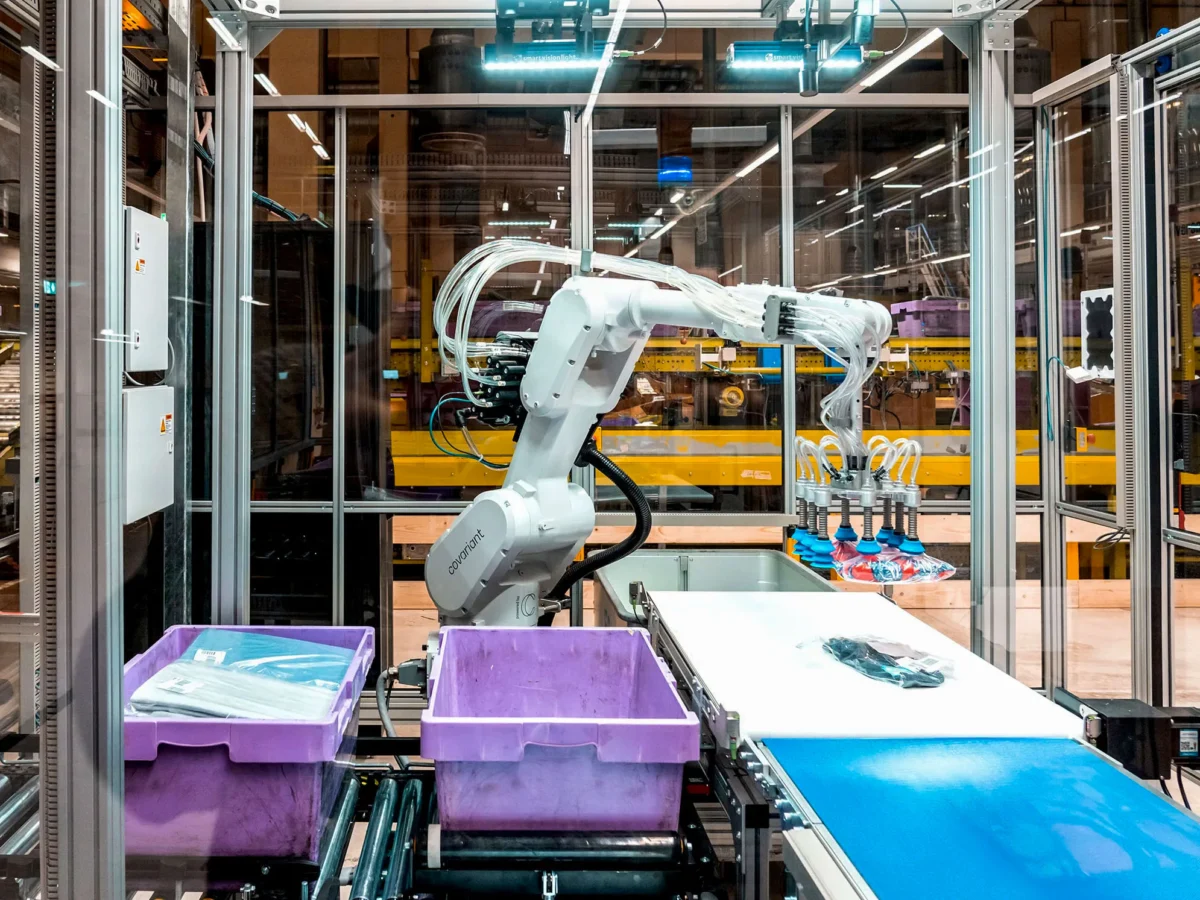
Emerging from the pioneering spirit of OpenAI’s early robotics team, Covariant was founded in 2017 with a pragmatic focus on warehouse automation rather than futuristic humanoids. Their objective was to create robotic arms capable of efficient picking and moving of items in logistics environments. Building upon a foundation model architecture similar to Google’s, Covariant deployed its platform in warehouses operated by companies like Crate & Barrel, establishing a robust data collection pipeline.
By 2024, Covariant unveiled RFM-1, a robotics model designed for intuitive interaction, akin to collaborating with a human colleague. For instance, after being shown multiple sleeves of tennis balls, the robot could be instructed to move each sleeve to a designated area. RFM-1 demonstrated an ability to anticipate potential challenges, such as predicting difficulties in gripping an item, and could proactively seek guidance on the appropriate suction cups to use.
While such interactive capabilities had been demonstrated in experimental settings, Covariant’s achievement lay in scaling this functionality. The company’s widespread deployment of cameras and data collection systems across customer sites provided a continuous stream of valuable data for model refinement.
However, the system was not without its limitations. In a March 2024 demonstration involving various kitchen items, the robot encountered difficulties when asked to "return the banana" to its original location. It initially attempted to place a sponge, then an apple, and a series of other items before successfully completing the task. Co-founder Peter Chen acknowledged that the model "doesn’t understand the new concept" of retracing steps, highlighting that performance can be compromised in environments lacking sufficient or relevant training data. Chen and fellow founder Pieter Abbeel were subsequently recruited by Amazon, a company that is now licensing Covariant’s robotics model and operates an extensive network of warehouses in the United States.
The Rise of Humanoid Robots and Real-World Deployment
The substantial investment flowing into robotics startups is increasingly directed towards machines designed in human form. Humanoid robots are envisioned to seamlessly integrate into existing human workplaces, obviating the need for costly retooling of infrastructure to accommodate specialized robotic designs.

Agility Robotics’ Digit: Stepping into Industrial Roles
Despite the theoretical advantages, the practical implementation of humanoids in real-world industrial settings remains a significant challenge. In the limited instances where they are deployed, humanoids are often confined to testing zones and pilot programs.
However, Agility Robotics’ humanoid, Digit, appears to be making tangible contributions. Its functional design, characterized by exposed joints and a utilitarian head, prioritizes performance over anthropomorphic aesthetics. Major companies such as Amazon, Toyota, and GXO (a logistics provider for brands like Apple and Nike) have deployed Digit, marking it as one of the first humanoid robots to offer demonstrable cost savings rather than merely novelty value. These robots are actively engaged in picking, moving, and stacking shipping totes in logistics operations.
The current iteration of Digit, while functional, is still some distance from the sophisticated, human-like helper envisioned by Silicon Valley. Its lifting capacity is limited to 35 pounds, and enhancements to its strength often increase its battery weight and charging frequency. Furthermore, standards organizations emphasize the need for more stringent safety regulations for humanoids compared to conventional industrial robots, given their design for mobility and operation in close proximity to humans.
Digit’s development underscores a key aspect of the current robotics revolution: the convergence of multiple learning methodologies. Agility Robotics employs simulation techniques akin to those used by OpenAI for its robotic hand, and has collaborated with Google’s Gemini models to enhance its robots’ adaptability to novel environments. This multifaceted approach, refined over more than a decade of experimentation, has propelled the industry from ambitious concepts to tangible, large-scale implementation, signifying a new era where robots are not just built, but are genuinely capable of performing meaningful work. The continued investment and rapid advancements in AI are poised to accelerate this trajectory, bringing the vision of helpful, adaptable robots closer to reality.