The landscape of enterprise finance is undergoing a quiet yet structural transformation, anchored increasingly by open-source distributed ledger technology. A comprehensive new report released by Ledger Insights and commissioned by LF Decentralized Trust (LFDT)—an initiative of the Linux Foundation—reveals that approximately 30 percent of all institutional blockchain platforms currently operate on technologies provided by the organization. Among the standout findings, prominent enterprise frameworks such as Hyperledger Fabric and Hyperledger Besu secured positions within the top three most widely utilized technologies globally.
While the headline figure of 29.4 percent demonstrates a commanding market presence, analysts and industry insiders suggest that the true footprint of Linux Foundation Decentralized Trust technologies is significantly higher. The findings underline a broader migration within global financial institutions toward open-source, neutral, and collaboratively governed digital asset infrastructure. This shift is reshaping how central banks, tier-one commercial institutions, and global market infrastructures approach tokenization, asset settlement, and cross-border connectivity.
The Scale of Institutional Adoption: From Central Banks to Global Depositories
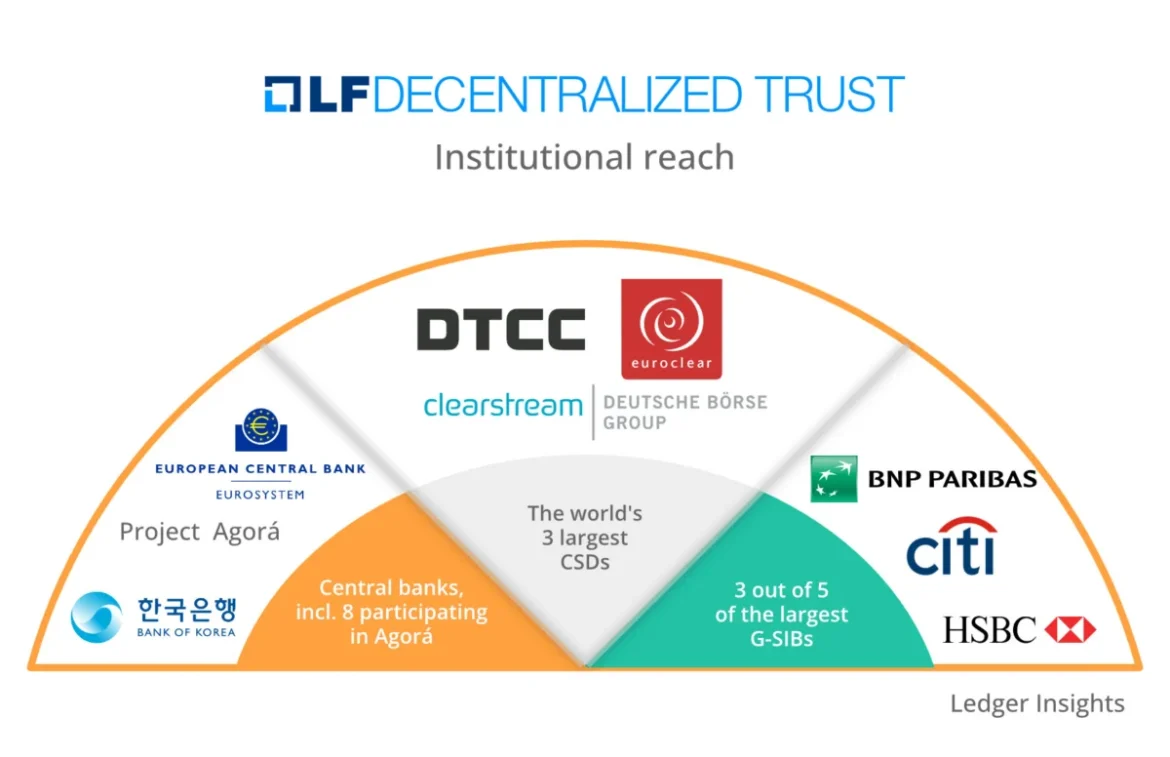
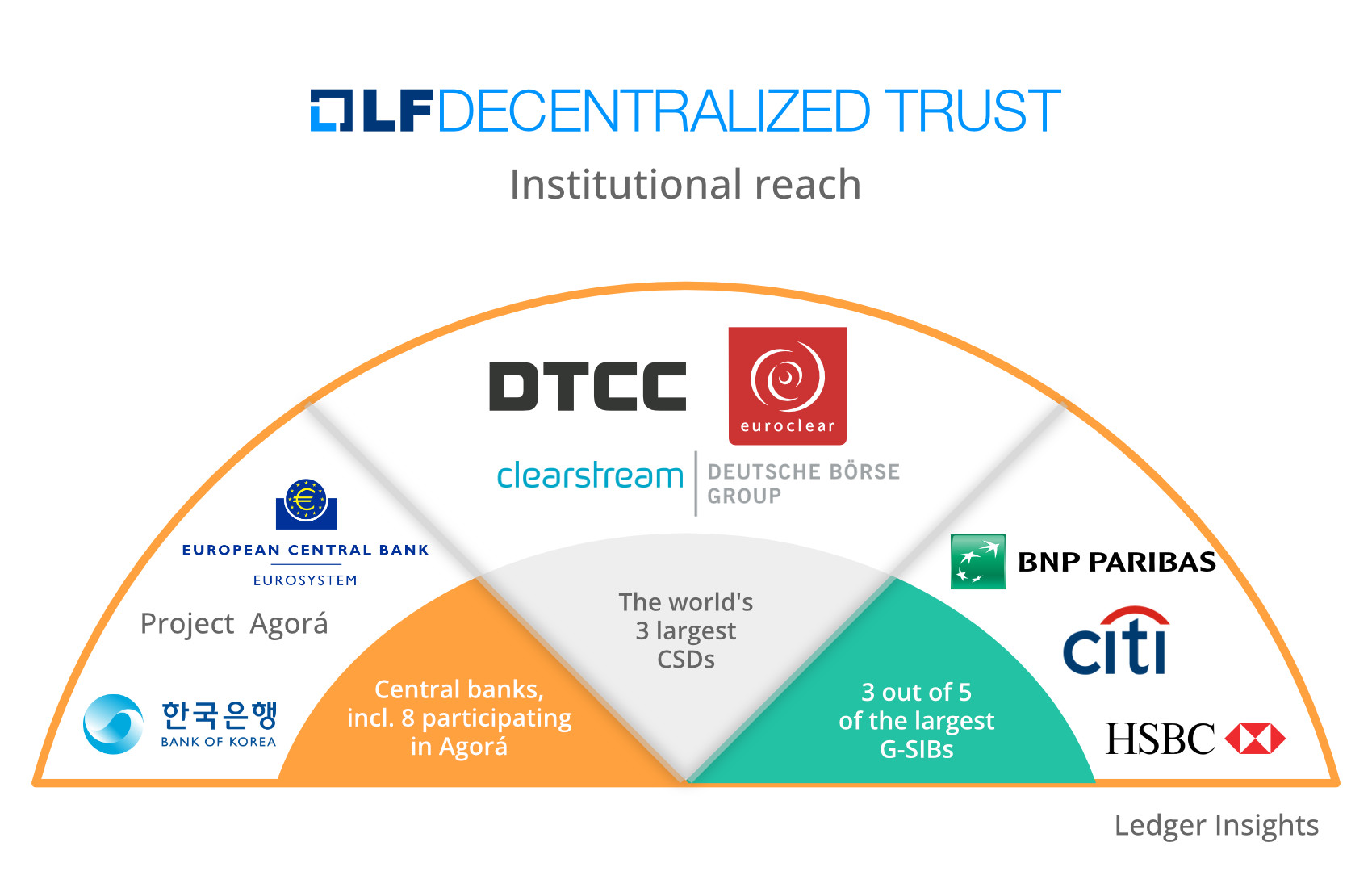
The significance of the LF Decentralized Trust ecosystem extends far beyond raw market share percentages; it is defined by the caliber and systemic importance of the entities deploying it. The Ledger Insights report highlights that some of the world’s most critical financial market infrastructures and central bank digital currency (CBDC) initiatives rely directly on LFDT infrastructure.
Notable implementations include Project Agorá, a major international initiative exploring the integration of wholesale central bank digital currencies involving economies across the G7. Similarly, the Eurosystem’s Project Pontes relies heavily on foundational technologies housed within the LFDT ecosystem. These central bank experiments are complemented by commercial applications within the world’s three largest central securities depositories (CSDs): Clearstream, the Depository Trust & Clearing Corporation (DTCC), and Euroclear.
Furthermore, three of the top five global systemically important banks—BNP Paribas, Citi, and HSBC—alongside major financial messaging networks such as Swift, have integrated these open-source architectures into their production or advanced pilot environments. For systems underpinning global financial stability, the decision to adopt open-source software backed by robust, neutral governance is not merely a technical preference, but a strategic risk-management imperative.
"Technology choices made by central banks, market infrastructure providers, and commercial banks carry implications for how financial systems will connect and evolve," stated Daniela Barbosa, General Manager of Decentralized Technologies at the Linux Foundation and Executive Director of LF Decentralized Trust. "They also bring long-term responsibilities for the communities maintaining the underlying code. We commissioned this research to help inform those responsibilities."
Methodological Insights: Why the Headline Market Share Likely Understates Reality
A closer examination of the methodology behind the Ledger Insights report reveals several factors indicating that the 29.4 percent market share figure is a conservative estimate.
First, more than a quarter of the institutional blockchain projects surveyed did not publicly disclose their underlying technology stack. Consequently, the headline statistic accounts exclusively for deployments that have openly acknowledged their architecture. While Hyperledger Fabric benefited from an early-mover advantage as one of the pioneering enterprise ledger technologies of the mid-2010s—with many of its earliest deployments remaining active in production—the steady stream of recent, large-scale adoptions indicates that LFDT’s growth is driven by ongoing modernization rather than legacy inertia.
Second, the report identifies two ambiguous classifications that account for a combined 25 percent market share: EVM-compatible technologies and proprietary systems. Independent research mapping staff skill sets and architectural blueprints strongly suggests that a substantial portion of projects categorized under generic EVM compatibility are, in fact, utilizing Hyperledger Besu. Because formal corporate confirmation was absent, these platforms were excluded from the direct LFDT tally.
Third, the "proprietary" category presents a similar dynamic. While institutions like Citi and India’s National Payments Corporation of India (NPCI)—the operator behind India’s massive Unified Payments Interface (UPI)—are transparent about their use of adapted LFDT codebases, numerous other financial institutions claim to run proprietary systems built from scratch. Industry experts remain skeptical that commercial entities would invest the capital required to build enterprise-grade distributed ledgers entirely without open-source foundations. Consequently, independent analysts conclude that the true collective market share of LF Decentralized Trust technologies within institutional finance comfortably exceeds the reported threshold.
Historical Context and Evolution of Enterprise DLT
The ascent of open-source decentralized trust frameworks did not happen overnight. To understand the current dominance of platforms like Hyperledger Fabric and Besu, it is necessary to examine the evolution of enterprise blockchain over the past decade.
[2015-2016] ──> Launch of Hyperledger Project; early enterprise experimentation
[2017-2019] ──> Proliferation of permissioned enterprise proofs-of-concept (PoCs)
[2020-2022] ──> Migration of production workloads; integration with tokenized securities
[2023-Present] ──> Convergence of public/private networks; central bank CBDC pilots
In the mid-2010s, enterprise blockchain was characterized by fragmented, proprietary experiments. Financial institutions were hesitant to adopt public, permissionless networks like Ethereum or Bitcoin due to privacy concerns, regulatory uncertainty, and scalability limitations. This vacuum led to the formation of collaborative initiatives, most notably the Linux Foundation’s Hyperledger project, which launched in 2015 to establish cross-industry standards for open-source distributed ledgers.
Over the subsequent decade, enterprise DLT evolved from isolated proofs-of-concept into hardened, production-grade infrastructure. Hyperledger Fabric emerged as the gold standard for permissioned, modular enterprise networks, while Hyperledger Besu bridged the gap between enterprise privacy and the Ethereum Virtual Machine (EVM), allowing institutions to interact with public-private hybrid networks. Today, the maturity of these codebases has allowed them to become the plumbing for institutional tokenization, multi-currency settlement systems, and cross-border payment rails.
The Strategic Appeal of Open-Source Governance
The widespread adoption of LFDT technologies by risk-averse financial institutions is driven by several enduring economic and operational principles:
- Avoidance of Vendor Lock-In: Proprietary software solutions often trap institutions within a single vendor’s ecosystem, exposing them to escalating licensing fees and asymmetric bargaining power. Open-source foundations ensure that code remains transparent, forkable, and adaptable.
- Developer Talent Pools: Technologies built on widely recognized open-source frameworks benefit from a global community of developers, making it significantly easier for banks to recruit and retain engineering talent familiar with the underlying architecture.
- Network Effects and Interoperability: As multiple institutions standardize around the same foundational codebases, the friction associated with cross-institution settlement and data sharing diminishes. As Clearstream noted in the report, shared technology dramatically lowers the barrier to establishing common market standards.
- Neutral Governance: Commercial software providers inevitably face conflicts of interest, where profit-driven motives may supersede the operational needs of utility-grade infrastructure. A foundation-backed, open-source model provides a neutral governance layer, ensuring that no single commercial entity dictates the roadmap of systemic financial plumbing.
Blurring Lines Between Public and Private Networks
One of the most revealing takeaways from the Ledger Insights report is the shifting boundary between permissioned and public blockchain infrastructure.
While institutional finance has historically favored strictly permissioned networks—where validators are known and vetted—three platforms with public blockchain roots secured spots in the top ten most utilized technologies. Most notably, the Ethereum mainnet ranked fifth overall in institutional adoption.
This public-chain integration is currently concentrated in specific use cases, primarily institutional fund tokenization and digital bond issuances. However, the presence of public networks alongside permissioned mainstays like Fabric and Besu signals a structural shift in institutional strategy. As financial institutions increasingly demand hybrid capabilities—operating permissioned ledgers for confidential bilateral trades while retaining the ability to settle on public rails—technologies like Hyperledger Besu, which natively support both permissioned and permissionless configurations, are uniquely positioned to capture future growth.
Implications for the Future of Financial Infrastructure
The data compiled by Ledger Insights underscores a critical reality: the digital transformation of global capital markets will not be built on closed, fragmented silos, but on collaborative, open-source foundations.
As central banks move closer to issuing wholesale digital currencies, and as commercial banks expand tokenized asset operations into mainstream production, the governance and security of underlying ledger technologies will remain paramount. The dominant market position held by LF Decentralized Trust highlights the value of neutral, community-driven software development in safeguarding the stability of the global financial architecture. For institutions navigating the complex intersection of traditional finance and distributed ledger technology, the path forward increasingly relies on shared code, transparent governance, and collaborative innovation.