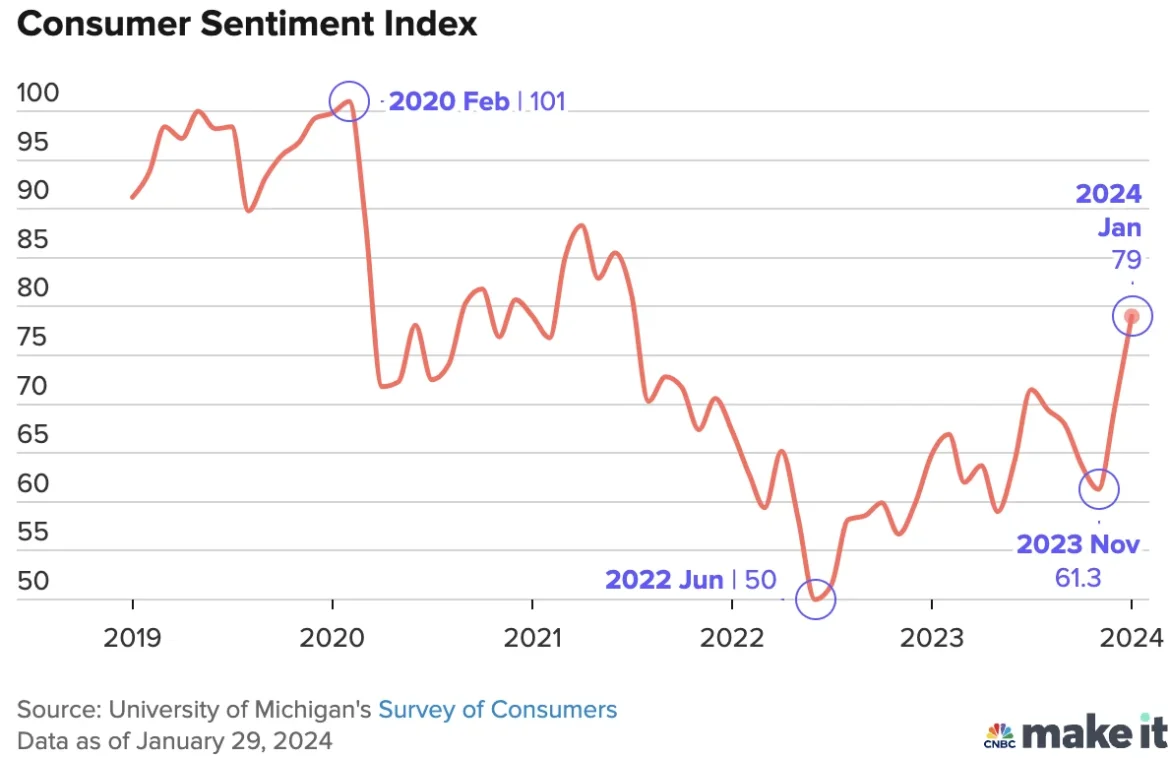
The latest data from the University of Michigan Surveys of Consumers reveals a palpable cooling in American economic optimism, with the consumer sentiment index falling 3.6 points in September to a final reading of 48.1. This decline marks the lowest level recorded in four months and represents a notable seven-point retreat from the same period last year. As the American public navigates a complex macroeconomic landscape defined by fluctuating fuel costs, trade volatility, and shifting inflation expectations, the survey highlights a growing disconnect between household financial stability and broader market conditions.
The decline is not isolated to a single demographic or economic indicator. The Current Economic Conditions Index, which tracks consumers’ immediate assessment of their financial standing, dipped to 50.9, reflecting a 9.5-point decline year-over-year. Even more concerning is the outlook for the future; the Consumer Expectations Index plummeted 5.2 points to 46.3. This downward trajectory underscores a widening sense of apprehension among households regarding the sustainability of their personal finances as they move into the final quarter of the year.
A Chronology of Economic Sentiment in 2026
To understand the severity of the September slide, it is necessary to examine the broader context of the 2026 fiscal year. Since January, consumer sentiment has been on a volatile path, currently sitting 15% lower than the year’s starting point. The first quarter of 2026 began with cautious optimism, as markets reacted to stabilized interest rates and a cooling labor market. However, the trajectory shifted dramatically as geopolitical tensions—specifically the conflict in Iran—began to disrupt supply chains and energy markets.
By February, inflation expectations had been hovering at a relatively manageable 3.4%. The subsequent escalation of international disputes acted as a catalyst for renewed inflationary pressure, driving energy costs upward and complicating domestic trade logistics. By June, inflation expectations had begun to creep toward the 4% threshold, and the most recent data shows a jump to 4.6%, the highest level since the mid-year mark. This timeline reflects a transition from post-pandemic recovery to a period characterized by external shocks that the average consumer is increasingly unable to buffer against.
The Anatomy of Declining Confidence
The September survey results offer a granular look at why Americans are feeling the pinch. Both current and year-ahead expected personal finances saw a 10% weakening this month. The primary culprit remains the persistence of high prices for essential goods. While consumers have shown a slight improvement in their willingness to purchase durable goods, the rationale is telling: many are opting to buy now under the assumption that prices will only escalate further in the future. This behavior, often referred to as "pull-forward" demand, is a classic signal of inflationary psychology, where consumers lose faith in price stability and seek to hedge against future costs.
Perhaps the most significant shift occurred in the short-run outlook for business conditions. The data indicates a sharp decline in confidence, largely fueled by fears of "pass-through" costs. As fuel prices remain elevated and trade disputes become increasingly intractable, businesses are struggling to absorb these costs, ultimately passing them on to the end-user. The survey suggests that these concerns are no longer limited to high-level economic analysts; they have permeated the daily discourse of the average household, impacting spending decisions and long-term financial planning.
Political Polarization in Economic Outlook
A striking feature of the latest University of Michigan report is the degree to which political affiliation correlates with economic perception. While the decline in sentiment is broad-based, the intensity varies across the political spectrum. Since January 2026, Republican sentiment has contracted by 20%, while Democratic sentiment has declined by 13%.
This divergence is often attributed to how different groups interpret government policy, trade negotiations, and the impact of geopolitical conflicts on domestic prosperity. However, the report highlights a rare point of convergence: both sides agree that the economic outlook has weakened significantly since the beginning of the year. This broad-based consensus suggests that regardless of political leaning, the reality of rising costs at the gas pump and the grocery store is the primary driver of current sentiment, overshadowing partisan rhetoric.

Inflationary Expectations: A Persistent Challenge
One of the most closely watched metrics in the survey is the evolution of inflation expectations. The jump to 4.6% for year-ahead inflation is a critical warning sign for policymakers. Long-run inflation expectations, which reflect the public’s confidence in the central bank’s ability to maintain price stability over the next five to ten years, also ticked up to 3.4%.
For the Federal Reserve and other financial institutions, these figures are problematic. When consumers begin to expect higher inflation in the long term, it often becomes a self-fulfilling prophecy. Wage demands increase to keep pace with the cost of living, which in turn can lead to a wage-price spiral. The fact that current long-run expectations have broken out of the 2024 range of 2.8% to 3.2% suggests that the public is losing confidence in the "transitory" nature of current price volatility.
Implications for the Banking and Retail Sectors
The implications for the banking and retail sectors are profound. For banks, the decline in sentiment is a bellwether for potential credit risk. As households feel the pressure of inflation and a deteriorating economic outlook, discretionary spending tends to contract, and reliance on credit may increase—or conversely, households may prioritize debt repayment to mitigate interest rate exposure.
Retailers, meanwhile, face a dual challenge. They must navigate a consumer base that is increasingly price-sensitive while simultaneously managing their own supply chain costs. The "pull-forward" demand for durable goods provides a temporary cushion for big-ticket retailers, but the broader weakening of personal finance indicators suggests that this may be a short-term phenomenon. If households continue to see their purchasing power erode, even demand for durables is likely to decline, leading to a broader slowdown in retail activity.
Economic Analysis and Future Outlook
The prevailing economic environment is defined by "stagflationary" risks—a scenario where growth stagnates while prices continue to climb. While the labor market has remained relatively resilient through much of 2026, the sentiment data suggests that the "wealth effect" of a strong labor market is being canceled out by the reality of a higher cost of living.
Analysts observing these trends note that the primary determinant of future sentiment will be the trajectory of the Iran conflict and its impact on energy prices. Should global fuel prices stabilize, it could provide the necessary relief for inflation expectations to retreat toward the 3% range. However, if trade disputes escalate further, the resulting supply chain disruptions could keep prices elevated well into 2027.
Furthermore, the role of interest rate policy cannot be ignored. As the Federal Reserve balances the need to combat inflation with the risk of stifling economic growth, the consumer’s perception of "buying conditions" will be heavily influenced by mortgage rates, auto loan availability, and credit card APRs. If borrowing costs remain elevated, the ability of the average consumer to maintain their standard of living will continue to face downward pressure.
Conclusion: A Critical Juncture
The September decline in consumer sentiment serves as a sobering reminder of the fragility of the current economic recovery. With sentiment at a four-month low and inflation expectations rising, the U.S. economy finds itself at a critical juncture. The combination of external geopolitical shocks and persistent domestic price pressures has created a climate of uncertainty that is clearly weighing on the minds of the American public.
As we move toward the final months of the year, the focus will remain on whether these inflationary expectations become "anchored" at a higher level or if economic policy can effectively steer the nation toward a period of greater stability. The University of Michigan Surveys of Consumers will remain a vital tool in gauging this transition, providing the necessary data to understand how the American household is adapting to an increasingly volatile economic reality. The message from the September data is clear: consumers are feeling the impact of a shifting global landscape, and their confidence in the near-term future is currently in a state of retreat.