A palpable shift in economic sentiment is quietly reshaping the American financial landscape. Following a prolonged period characterized by persistent inflation, aggressive monetary tightening by the Federal Reserve, and widespread recessionary fears, both ordinary consumers and small-to-medium-sized businesses (SMBs) are exhibiting a remarkable resurgence in economic optimism. Recent data from multiple economic trackers reveals that this newfound confidence is not merely a transient blip, but rather a sustained psychological and behavioral shift underpinned by tangible improvements in labor markets, wage growth, and stabilizing price pressures.
This growing optimism mirrors a broader narrative of economic resilience. While corporate giants and institutional investors navigate fluctuating global markets, Main Street enterprises and individual households are adapting to the post-pandemic "new normal." Financial analysts, policymakers, and industry observers are closely monitoring this trend, attempting to discern whether this wave of positive sentiment will translate into sustained long-term economic expansion or if underlying vulnerabilities still threaten to disrupt the recovery.
The Main Street Perspective: SMBs Lead the Charge
The foundation of this current wave of optimism can be traced back to the resilience displayed by small and medium-sized enterprises. Despite facing distinct operational hurdles—ranging from elevated commercial lending rates to escalating labor and supply costs—SMB owners have maintained a surprisingly upbeat outlook regarding their business trajectories and the broader macroeconomic environment.
Industry reports from early 2024 underscore this sentiment, highlighting that small business leaders are increasingly focusing on strategic growth rather than mere survival. Many SMBs have successfully passed on rising costs to consumers without severely eroding demand, while others have leveraged digital transformation and automated tools to optimize operational efficiency. This proactive adaptation has allowed small businesses to stabilize their cash flows, preserve profit margins, and maintain payrolls in an environment that many economists initially predicted would trigger widespread retrenchment.
Furthermore, this small business optimism serves as a vital economic bellwether. Because SMBs account for nearly half of total U.S. private-sector employment and drive a significant portion of domestic economic activity, their confidence directly impacts local labor markets, consumer spending power, and regional bank deposits. As regional banks and financial technology firms report stabilized deposit inflows from these commercial clients, it becomes increasingly clear that the small business sector is anchoring a broader economic stabilization.
The Consumer Recovery: A Historic Rebound in Sentiment
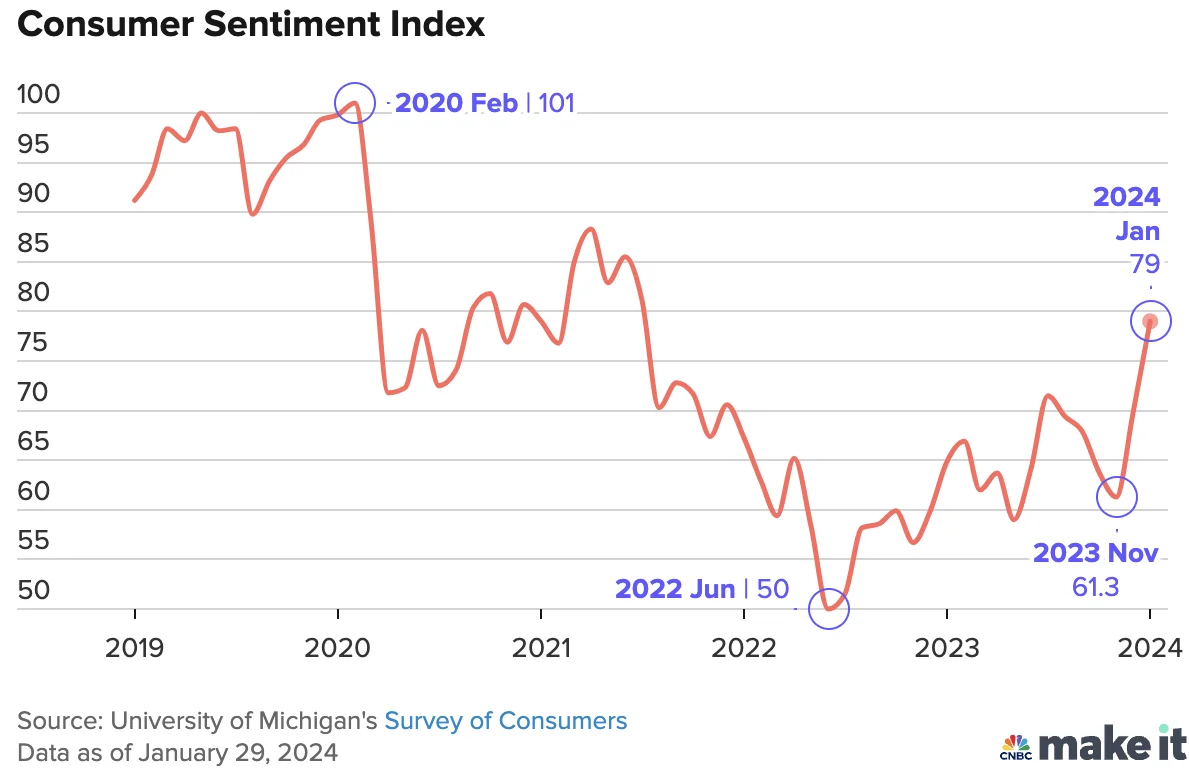
While small businesses have steadily maintained their footing, the American consumer has delivered a more dramatic psychological turnaround. Following years of pandemic-era disruptions, supply chain bottlenecks, and the historic inflation spikes of 2022 and 2023, household sentiment plummeted to historic lows. However, the opening months of 2024 have marked a dramatic departure from that gloom.
Chronology of the Sentiment Shift: A Five-Month Ascent

To understand the magnitude of the recent shift in consumer confidence, it is instructive to examine the timeline of economic sentiment markers leading up to the spring of 2024:
- Late Summer to Autumn 2023: Consumer sentiment hovered near depressed levels as persistent inflation and high interest rates weighed heavily on households. Markets remained deeply anxious about the likelihood of a Federal Reserve-induced recession.
- December 2023: Early signs of a sentiment reversal emerged as holiday retail sales outperformed conservative forecasts and inflation readings showed consistent month-over-month moderation.
- January 2024: Consumer confidence registered its highest level in five months, according to major index trackers. Households began to internalize the reality that the labor market remained robust despite higher borrowing costs.
- February 2024: Confidence metrics surged to a formidable two-year peak. This milestone signaled that the psychological barrier of post-pandemic inflation shock was finally beginning to break down among everyday shoppers.
- March 2024 and Beyond: Economists noted that consumers were not just feeling better about the macro economy; they were actively realigning their purchasing habits to reflect their renewed stability.
Drivers of the Rebound: Wages, Jobs, and Markets
Several converging macroeconomic factors have fueled this remarkable two-year peak in consumer confidence. Chief among them is the persistent strength of the labor market. Despite consistent predictions of a cooling job market, the U.S. economy has continued to add jobs at a steady clip, keeping the unemployment rate near historic lows. For workers, this labor market tightness has translated into sustained wage growth. Crucially, for many demographic groups, nominal wage increases have finally begun to outpace the rate of inflation, resulting in a restoration of real purchasing power.
At the same time, the rate of inflation has moderated significantly from its multi-decade peaks. While the cost of living remains elevated compared to pre-pandemic baselines, the sudden, shock-inducing price spikes that characterized 2022 have largely given way to a more predictable, gradual price environment. This predictability allows households to construct more reliable monthly budgets and plan for discretionary expenditures with greater peace of mind.
Compounding these foundational economic pillars is the remarkable recovery of the stock market. Major equity indices, including the S&P 500 and the Dow Jones Industrial Average, achieved historic milestones in early 2024, repeatedly shattering previous records. For affluent and middle-class households alike—many of whom hold retirement accounts, mutual funds, or direct equity investments—this portfolio appreciation has generated a powerful "wealth effect." The psychological boost of seeing retirement accounts recover and grow has counteracted lingering anxieties stemming from high mortgage rates and credit card debt.
The Evolution of Consumer Spending Habits
Despite the undeniable surge in confidence, consumer behavior has not simply reverted to the unrestrained spending patterns observed during the post-lockdown stimulus era. Comprehensive market research and consumer surveys—including recent insights compiled by McKinsey & Company—reveal that shoppers are undergoing a permanent evolution in how they evaluate value, utility, and necessity.
Rather than abandoning the marketplace, consumers are adopting a highly mindful, deliberate approach to their purchasing decisions. The days of indiscriminate spending are largely in the past. Instead, modern shoppers are engaging in deliberate trade-offs: pulling back on non-essential categories or premium brands while allocating capital toward experiences, health, wellness, and high-utility goods. This nuanced behavior indicates that consumers are celebrating their financial stabilization not through reckless consumption, but through strategic prioritization.
For retailers, consumer packaged goods (CPG) companies, and financial institutions, this behavioral shift demands a sophisticated response. Businesses can no longer rely solely on brand loyalty or broad-stroke marketing campaigns; they must demonstrate clear, undeniable value, transparency, and product differentiation to capture the attention of today’s discerning buyer.
Official Reactions and Expert Perspectives

As economic indicators continue to surprise consensus forecasts, economists, monetary policymakers, and industry executives have offered varying interpretations of these trends.
Federal Reserve officials, while acknowledging the positive momentum in consumer sentiment and labor markets, have maintained a stance of cautious vigilance. Central bankers have emphasized that while the trajectory of inflation is encouraging, policymakers require sustained evidence that price pressures are durably returning to the central bank’s stated 2% target before initiating any significant adjustments to benchmark interest rates. Consequently, statements from monetary authorities stress that premature optimism should not overshadow the ongoing necessity of prudent fiscal and monetary management.
Financial sector analysts have similarly weighed in on the intersection between small business health and consumer behavior. Commercial banking executives note that credit performance across SMB portfolios has remained remarkably stable, defying fears of a wave of defaults. Loan delinquency rates, while ticking slightly upward from historic lows, remain well within manageable historical parameters. This stability suggests that the underlying cash flow generation of Main Street businesses is fundamentally sound.
At the same time, retail and consumer sector analysts point out that the widening gap between different income cohorts remains a critical risk factor. While upper- and middle-income households—bolstered by stock market gains and home equity—are driving the recent surge in confidence, lower-income consumers continue to grapple with depleted savings buffers and the cumulative burden of high interest rates on revolving debt. This bifurcated reality complicates the broader narrative of universal economic recovery.
Broader Economic Implications and Future Outlook
The convergence of small business resilience and surging consumer confidence carries profound implications for the trajectory of the broader economy. If consumer confidence remains elevated, it serves as a self-fulfilling prophecy of sorts, encouraging households to continue spending, businesses to continue hiring and investing, and financial institutions to maintain healthy credit pipelines. This dynamic significantly diminishes the probability of an imminent economic contraction, moving the consensus baseline scenario firmly away from recession and toward a soft landing.
However, structural risks remain on the horizon. Geopolitical tensions, potential disruptions to global supply chains, and the path of future monetary policy decisions by the Federal Reserve all possess the capacity to alter sentiment rapidly. Furthermore, the persistent high cost of housing—driven by elevated mortgage rates and tight inventory—continues to act as a significant drag on consumer mobility and first-time homeownership aspirations.
Ultimately, the current economic landscape reflects a period of profound transition. Small businesses and consumers have successfully weathered the most volatile phases of the post-pandemic economic cycle. By recalibrating their strategies, embracing mindful financial habits, and capitalizing on steady labor market fundamentals, they have laid the groundwork for a more stable and sustainable economic expansion. As the year progresses, the resilience demonstrated by Main Street and the American household will undoubtedly remain the primary engine driving the nation’s economic future.