The General Data Protection Regulation (GDPR) has officially entered its eighth year of full implementation, marking a transformative period where privacy compliance has evolved from a secondary legal concern into a cornerstone of global corporate strategy. Since its enforcement began in May 2018, the regulation has fundamentally reshaped how organizations handle personal information, particularly for those operating within or catering to the European Union market. As of 2026, the landscape of data protection has reached a critical inflection point characterized by unprecedented enforcement levels, the integration of artificial intelligence (AI) regulations, and a shift in corporate perception regarding the value of data transparency.
The Escalation of Enforcement and Financial Accountability
The year 2026 has witnessed a dramatic surge in regulatory activity, signaling that the "grace period" for organizational adjustment is firmly in the past. While the total fines for the 2025 calendar year amounted to approximately 1.2 billion Euros, the first few months of 2026 alone have seen penalties exceed seven billion Euros. This exponential increase is not merely a result of more frequent audits but reflects the conclusion of multi-year investigations into major technology firms and systemic failures in data handling across the finance and healthcare sectors.
Data from European regulatory bodies indicate that the enforcement map is widening. Initially, high-profile cases focused almost exclusively on Silicon Valley giants such as Meta, Amazon, and TikTok. However, recent actions have targeted telecommunications providers, public sector entities, and mid-sized enterprises. This shift underscores a fundamental reality of the current regulatory environment: the size of the company no longer offers a shield against scrutiny.
Regulators have clarified that while the magnitude of fines is designed to be "effective, proportionate, and persuasive," they do recognize proactive efforts. Organizations that can demonstrate a "privacy-by-design" framework—evidenced by comprehensive documentation, regular audits, and a clear intent to protect user rights—often face mitigated penalties compared to those found guilty of systemic negligence or repeat offenses.
A Chronology of Data Protection Evolution
To understand the current state of GDPR in 2026, it is essential to trace the trajectory of data privacy laws over the last three decades. The journey began with the 1995 Data Protection Directive, a set of guidelines that lacked the enforcement teeth required for the burgeoning digital age. Recognizing the rise of the "surveillance economy" and the rampant collection of personal data without consent, the European Commission proposed a unified framework in 2012.
The GDPR was officially adopted in April 2016 and became enforceable on May 25, 2018. The subsequent years were marked by a series of landmark events:
- 2019-2021: The first wave of major fines, including a then-record 746 million Euro penalty against Amazon for non-compliant advertising practices.
- 2023: Meta was hit with a 1.2 billion Euro fine regarding cross-border data transfers to the United States, highlighting the fragility of international data flows.
- 2024-2025: The introduction and subsequent phased implementation of the EU AI Act, which created a new layer of complexity for data controllers.
- 2026: The European Data Protection Board (EDPB) launched a coordinated enforcement action specifically focusing on Articles 12–14, targeting transparency and the obligation to provide clear information to data subjects.
The Core Principles: Accountability as the Foundation
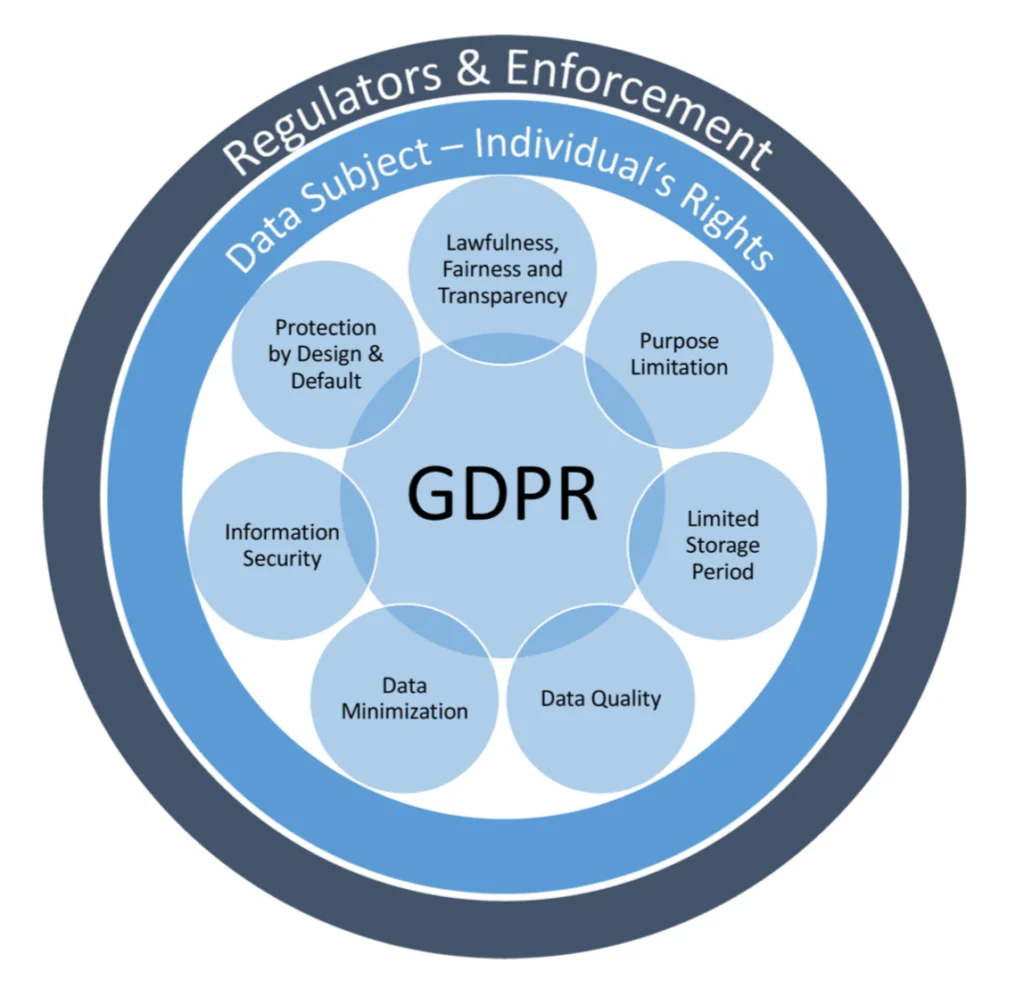
At its heart, the GDPR remains anchored in the philosophy that personal data is a human right, belonging to the individual rather than the entity that collects it. This philosophy is operationalized through several core principles that must govern every data processing decision:
- Lawfulness, Fairness, and Transparency: Processing must be based on a valid legal ground, and companies must be entirely open about how data is used.
- Purpose Limitation: Data collected for one reason cannot be used for another unrelated purpose without new consent.
- Data Minimization: Organizations should only collect the specific data necessary for the intended task.
- Accuracy: Companies are responsible for ensuring the data they hold is correct and up to date.
- Storage Limitation: Data must be deleted once it is no longer needed for its original purpose.
- Integrity and Confidentiality: This principle mandates robust security measures to prevent unauthorized access or accidental loss.
- Accountability: This is the most critical operational shift; the onus of proving compliance rests entirely on the organization.
In 2026, the definition of "personal data" has expanded to include AI-generated inferences. If an algorithm predicts a user’s health status, political leaning, or creditworthiness based on their behavior, that prediction itself is considered personal data and is subject to the same protections as a name or social security number.
The Intersection of GDPR and the EU AI Act
The most significant complication in 2026 is the convergence of GDPR with the EU AI Act. With the August 2026 deadline for high-risk AI systems approaching, businesses are finding that the two frameworks overlap significantly. High-risk systems—such as those used in recruitment, education, or law enforcement—must meet stringent transparency and accuracy standards that mirror GDPR’s core tenets.

A primary challenge lies in the "black box" nature of many Large Language Models (LLMs). Because many AI developers have not been fully transparent about the datasets used to train their models, downstream users (data controllers) often struggle to verify if the data was obtained with proper consent. The EDPB has noted that LLMs rarely meet the strict "anonymization" standards required to move outside the scope of GDPR. Consequently, any organization deploying a third-party AI tool that processes personal data is legally classified as a data controller, assuming full liability for any privacy breaches the AI might commit.
Strategic Advantage: Turning Compliance into ROI
While many executives historically viewed GDPR as a "check-box" burden, a paradigm shift is occurring in 2026. Forward-thinking companies are now treating data governance as a strategic infrastructure investment. The logic is simple: to comply with GDPR, an organization must have total visibility over its data. This visibility, once achieved, yields significant operational benefits.
According to the 2026 Thales Data Threat Report, only 34% of organizations currently possess complete knowledge of where their data is stored. For the remaining 66%, the lack of visibility represents both a compliance risk and a massive operational inefficiency. Fragmented and duplicated data slows down decision-making and increases storage costs. By contrast, organizations with a "clean house" can respond faster to market trends, provide better customer service, and detect security breaches within the mandatory 72-hour window with greater accuracy.
Furthermore, there is a growing "trust economy." Consumers in 2026 are more privacy-conscious than ever before. Demonstrating ethical data handling has become a competitive differentiator. Partners and clients are increasingly conducting "privacy due diligence" before signing contracts, favoring vendors who can prove their compliance through automated, auditable systems.
The Role of RegTech in 2026
The sheer volume of data generated in the mid-2020s has made manual compliance management impossible. In response, the Regulatory Technology (RegTech) sector has become an essential partner for modern enterprises. Modern RegTech solutions provide more than just digital checklists; they offer automated data mapping, real-time monitoring of data flows, and "one-click" responses to Data Subject Requests (DSRs).
A robust RegTech implementation in 2026 provides:
- Dynamic Data Inventory: An automated, real-time map of where data enters, resides, and exits the organization.
- Automated Impact Assessments: Streamlined Data Protection Impact Assessments (DPIAs) for new projects or AI deployments.
- Vendor Risk Management: Tools to monitor the compliance status of third-party processors.
- Scalable Governance: The ability to adapt to new regulations—such as the AI Act or evolving cross-border transfer rules—without rebuilding the entire infrastructure.
Implications and Future Outlook
As the EDPB shifts its focus toward transparency in the latter half of 2026, the message to the global business community is clear: "obscurity is not a strategy." Regulators are actively checking whether privacy notices are not only present but also understandable to the average user. The era of the 50-page, legalese-heavy privacy policy is being replaced by requirements for layered, machine-readable, and concise disclosures.
The long-term impact of GDPR enforcement is a more resilient and transparent digital economy. While the financial exposure of non-compliance is at an all-time high, the rewards for getting it right are equally significant. Companies that have used the regulation as a forcing function to modernize their data architecture are finding themselves more agile and better prepared for the AI-driven future.
Ultimately, the state of GDPR in 2026 proves that data protection is no longer a localized European issue but a global standard. As other jurisdictions—from California to Brazil and India—continue to model their laws after the GDPR, the infrastructure built for European compliance is becoming the baseline for global operations. The organizations thriving today are those that stopped asking how to avoid the regulation and started asking how to use it to build a more efficient, trustworthy business.