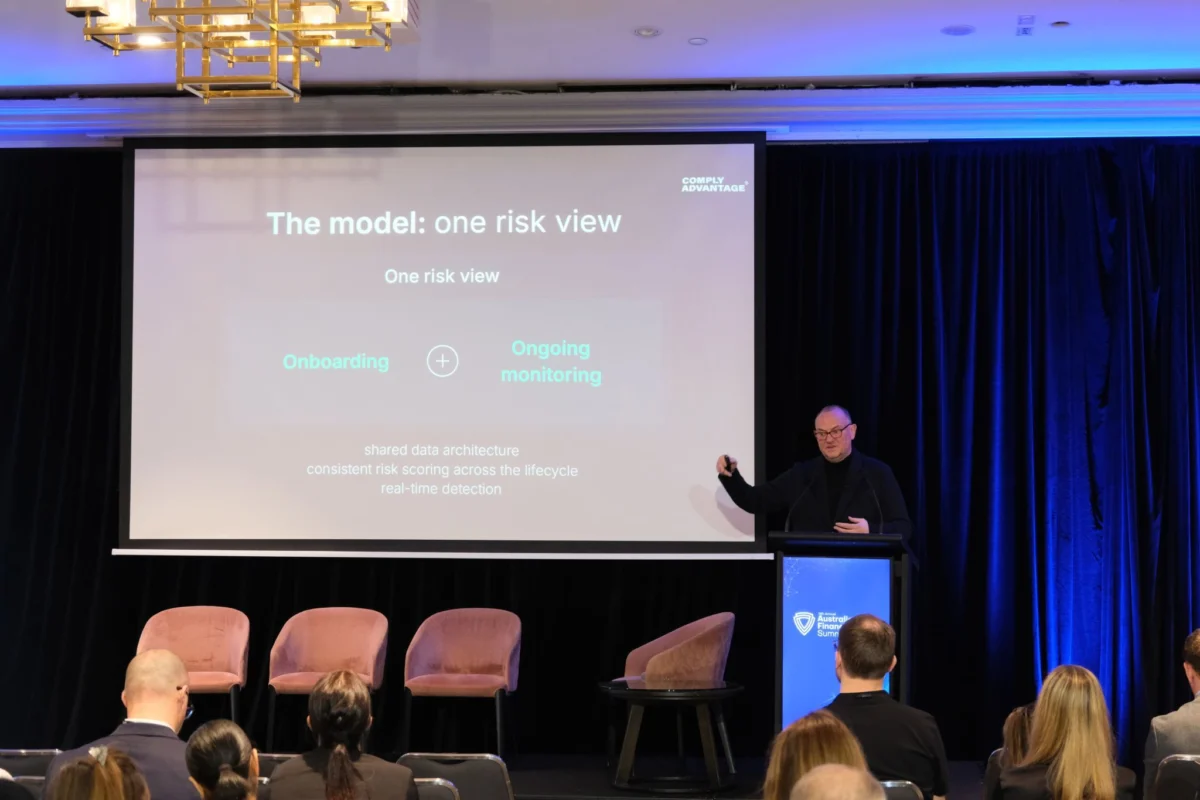
The regulatory landscape for financial institutions is undergoing a period of profound transformation, characterized by an uncompromising demand for demonstrated effectiveness in anti-financial crime efforts. As the Australian Financial Crime Summit (AFCS) convened in Sydney on September 1, 2026, the discourse among industry leaders underscored a critical reality: compliance teams are struggling to provide evidence of operational effectiveness because their onboarding and ongoing monitoring functions remain tethered to disparate, disconnected systems. For institutions operating under increasingly complex mandates, the inability to connect the dots between initial risk assessment and behavioral monitoring is no longer merely an operational nuisance; it is a significant regulatory and existential risk.
Andrew Davies, Global Head of Financial Crime Compliance (FCC) Strategy at ComplyAdvantage, articulated this challenge during the summit, arguing that the traditional, fragmented approach to compliance is fundamentally incompatible with a risk-based approach. When onboarding data is siloed away from transaction monitoring systems, the result is a fragmented customer view that leaves institutions vulnerable to sophisticated criminal actors.
The Australian Regulatory Context and the Escalating Threat Landscape
The urgency for this transition is underscored by the staggering financial impact of illicit activities in Australia. According to the National Anti-Scam Centre’s 2025 report, financial losses attributable to scams reached a record $2.18 billion, driven by over 274,000 individual reports. This figure represents more than a financial drain; it is a clear indicator that existing fraud detection and AML controls are failing to keep pace with the evolving tactics of organized crime.
The threat environment is further complicated by the emergence of high-tech methodologies, including the rapid proliferation of AI-enabled document fraud. As detailed in the AUSTRAC Money Laundering Update 2026, criminal networks are leveraging synthetic identities and deepfake technology to bypass traditional Know Your Customer (KYC) protocols.
This environment is colliding with a major regulatory shift. The implementation of Tranche 2 AML/CTF obligations, which took effect on July 1, 2026, has brought approximately 80,000 previously unregulated businesses into the compliance fold. These entities, ranging from real estate professionals to lawyers and accountants, are now subject to rigorous reporting standards. Furthermore, the horizon is marked by the March 31, 2027, deadline for the Scams Prevention Framework, which imposes strict detection and reporting obligations on banking, telecommunications, and digital platform providers. The framework mandates a holistic approach to customer oversight, leaving no room for the data silos that have historically hampered compliance effectiveness.
A Chronology of Compliance Evolution
The compliance industry has historically evolved through sequential, reactive stages. Initially, the focus was centered on basic sanctions screening. As regulatory pressure mounted, the industry expanded to include Anti-Money Laundering (AML) transaction monitoring. More recently, the industry attempted to reconcile these disciplines through "FRAML"—an effort to manage fraud and AML under a unified administrative umbrella.
However, as Davies emphasized at the AFCS, the "FRAML" paradigm is already proving insufficient. Financial crime is no longer a binary choice between fraud and money laundering. It is increasingly sophisticated and interconnected. Modern compliance must account for a broader spectrum of activity, including human trafficking, proliferation financing, bribery, and corruption.
The scope of the challenge is reflected in global statistics: the International Labour Organization (ILO) estimates that 50 million people are currently living in conditions of modern slavery. The proceeds from these activities are laundered through the same global payment networks that facilitate legitimate commerce. Furthermore, Global Financial Integrity research suggests that transnational crime generates between $1.6 trillion and $2.2 trillion in illicit proceeds annually. These networks operate like legitimate global supply chains, often moving illegal goods—such as precursor chemicals for the global fentanyl trade—across multiple jurisdictions. Because financial crime is fundamentally a network problem, regulators globally, including FinCEN in the United States, the Monetary Authority of Singapore (MAS), and the Financial Action Task Force (FATF), have signaled that detection must also evolve into a network-based exercise.
The Operational Gap: The Handoff Problem
The most significant operational vulnerability identified in current industry research is the "handoff" between customer acquisition and ongoing lifecycle management. Most organizations treat onboarding as a static, point-in-time event. They verify identity, perform a risk assessment, and calculate a risk score. However, this critical context—the "why" behind the risk score—rarely flows into the transaction monitoring systems that oversee the account’s daily activity.
According to ComplyAdvantage’s State of Financial Crime 2026 report, over 50% of compliance leaders currently operate across eight to ten separate, non-integrated systems. While 99% of these leaders acknowledge that an integrated interface is essential for efficacy, the practical implementation remains stalled by legacy technical debt. Every gap between these systems represents a point where customer risk profiles become stale, and anomalous behavior goes undetected.
The integrity of data is paramount. In a landscape of disparate systems, maintaining the veracity and continuity of risk signals is nearly impossible. Davies suggests that firms do not necessarily need to rip and replace their entire legacy architecture to solve this. Instead, the implementation of an "orchestration layer" can serve as a connective overlay. This layer acts as a unified interface that pulls data from underlying systems, synchronizing customer identity and risk signals across the entire lifecycle without requiring a complete infrastructure overhaul.
Measuring Effectiveness: A Three-Dimensional Framework
To satisfy both internal stakeholders and external regulators, compliance leaders must move toward a quantifiable measurement of effectiveness. This requires a transition from qualitative reporting—simply describing the number of suspicious matter reports (SMRs) filed—to a quantitative model centered on a single view of the customer.
Effectiveness can be measured across three primary dimensions:
- Risk Exposure and Quantification: By centralizing data, institutions can provide executives and regulators with an accurate, real-time assessment of their total financial crime risk. This allows for data-driven decisions on resource allocation and risk appetite.
- Operational Remediation: A unified system allows for the rapid identification and resolution of issues across screening, onboarding, and monitoring. When an investigation outcome is fed back into the initial screening protocol, the system effectively "learns" from the previous cycle, creating a continuous improvement loop.
- Business Value and Trust: Compliance is not an isolated function; it is a key component of the customer relationship. Customers in the modern digital economy expect safety and security as the baseline for their financial interactions. By effectively mitigating risk, firms reinforce the lifetime value of the customer relationship and bolster trust in the broader financial system.
The Future of the Compliance Vanguard
As the compliance profession moves into the latter half of the 2020s, the role of the compliance officer is shifting from a bureaucratic function to a strategic, protective role. They are, in effect, the "vanguard" of the financial system.
The integration of advanced technology—specifically machine learning and network analysis—is no longer an optional upgrade. It is a necessary response to the reality that criminals are already using these tools to exploit systemic weaknesses. The objective for the next 18 months, leading up to the 2027 Scams Prevention Framework deadlines, must be the elimination of the silos that have traditionally allowed illicit funds to transit through the global economy undetected.
Ultimately, the goal of achieving "effectiveness" is not merely to appease regulators, but to protect the most vulnerable segments of the population who are disproportionately targeted by financial scams and criminal networks. By leveraging data, technology, and sophisticated expertise to create a single, unified view of the customer, financial institutions can effectively dismantle the networks that rely on fragmented systems to survive. The message from the 2026 Australian Financial Crime Summit is clear: the era of the siloed compliance system is over, and the era of the integrated, network-aware defense has begun.