
Modern digital wealth management has fundamentally transformed how everyday investors approach asset allocation, risk management, and overall portfolio construction. While traditional financial advisory services long relied on manual interventions to optimize after-tax returns, automated investment platforms have democratized sophisticated wealth-building strategies. Among these, tax-loss harvesting (TLH) has emerged as a cornerstone of automated tax-efficiency. Financial technology firms have increasingly refined these algorithms to scan markets continuously, transforming routine market volatility into tangible tax savings for retail and high-net-worth investors alike.
Understanding the Mechanics of Tax-Loss Harvesting
At its core, tax-loss harvesting is an intentional strategy designed to lower an investor’s overall tax liability by systematically realizing capital losses to offset capital gains. In a traditional well-diversified portfolio, every asset class fulfills a precise mandate to maintain targeted market exposure. Consequently, liquidating a depreciated asset typically forces an investor to forfeit expected market returns unless a thoughtful replacement strategy is deployed.
To circumvent this dilemma, advanced tax-loss harvesting algorithms execute a precise substitution: when a security experiences a temporary price dip due to market fluctuations, the system sells the depreciated asset and immediately reinvests the proceeds into a correlated, yet distinct, replacement security. This dual-action mechanism allows investors to "harvest" a valuable tax loss while preserving their overarching asset allocation and continuous market participation.
Navigating the Complexities of the IRS Wash-Sale Rule
The primary operational hurdle in any tax-loss harvesting framework is strict adherence to the Internal Revenue Service (IRS) wash-sale rule. Established to prevent taxpayers from claiming artificial losses, the rule disallows a capital loss deduction if a "substantially identical" security is purchased within a 30-day window before or after the sale. Furthermore, the regulatory scope extends beyond a single taxable account, encompassing traditional individual retirement accounts (IRAs), Roth IRAs, employer-sponsored 401(k) plans, and accounts held by a spouse.

Unmanaged wash sales can severely undermine or entirely reverse the benefits of tax-loss harvesting. For instance, if an investor sells a depreciated asset in a taxable brokerage account and subsequently makes a routine payroll contribution to an employer-sponsored retirement plan that purchases the same or a substantially identical asset within the forbidden 30-day window, the realized loss can be permanently disallowed.
To mitigate these risks without keeping capital idle in cash—which chronically impairs long-term portfolio performance—sophisticated automated platforms deploy multi-tiered parallel security frameworks. By establishing primary, secondary, and tertiary tickers that track closely correlated market segments without violating IRS definitions of substantially identical assets, automated systems navigate complex cash-flow events, regular deposits, and dividend reinvestments.
Pitfalls of Manual Implementation and Legacy Strategies
Historically, manual or rudimentary algorithmic implementations of tax-loss harvesting suffered from severe structural limitations. Financial analysts have categorized these legacy approaches into three primary methodologies, each carrying distinct disadvantages:
- Delaying Reinvestment: Keeping harvest proceeds in cash for the full 30-day regulatory window eliminates market exposure, resulting in an opportunity cost that often eclipses the value of the harvested tax loss.
- Unplanned Reallocation: Shifting harvest proceeds entirely into unrelated asset classes distorts the investor’s target risk profile and frequently triggers cascading wash sales across other portfolio components.
- The 30-Day Switchback: A common manual practice involving the repurchase of the original security after the 30-day window expires. This method frequently triggers short-term capital gains (STCG) if the asset rebounds, creating negative tax arbitrage and potentially leaving the investor with a higher tax bill than if no harvesting had occurred.
Negative tax arbitrage represents a critical hazard in unsophisticated tax-loss harvesting. Because tax regulations require strict netting of like-against-like capital gains and losses—where long-term capital losses must first offset long-term capital gains before touching short-term gains—poorly timed switchbacks can inadvertently consume valuable long-term losses to shelter lightly taxed gains, exposing subsequent short-term gains to significantly higher marginal tax rates.
Automated Solutions and Parallel Position Management
To resolve the structural flaws inherent in legacy harvesting, modern robo-advisory platforms have engineered sophisticated automated ecosystems, such as Parallel Position Management (PPM) systems. These platforms utilize rigorous multi-factor screening processes—evaluating expense ratios, bid-ask spreads, tracking error against benchmarks, and asset covariance—to maintain optimized parallel securities within each asset class.
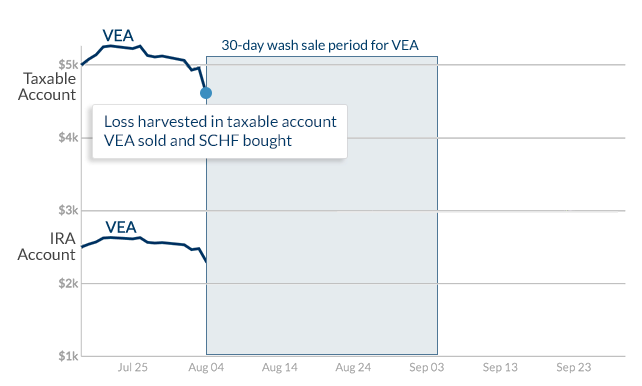
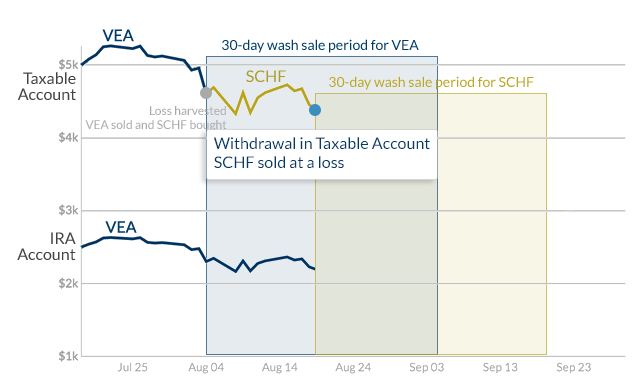
PPM architectures dynamically govern all portfolio transactions, including customer-initiated withdrawals, regular deposits, and automated rebalancing. When a withdrawal is processed, the system systematically prioritizes selling tax lots from alternate positions or long-term capital gain lots to minimize immediate tax liabilities. Conversely, incoming cash flows—such as new deposits or dividend reinvestments—are intelligently routed to underweight asset classes and primary securities, provided doing so does not trigger a wash sale.
Moreover, the integration of tertiary ticker systems provides a vital safeguard against permanent loss disallowance stemming from retirement account inflows. By maintaining a third, highly correlated asset specifically designated to absorb incoming retirement contributions during sensitive 30-day windows, automated platforms protect previously realized taxable losses without interrupting an investor’s long-term savings cadence.
Model Calibration and Quantitative Backtesting
Developing a resilient tax-loss harvesting engine requires extensive quantitative calibration to balance potential tax benefits against execution costs, trading fees, and tracking errors. Industry experts emphasize that relying exclusively on historical backtesting introduces severe data-snooping bias, as historical market conditions over a 10-to-20-year window cannot accurately predict macroeconomic environments across a 40-to-50-year investment horizon.
To overcome this limitation, quantitative researchers employ advanced Monte Carlo simulation frameworks. By deploying thousands of server instances to run tens of thousands of forward-looking economic scenarios, platforms calibrate their harvesting thresholds based on probabilistic models of future market volatility and expected returns. This empirical rigor ensures that the algorithm executes harvest events only when the net expected after-tax benefit reliably exceeds transaction and tracking friction.
Demographics and Investor Profiles: Who Benefits Most?
Financial professionals note that while tax-loss harvesting can provide incremental value to a broad spectrum of investors, its cumulative impact varies significantly based on individual financial profiles, tax brackets, and long-term liquidity plans. Empirical analyses highlight several distinct investor archetypes:
- High-Income Earners: Individuals in top marginal tax brackets residing in high-tax jurisdictions can utilize capital losses to offset up to $3,000 of ordinary income annually, yielding immediate cash-flow relief. Furthermore, utilizing losses to offset ordinary income taxed at high marginal rates while eventually paying lower long-term capital gains rates creates favorable positive tax arbitrage.
- Investors with Consistent Capital Gains: High-net-worth individuals who routinely realize capital gains from selling appreciated real estate or individual equities can instantly absorb harvested losses to neutralize their tax liabilities.
- Philanthropists: Investors who plan to donate highly appreciated securities to charitable organizations or pass wealth down to heirs via a step-up in basis can maximize the structural advantages of tax deferral, neutralizing the future tax liabilities generated by historical harvesting activities.
Conversely, investors with imminent liquidity needs, those anticipating substantially higher future tax brackets, or individuals maintaining fragmented portfolios across multiple external brokerages face heightened risks of adverse tax consequences. If an investor maintains overlapping asset holdings in uncoordinated external accounts, unexpected trade collisions can trigger unintended wash sales, neutralizing the automated platform’s optimization efforts.
Broader Implications for the Wealth Management Industry
The widespread adoption of automated tax-loss harvesting marks a definitive shift in the consumer financial services landscape. By embedding institutional-grade tax optimization into accessible retail accounts—typically delivered at no incremental advisory fee beyond standard platform management charges—fintech innovations have altered client expectations across the wealth management sector.
As regulatory environments evolve and computational capabilities expand, the integration of holistic tax-efficiency tools will likely remain a defining differentiator for digital asset management platforms. Industry analysts project that as machine learning models become more deeply integrated into portfolio administration, automated tax optimization will continue to evolve from an auxiliary feature into an indispensable component of comprehensive long-term financial planning.