The landscape of artificial intelligence development has shifted from a race of pure innovation to a high-stakes war of attrition, with more than $100 billion in capital poured into research-first AI startups—often referred to as "neolabs." Despite this massive influx of funding, the structural reality for these entities is increasingly grim. Founders, many of whom are former key researchers from industry titans like Google, OpenAI, and Anthropic, are discovering that producing cutting-edge models is no longer enough to secure independence. As these startups struggle to compete with the sheer compute capacity and distribution networks of the established giants, a singular entity has emerged as the ultimate beneficiary: Nvidia. By acting simultaneously as the primary supplier of infrastructure, a lead venture investor, and an eventual acquirer of talent, Nvidia has architected a business model that ensures it profits regardless of which individual startup succeeds or fails.
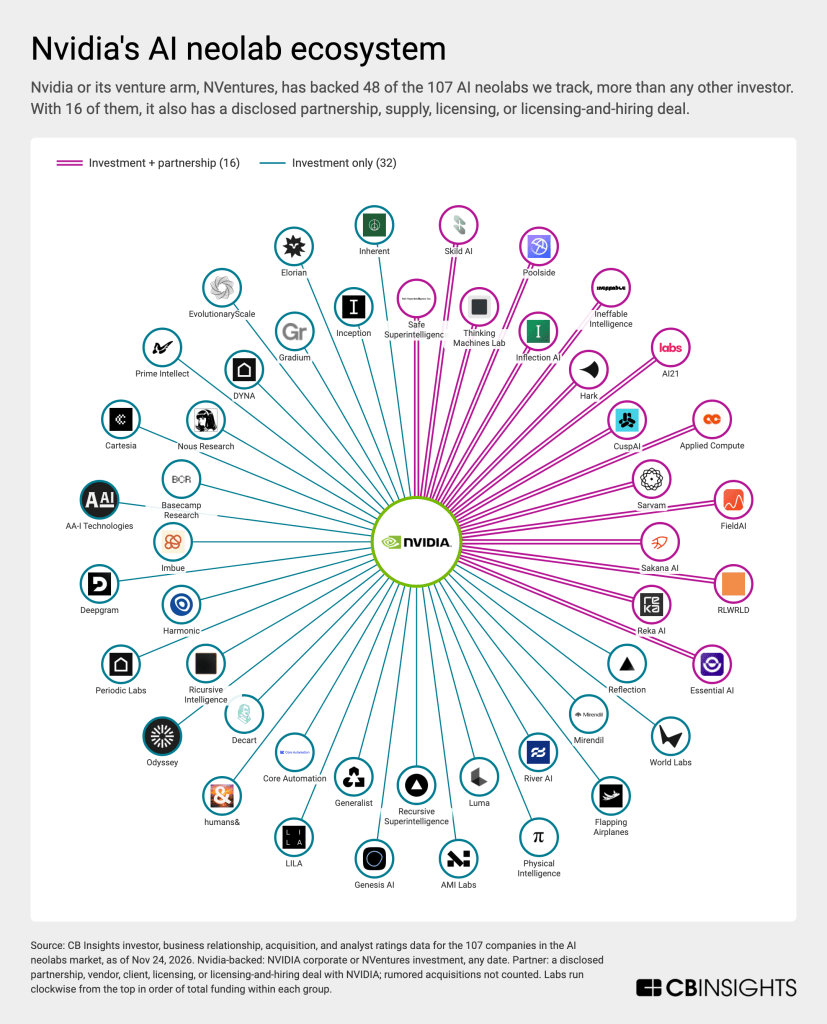
The current market architecture reveals that of the 107 prominent AI neolabs currently tracked by industry analysts, Nvidia maintains equity stakes in 48 of them. This represents a concentration of corporate influence that dwarfs other major players, such as Samsung, which holds stakes in 22. This strategy is not merely an investment portfolio; it is a defensive and offensive moat designed to capture the value flowing through the entire AI value chain.
The Structural Disadvantage of Neolabs
The fundamental challenge for the current generation of AI startups is the "scale-at-any-cost" paradigm. While neolabs like Poolside and AI21 Labs may develop proprietary architectures that match or occasionally outperform those of Big Tech, they face an insurmountable barrier to entry regarding infrastructure. The "big labs" (OpenAI, Google, Anthropic, and Microsoft) possess a symbiotic relationship between their compute resources and their distribution channels. They can iterate models at a speed and cost that smaller, venture-backed entities cannot replicate.
Analysts note that for most of these neolabs, the path to profitability is obscured by massive, recurring computing bills. These companies are effectively renting the future of their revenue streams to the companies providing the silicon. Consequently, the industry is witnessing a transition where the initial goal of building a sustainable, independent enterprise is being replaced by the goal of achieving a "soft landing"—a licensing deal or an acqui-hire.
The chronology of recent industry moves underscores this trend. In June 2026, Nvidia completed the acquisition of the core team from Essential AI, a portfolio company that had been part of its ecosystem since 2023. This move signaled a clear preference for integrating specialized talent directly into the Nvidia fold rather than allowing them to attempt a standalone product launch in an oversaturated market. Similar reports suggest that Reflection and Inception are also being positioned for potential acquisition, reflecting a pattern where the investor dictates the eventual exit strategy.
The Economics of Infrastructure Spending
The core of the issue lies in the front-loading of capital expenditures. Neolabs have raised over $100 billion, with the vast majority of these funds immediately recycled back into the semiconductor supply chain. For these companies, computing power is not just an expense; it is the primary product they must purchase to exist.
Data indicates that the median Nvidia-backed neolab has raised approximately $466.5 million, compared to roughly $150 million for their non-backed counterparts. This suggests that Nvidia is not merely betting on the success of these companies, but is actively funding their ability to consume Nvidia’s own products. For example, the $1 billion stake in Poolside, combined with a $6 billion non-exclusive license agreement, highlights a complex, multi-layered relationship. In this dynamic, Nvidia is simultaneously an investor, a service provider, and a competitor, as it develops its own low-cost coding models.
This "circular" funding model ensures that even if a startup fails to gain market share, the capital it raised is already accounted for in Nvidia’s quarterly revenue reports. The compute bills arrive long before the paying customers, ensuring that the hardware provider is the first to be paid in the hierarchy of AI business failures.
The Exception: Vertical Specialization
While the outlook for general-purpose model developers is increasingly skeptical, analysts have identified a "bright spot" in the sector: specialized AI neolabs. These companies focus on vertical-specific applications—such as robotics, scientific research, or industrial automation—where data is proprietary and cannot be easily accessed or scraped by general-purpose LLMs.
The success of companies like Applied Compute, FieldAI, and Skild AI provides a roadmap for sustainable growth. These companies derive their value from "real-world data moats." For instance, FieldAI has utilized robotic platforms to generate unique training data that is effectively impossible for competitors to replicate without the same physical infrastructure. This specific type of technical defensibility has caught the eye of the market.
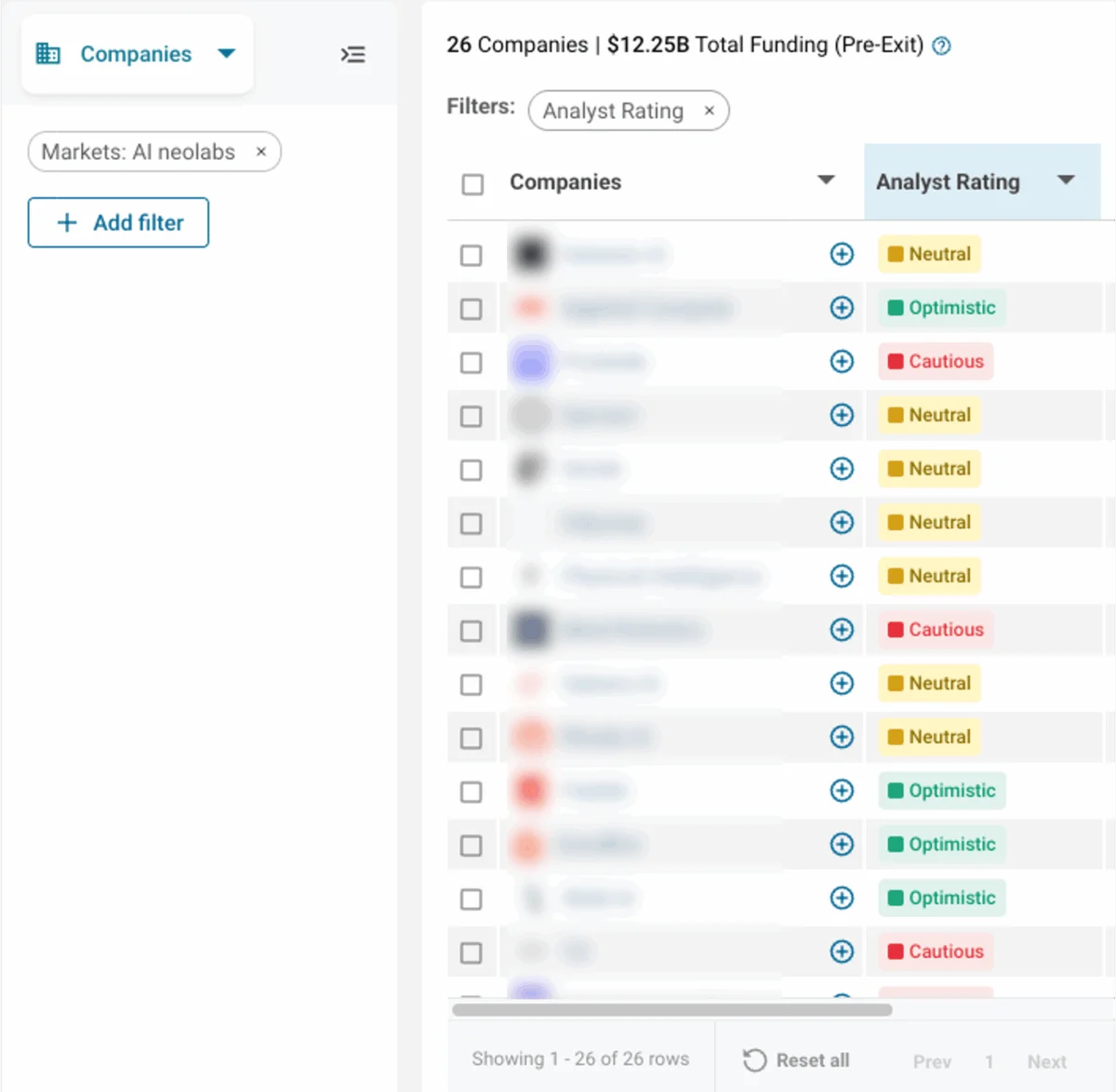
The recent $4.5 billion acquisition of Applied Compute by Palo Alto Networks serves as a landmark event. Having been rated as an "Optimistic" prospect by analysts just two weeks prior to the deal, the acquisition demonstrated that incumbents are eager to pay a premium for startups that solve specific, high-value technical problems rather than attempting to build a generalist "foundation" model. Investors like Denny Hua of Prysm Capital have emphasized that for robotics-focused AI firms, the compounding nature of their data provides a competitive barrier that is far more resilient than the algorithmic advantages of their peers.

Broader Market Implications
The concentration of Nvidia’s influence has prompted questions regarding the long-term health of the innovation ecosystem. While Nvidia’s presence provides the necessary runway for experimentation, it also creates a form of dependency that may stifle true disruption. If the majority of promising startups are destined to be absorbed by either the big labs or the primary hardware supplier, the market may eventually consolidate into a handful of oligopolistic entities.
Furthermore, the "acqui-hire" trend threatens to drain the labor market of independent research talent. When the most brilliant minds in the industry are immediately brought in-house by companies like Nvidia or Google, the diversity of thought and the number of independent, competing approaches to AI architecture diminish.
However, from an investor’s perspective, the current trajectory is undeniably profitable. The 1.4x step-up in valuation for the Applied Compute acquisition within a single month of NVentures’ investment highlights the short-term gains available in this market. The strategy of investing in the infrastructure providers, while simultaneously taking small, influential stakes in the downstream startups that consume that infrastructure, creates a hedging mechanism that is perhaps unique in the history of technology.
Looking Toward 2027
As the industry moves into the next fiscal cycle, the divide between "commodity AI" and "specialized AI" will likely widen. General-purpose labs will continue to face intense pressure from incumbents who can afford to train models at an infinite scale. For these startups, the only viable exit strategy will continue to be integration into larger corporate structures.
Conversely, companies that can prove their utility in industry-specific settings—such as chip manufacturing, cybersecurity, or autonomous logistics—will likely see sustained interest. The partnership between Skild AI, Nvidia, and Foxconn at a semiconductor manufacturing plant is a prime example of this model. By integrating AI directly into the industrial workflow, these startups provide immediate, tangible value that justifies their capital-intensive nature.
For investors and industry participants, the takeaway is clear: the era of speculative, generalist AI funding is closing. We are entering a phase of consolidation where technical utility, proprietary data access, and proximity to the hardware backbone are the only reliable indicators of long-term viability. Nvidia has effectively positioned itself at the nexus of this transformation, ensuring that whether the AI revolution succeeds through independent innovation or through the consolidation of the current cohort, the returns on the underlying infrastructure remain in their favor. The future of AI, at least for the next few years, appears less like a decentralized explosion of new software entities and more like a tightly controlled expansion of the existing hardware-software stack.