When Hyperliquid introduced HIP-4 in early May 2026, the initial focus in media headlines gravitated towards its headline-grabbing "zero-fee" prediction markets, positioning it as a direct competitor to established players like Polymarket. While the concept of a fee war might capture immediate attention, a deeper analysis reveals that the true significance of HIP-4 lies not in its pricing model, but in its fundamental structural divergences from its rivals. The underlying philosophies guiding market operation, creation, and, most critically, outcome resolution, represent a profound fork in the road for the burgeoning prediction market industry. This article, reflecting the state of HIP-4 as of late May 2026, delves into these architectural distinctions, exploring whether Hyperliquid’s new primitive is destined to be a "Polymarket killer" or a distinctly different product serving a unique niche within the rapidly expanding decentralized finance (DeFi) ecosystem.
The Expanding Horizon of Prediction Markets
Prediction markets, platforms where users can trade on the outcome of future events, have witnessed exponential growth and increasing mainstream recognition in recent years. Initially a niche within crypto, these markets have evolved to cover a vast array of topics, from cryptocurrency price movements and geopolitical events to macroeconomic indicators and entertainment outcomes. This expansion has attracted significant user engagement and capital, transforming them from speculative curiosities into influential tools for aggregating collective intelligence and expressing probabilistic beliefs. Alongside this growth, regulatory scrutiny has intensified, particularly in key jurisdictions like the United States, forcing platforms to navigate a complex legal landscape.
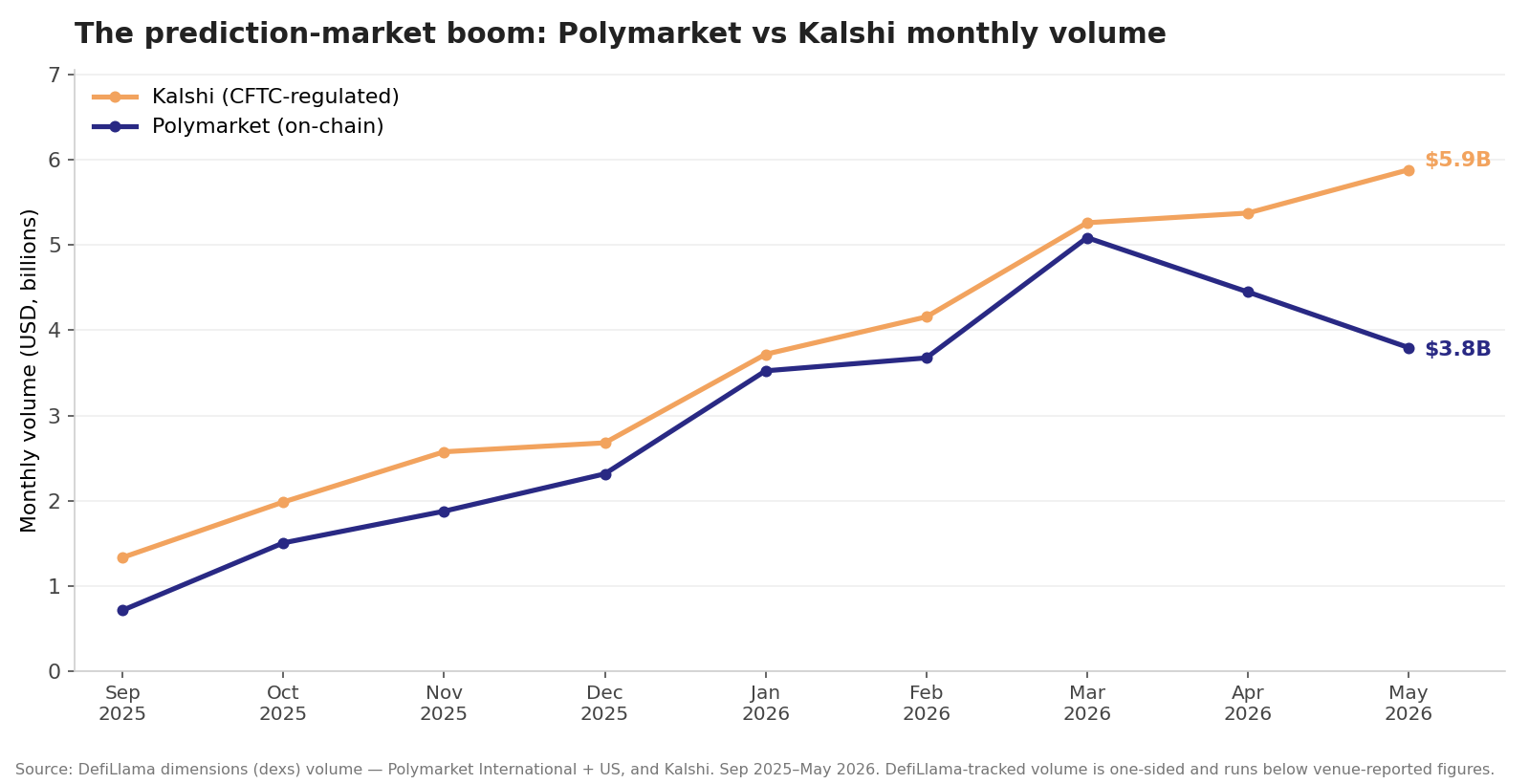
Polymarket, launched in 2020, stands as a testament to this growth, establishing itself as the incumbent and arguably the most prominent on-chain prediction market. Its success paved the way for other players, including CFTC-regulated entities like Kalshi, to enter the arena. The sector’s combined monthly trading volume soared into the billions of dollars by early 2026, indicating a robust and competitive environment ripe for innovation and disruption. It is into this dynamic landscape that Hyperliquid, an established player in decentralized perpetuals trading, has launched its own ambitious foray with HIP-4.
Hyperliquid’s Innovative Approach: Outcome Markets as a Core Primitive
HIP-4 introduces a novel instrument type to the Hyperliquid ecosystem: outcome markets. These are fully collateralized binary contracts, designed to settle within a fixed range, paying out based on a "Yes" or "No" resolution. For instance, buying a "Yes" contract at 0.60 means paying 0.60 units of the quote asset, with a payout of 1.00 if the event resolves true, and a loss if it resolves false. This payoff structure mirrors that employed by Polymarket for years, offering a familiar interface for participants.
However, the similarity largely ends at the surface. Crucially, HIP-4 is not a standalone application built atop Hyperliquid; it is a fundamental primitive integrated directly into HyperCore, the very base layer that powers the chain’s existing spot and perpetual markets. This deep integration means outcome contracts trade on the same on-chain central limit order book (CLOB), settle into the same collateral pool, and reside within the same user account as their perpetual futures positions. Hyperliquid frames this as adding "non-linearity, dated contracts, and an alternative form of derivative trading that does not involve leverage or liquidations" to its offerings. In essence, it transforms Hyperliquid into a comprehensive derivatives exchange that natively incorporates prediction markets, rather than a prediction market attempting to build its own infrastructure from scratch.
A notable design feature is the merged order book, which treats a buy order for "Yes" at price ‘p’ as functionally identical to a sell order for "No" at ‘1-p’. This mechanism efficiently pools liquidity, a critical factor for binary markets. While effective, this is not a unique innovation; Polymarket employs a similar approach, demonstrating a convergence of best practices within the industry.
The genesis of HIP-4 aligns with Hyperliquid’s broader strategy of fostering builder-deployed instruments, following the success of HIP-3, which launched in October 2025 and enabled external teams to deploy their own perpetual markets. HIP-4 extends this framework to event-based contracts. Initial markets, launched in early May 2026, focused on recurring daily Bitcoin price binaries, facilitated by builders such as Outcome (Outcomexyz) and the Stratium frontend. By late May 2026, Hyperliquid had expanded its scope to include macroeconomic events, such as US inflation prints and Federal Reserve decisions—precisely the territory where Polymarket and Kalshi have established their brands.
Polymarket: The Incumbent’s Evolving Strength
Polymarket, launched in 2020, has long been the dominant force in the on-chain prediction market space. Its journey has been marked by significant volume growth, with DefiLlama reporting monthly trading volumes climbing approximately sevenfold between late 2025 and early 2026, peaking near $5 billion in March 2026. Polymarket’s internal figures often report volumes double that, illustrating its substantial scale. While the CFTC-regulated Kalshi has matched and occasionally surpassed Polymarket in certain metrics, Polymarket remains a formidable player.
Architecturally, Polymarket operates as an application layer built on Polygon. Each market utilizes Gnosis Conditional Tokens, which represent outcome shares that become redeemable upon a known result, with all settlements occurring in USDC. Order matching is primarily handled off-chain via a central limit order book, with final settlement on-chain, providing a gasless user experience while ensuring fund security through smart contracts.

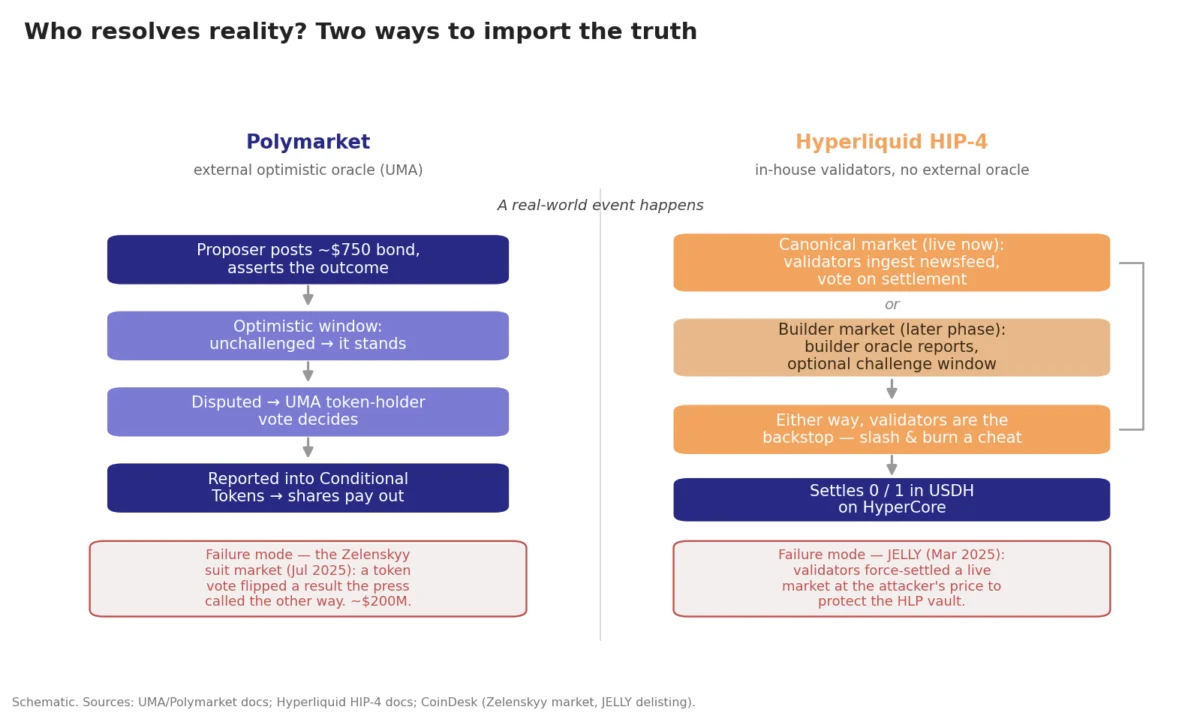
However, the most significant point of comparison, and indeed contention, lies in its outcome resolution mechanism. Polymarket deliberately externalizes the determination of truth to UMA’s optimistic oracle. This system resolves approximately 78% of Polymarket’s markets through an economic game: a proposer stakes a bond (around $750 USDC) to assert an outcome. If unchallenged within a specific window, the outcome stands, and the proposer earns a small reward. A dispute, however, escalates the question to a vote among UMA token holders, who are also bonded and incentivized to converge on the correct answer. The security of Polymarket’s resolutions thus hinges on the economic robustness of UMA’s external, token-weighted dispute market. This modular separation, as evidenced by the 2023 Polymarket key-compromise incident where resolution contracts remained secure despite a backend wallet breach, highlights UMA as a distinct, swappable component in the platform’s architecture.
The Core Battleground: Resolution Mechanisms and Trust Models
The primary philosophical and practical divergence between HIP-4 and Polymarket centers on their respective approaches to outcome resolution. This is not merely a technical detail; it embodies fundamentally different trust models and has profound implications for market integrity and user confidence.
Polymarket’s reliance on UMA’s optimistic oracle pushes the resolution process to an external, permissionless economic game. While this design promotes decentralization—anyone can propose, anyone can dispute—it is not without its vulnerabilities. Critics point to potential issues of latency, ambiguity, and even "capture" by large token holders. The July 2025 market on whether Ukrainian President Volodymyr Zelenskyy wore a suit at the NATO summit, with approximately $200 million at stake, served as a stark illustration. Despite mainstream media outlets like the BBC and The New York Times describing his attire as a suit, UMA’s oracle initially resolved the market as "Yes," only for a subsequent token-holder challenge to flip the outcome to "No." This incident ignited debate, with some arguing that voters were swayed by perceived majority sentiment or the influence of major holders rather than objective facts. This scenario underscores the failure mode of an open economic oracle: its honesty is intrinsically linked to the incentives and collective wisdom of its largest voters, and the path to resolution can be slow and contentious.
HIP-4, conversely, internalizes the referee function. For canonical markets—such as the daily Bitcoin binaries at launch and the macro markets that followed—the Hyperliquid validator set, comprising 24 nodes (expanding to 27), ingests external information via newsfeed software and votes on settlement. For permissionless markets deployed by external builders, the builder runs an authorized oracle updater that reports the result. An optional challenge window allows for disputes, with the validator set serving as a slashing backstop if a builder attempts to manipulate an outcome. In either configuration, there is no external oracle protocol. The truth is determined either by the chain’s block-producing validators or by a single bonded reporter subject to validator oversight and potential punishment. This closed loop design means the entity calling the truth is either the chain operator or a deployer accountable to them.
This in-house resolution model is not hypothetical, and Hyperliquid has a significant precedent. In March 2025, prior to HIP-4’s existence, the same validator set intervened in a live market. Following a short squeeze on the JELLY perpetual that exposed Hyperliquid’s HLP vault to an estimated $13.5 million loss, validators voted within minutes to delist the contract and force-settle all positions at $0.0095—the attacker’s entry price—rather than the market’s actual trading price of approximately $0.50. While users were later compensated by the Hyper Foundation, critics termed this a "validator put," highlighting that when the protocol’s own funds are at risk, the validators have demonstrated a willingness to override market prices. At the time, more than half of the validating stake was held by five Foundation nodes, raising questions about centralization and conflict of interest. This incident crystallizes the trust question for HIP-4: the body responsible for resolving a macroeconomic prediction has already shown it will intervene in market dynamics when its own financial interests are threatened.
Each approach represents a trade-off. Hyperliquid’s closed loop offers speed and removes the complexity of a separately governed external oracle. However, the claim of "no external oracle" warrants scrutiny; the validators still depend on external data feeds, simply integrating that dependency within their own set. The critical difference lies in the shape of the trusted group. A validator set of two dozen voting on sensitive economic data, or a single bonded builder reporting an outcome, constitutes a small, identifiable group of resolvers. Canonical markets offer no external appeals process, whereas UMA, despite its flaws, provides a mechanism for disputants to post a bond and force a wider vote. Polymarket’s referee is large and distributed, but vulnerable to token-weighted influence; Hyperliquid’s is fast and integrated, but potentially subject to the same party running the exchange and controlling the vault. It is a choice between two distinct failure modes.
Market Creation: Curated vs. Capital-Intensive
Both platforms exhibit more permissioned characteristics than their marketing often suggests, albeit in contrasting ways. On Polymarket, while the capital cost to propose a resolution (around $750 bond) is relatively low, the menu of available markets is curated by Polymarket itself. Users primarily act as price-takers on the selection of questions.
For HIP-4, initial markets are canonical, chosen and resolved by the validators, implying a gatekeeping function by the validator set. A later "permissionless" phase is planned, allowing outside builders to deploy their own outcome markets. This path, however, requires posting a substantial stake, reportedly around 1,000,000 HYPE tokens. With HYPE trading at approximately $65 per token in late May 2026, this translates to a bond near $65 million. While this functions as a reusable deployer slot rather than a per-market fee, such a significant capital barrier effectively restricts market creation to a handful of exceptionally well-capitalized teams. Thus, while Polymarket gates by editorial control, HIP-4 gates by validator selection in its initial phase and by substantial capital requirements in its future permissionless model.
Liquidity, Fees, and Settlement Dynamics
In terms of core mechanics, both platforms utilize central limit order books with the same merged "Yes/No" design. The crucial distinction lies in where order matching occurs. Polymarket employs a hybrid model, matching orders off-chain and settling them on-chain on Polygon, which provides a fast and gasless user experience. HIP-4, conversely, matches orders on-chain within HyperCore, allowing traders to hold event contracts alongside leveraged perpetuals against a single pool of collateral in the same margin account. This cross-margin proximity is HIP-4’s primary structural advantage, offering enhanced capital efficiency for active traders, particularly those looking to hedge crypto positions with macro event contracts.
However, Polymarket holds a significant advantage in established liquidity. Years of operation, a deep base of traders, and its reputation as the go-to platform during major elections or breaking news events have cultivated unparalleled market depth. A sophisticated matching engine, no matter how well-designed, cannot instantly replicate a liquid book. HIP-4, starting nearly from scratch, saw its flagship daily Bitcoin binary market attract around 4,000 traders on launch day, capturing approximately 0.7% of global prediction-market volume. While a commendable start for a new instrument, this figure pales in comparison to the billions cleared monthly by Polymarket and Kalshi.
The fee narrative, often highlighted in initial coverage, is perhaps the least durable difference. HIP-4 charges no protocol fee for opening positions during its initial testing phase, though builders can implement their own fees, potentially taking up to a 50% share. Polymarket has historically maintained near-zero trading fees. Both models are subject to change, rendering "zero fees" a promotional, rather than structural, moat.
A more subtle, yet persistent, difference lies in the settlement currency. Polymarket exclusively settles in USDC. HIP-4 markets, at launch, settled in USDH, Hyperliquid’s proprietary stablecoin. This requires traders to first swap USDC into USDH on the spot market to fund positions. This presents a transitional wrinkle, as USDH is actively being phased out following Coinbase’s designation as Hyperliquid’s official USDC treasury deployer in May 2026. The migration to USDC for quoting and settlement across the chain is ongoing, meaning HIP-4 launched utilizing a stablecoin that the ecosystem is actively retiring.
The Regulatory Divide: Onshore vs. Offshore
Perhaps the most impactful long-term distinction, particularly concerning market reach and institutional adoption, is the divergent regulatory postures of the two platforms. This factor cuts decidedly against Hyperliquid in the context of major regulated markets.
Polymarket has embarked on an expensive and deliberate strategy to re-enter the United States as a regulated entity. This multi-faceted approach included the acquisition of QCEX, a CFTC-licensed exchange and clearinghouse, for a reported $112 million. Subsequently, Polymarket secured an amended CFTC order allowing intermediated US access through brokers and futures commission merchants. Further solidifying its position, it received an investment of up to $2 billion from Intercontinental Exchange (ICE), the parent company of the New York Stock Exchange, at an impressive $8 billion valuation. Polymarket is consciously building a pathway to become a fully regulated US venue, backed by institutional infrastructure.
HIP-4, conversely, embodies an opposite posture: offshore, permissionless, and operating without Know Your Customer (KYC) requirements. Its event resolution is performed by a validator set that is not subject to regulatory oversight. While this approach might be less contentious for crypto-price outcomes, it directly challenges the territory where the CFTC has been most assertive: markets on US inflation, elections, and Federal Reserve decisions. The inherent tension here is profound: a product designed for maximum decentralization and permissionlessness may struggle significantly to attract regulated US capital flows, while the product embracing compliance, despite its overhead, may become the only legally viable option for US institutions. The forces of decentralization and broad market distribution are pulling in fundamentally different directions.
Broader Implications and Future Outlook
Hyperliquid’s HIP-4 is undeniably a well-engineered product. Its integration of outcome markets as a core exchange primitive, sharing a single margin account with perpetuals, and adopting an in-house resolution mechanism without an external oracle, represents a cleaner, more streamlined architecture compared to bolting a prediction market onto a general-purpose chain and outsourcing its truth-telling. From an engineering standpoint, Hyperliquid has a strong case.
However, the very elements Hyperliquid optimized away are those Polymarket deliberately maintains as features. Polymarket prioritizes the separation of the referee from the venue, accepting the trade-offs of latency and occasional, high-stakes disputes, as seen in the $200 million Zelenskyy market. Hyperliquid, by contrast, integrates the referee into the chain itself—either through validator votes for canonical markets or a single bonded builder for others—gaining speed and self-sufficiency at the cost of concentrating the authority to declare truth. Neither approach is unequivocally superior; they represent a fundamental divergence in how to construct a market that must import facts from the external world.
The "fee war" is likely to be ephemeral noise. The resolution question, however, will persist as the central defining characteristic. The choice between trusting an open economic dispute market (Polymarket/UMA) or the validators running the very chain you are trading on (Hyperliquid) forms the entire bet for users. Everything else, from order books to settlement assets, constitutes mere plumbing.
The implications for the prediction market landscape are significant. HIP-4’s structural advantage in cross-margin trading positions it well to attract Hyperliquid’s existing base of sophisticated crypto traders looking to hedge macroeconomic risks. This might be a different, potentially smaller, game than Polymarket’s broader appeal to a mainstream "bet on the news" audience. Furthermore, the stark difference in regulatory posture will likely segment the market, with HIP-4 potentially dominating the offshore, permissionless long tail, while Polymarket aims to capture the regulated core, especially within the lucrative US market. The ongoing evolution of both platforms will serve as a fascinating case study in the tension between technological innovation, decentralized ideals, and the realities of regulatory compliance in the rapidly maturing Web3 financial landscape.