On July 2, 2026, Robinhood, the prominent American financial services company, officially launched its public blockchain, Robinhood Chain, marking a significant strategic pivot for a firm still grappling with the legacy of its actions during the GameStop trading frenzy. The new Layer 2 network, built on Arbitrum’s Orbit stack, positions itself as "permissionless," a term that immediately draws a sharp contrast with the company’s infamous decision to restrict trading on several "meme stocks" in January 2021. This move, which saw Robinhood disable the "buy button" for GME, AMC, and other volatile assets, left a lasting impression on its user base and the broader market, raising questions about platform control and unilateral decision-making in financial markets.
The launch of Robinhood Chain, five and a half years after the GameStop controversy, introduces a complex duality: a technically robust, open-source blockchain infrastructure designed for broad participation, juxtaposed with a flagship product – tokenized stocks – that is inherently centralized, jurisdictionally restricted, and unavailable to Robinhood’s core American audience. The fundamental question surrounding this ambitious venture is not merely the efficacy of its underlying technology, which appears sound, but rather the implications of a company with Robinhood’s history operating rails it describes as open, and whether the openness of the chain truly extends to its most promoted asset. This report reflects the state of Robinhood Chain as of its mainnet launch, with architectural details confirmed by official materials and initial reporting, while early adoption metrics remain nascent and subject to real-time verification.
The Genesis of Robinhood Chain: From Controversy to Blockchain Innovation
To understand the context of Robinhood Chain, one must revisit the events of January 2021. During the peak of the GameStop short squeeze, retail investors, largely mobilized through online forums, pushed the prices of several heavily shorted stocks to unprecedented levels. In response, Robinhood and several other brokerages abruptly halted buying of these "meme stocks," citing unprecedented clearinghouse collateral requirements. While these requirements, which necessitate brokers to post collateral to cover potential losses from unsettled trades, were a genuine operational constraint amplified by extreme market volatility, Robinhood’s decision to allow selling but block buying was widely perceived as protecting institutional counterparties at the expense of its retail users. The incident led to a public outcry, congressional hearings featuring CEO Vlad Tenev, and a significant blow to Robinhood’s public image. The phrase "buy button" became shorthand for the power of a platform to arbitrarily dictate market access.
In the aftermath, Robinhood faced lawsuits, increased regulatory scrutiny, and a profound crisis of trust. This historical baggage informs much of the skepticism surrounding Robinhood Chain’s "permissionless" claims. The company has since sought to rebuild trust and diversify its offerings, including a significant push into cryptocurrency trading. The launch of its own blockchain can be seen as a strategic response, aiming to reclaim narrative control and leverage the transparency and immutability principles of blockchain technology, even if its implementation is nuanced.
Technical Architecture: A "Conservative, Sensible Design"
From a purely technical standpoint, Robinhood Chain has been described by crypto-native observers as "architecturally serious." It is an Ethereum Layer 2 solution built upon Arbitrum’s Orbit stack, a highly regarded framework known for its Nitro-based technology, which underpins numerous application-specific chains. This choice allows Robinhood Chain to benefit from the security and decentralization of Ethereum, as it settles transactions to the mainnet and utilizes Ethereum blobs for data availability. Gas fees on Robinhood Chain are paid in ETH, not a proprietary token, and the company has not announced plans for a native chain token, further reinforcing a conservative approach. The mainnet chain ID is 4663, with 46630 designated for its testnet.
The design prioritizes compatibility and developer familiarity. Standard Solidity and Vyper smart contracts can be deployed without modifications, and the chain supports ERC-4337 account abstraction, enabling features like gas sponsorship and batched transactions, which can significantly enhance user experience. Transaction sequencing operates on a first-come, first-served basis. Complementing the launch, comprehensive developer documentation and a Blockscout explorer went live, providing essential tools for ecosystem participants. Robinhood’s decision not to invent a novel virtual machine or consensus mechanism, instead opting for a battle-tested L2 stack, reflects a pragmatic approach focused on stability and rapid deployment.
Key Integrations and Ecosystem Partners
A notable aspect of Robinhood Chain’s launch is the depth and breadth of its day-one integrations, signaling a concerted effort to establish a robust ecosystem from the outset. This extensive roster includes leading players across various layers of the blockchain infrastructure and DeFi landscape:
- Infrastructure: Alchemy serves as the primary RPC provider, offering reliable access to the network. Arbitrum itself is a core partner, providing the underlying Orbit technology. Chainlink oracles deliver secure and decentralized data feeds, crucial for accurate pricing and smart contract execution. BitGo and Fireblocks, institutional-grade custody solutions, ensure secure asset management. LayerZero facilitates cross-chain communication, enhancing composability, and QuickNode provides additional node infrastructure.
- Trading / DEX: The chain supports several trading venues. Uniswap, a pioneer in decentralized exchange technology, hosts a dedicated Automated Market Maker (AMM) for public liquidity. Pleiades offers a proprietary AMM tailored for professional trading. Lighter, uniquely, provides an order-book based DEX for perpetual futures, addressing a different market segment. Furthermore, routing through aggregators like 1inch, Rialto, and Arcus is enabled for various stock-token venues.
- Lending: DeFi lending protocols are also integrated. Morpho powers Robinhood Earn, the platform’s on-chain lending product. Ecosystem partners such as Steakhouse, Ethena, Spark, and Maple contribute to a diverse lending environment. Robinhood’s ability to attract such a significant lineup of reputable partners underscores the strategic importance and potential reach of its new blockchain initiative, despite the lingering trust issues.
The Flagship Asset: Tokenized Stocks and Their Nuances
At the heart of Robinhood Chain’s value proposition are its tokenized stocks, designed to offer 24/7 exposure to popular equities like Nvidia, Apple, and Alphabet, with the added utility of being usable as collateral and tradable on-chain. However, the nature of these tokens demands careful scrutiny of the fine print.
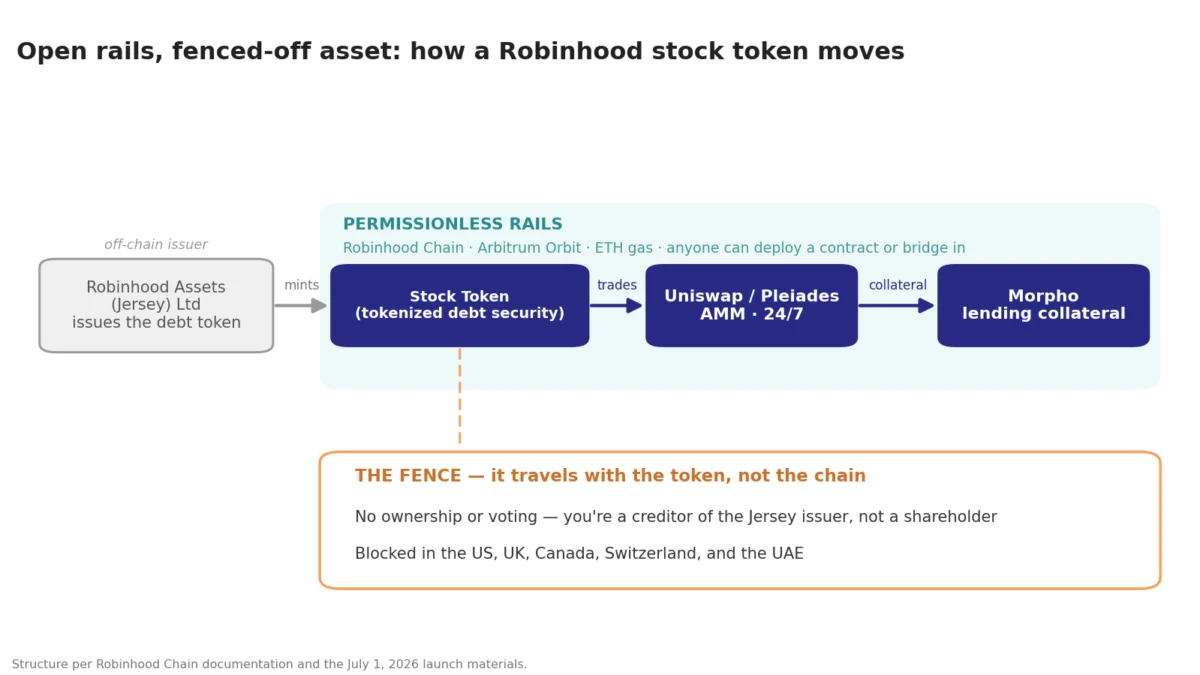
Crucially, these tokens are not actual shares. Instead, they are structured as tokenized debt securities issued by Robinhood Assets (Jersey) Limited, a subsidiary established in the Channel Islands. Holding one of these tokens grants price exposure to the underlying stock but confers no ownership rights, voting rights, or a direct claim on the issuing company. In essence, users hold a liability of a Robinhood entity that tracks the stock’s price. Redemption is currently facilitated for cash through authorized participants, with the option for redemption into the actual underlying securities described as a "future plan," not a present feature. Should the Jersey-based issuer fail, token holders would be creditors of that entity, not shareholders of the underlying public company. This structural model is not new; similar tokenized-equity efforts have faced public pushback, including instances where underlying companies like OpenAI in 2025 distanced themselves from unauthorized tokens claiming to represent their equity.
A comparative table highlights the stark differences:
| Feature | Robinhood Stock Token | The Actual Share |
|---|---|---|
| What it is | Tokenized debt security | Equity ownership |
| Counterparty | Robinhood Assets (Jersey) Limited | The company itself |
| Ownership / Voting | None | Yes |
| Claim if issuer fails | Creditor of the Jersey entity | Shareholder of the company |
| Redemption | Cash via authorized participants (underlying securities "planned") | Sell on the exchange |
| Who can hold | 120+ countries, not the US, UK, Canada, Switzerland, or UAE | Anyone with a broker |
| Trading | 24/7 on an AMM | Exchange hours, on an order book |
This is Robinhood’s second foray into tokenized equities. In June 2025, the company launched over 200 tokenized US stocks and ETFs for EU and EEA users, rebranded now as "Classic Stock Tokens" and confined to the Robinhood Europe app. The new Stock Tokens on Robinhood Chain represent a second generation, with the key differentiator being composability – the ability for these tokens to move freely within the broader DeFi ecosystem, rather than being siloed within a single application.
Jurisdictional Constraints and Global Ambitions
Despite the global reach implied by a public blockchain, the availability of Robinhood’s tokenized stocks is geographically constrained. They are accessible in over 120 countries but explicitly excluded from the United States, United Kingdom, Canada, Switzerland, the UAE, and sanctioned jurisdictions. The most significant exclusion is the United States, Robinhood’s primary market and where its largest user base resides. This restriction is largely a function of the current regulatory landscape; US securities law lacks a clear framework for retail-traded tokenized debt securities wrapped around equities, and Robinhood has evidently chosen not to pursue this complex regulatory battle at present.
The practical implication is that Robinhood’s core American retail audience cannot access the flagship product designed for its new blockchain. While eligible US users can participate in Robinhood Earn, an on-chain lending product, they are denied the tokenized equity component that forms the chain’s central use case. This creates a significant paradox: a "permissionless" blockchain whose marquee asset is subject to stringent jurisdictional gating, issued by an offshore subsidiary, and devoid of true ownership rights. The chain itself is open for anyone to deploy contracts or bridge ETH, but the very product justifying its existence operates behind a substantial fence. This dichotomy positions Robinhood’s stock tokens more towards the "represented" end of the "Distributed vs. Represented" RWA framework, highlighting mobility and composability without full decentralization of ownership.
Market Structure and Liquidity Challenges
Even assuming the tokenized stocks function as advertised, the chosen market structure presents potential challenges. For spot trading of stock tokens, Robinhood Chain relies on Automated Market Makers (AMMs), specifically Uniswap’s dedicated AMM and Pleiades, a proprietary AMM. While AMMs are highly effective for long-tail crypto assets, their suitability for highly liquid equities, which have historically relied on central limit order books (CLOBs) for price discovery, is debatable. Equities markets operate continuously during exchange hours, with a constantly updating reference price. An AMM for tokenized Nvidia, for instance, requires constant arbitrage to align its price with the real-world NVDA quote. Arbitrageurs extract value from liquidity providers (LPs), potentially leading to "impermanent loss" for LPs, especially in markets with thin liquidity and a rapidly moving external reference. This dynamic can deter LPs and further thin the books.
Robinhood’s awareness of these market dynamics is suggested by its choice of an order-book DEX, Lighter, for perpetual futures trading, where the CLOB model is generally preferred for its efficiency and deeper liquidity for derivatives. The decision to use an AMM for the more fundamental tokenized stock product represents a significant bet. The liquidity profile of these stock tokens in the coming weeks will be a critical metric to watch, and as of launch, reliable figures are unavailable.
The "Permissionless" Paradox: Trust, Centralization, and Incentives
The tension between Robinhood’s historical actions and its current "permissionless" branding is palpable. At launch, Robinhood Chain operates with a single sequencer, managed by or on behalf of Robinhood. While this is a common starting point for many new Arbitrum Orbit chains, with decentralization planned for later stages, it means that the entity that once controlled the "buy button" now controls transaction ordering on a chain whose core asset is issued by its own subsidiary. While the canonical bridge to Ethereum is trustless, and contracts are open for scrutiny, canonical withdrawals involve Ethereum’s roughly seven-day challenge period, requiring users to rely on third-party fast bridges for instant liquidity. For now, the sequencer, the asset issuer, and the primary application are all consolidated under Robinhood.
Further contributing to skepticism are recent corporate developments. In mid-June 2026, weeks before the blockchain launch, Robinhood announced layoffs impacting approximately 10% of its workforce, incurring restructuring charges of around $28 million. While management characterized these cuts as a move "from a position of business strength," the timing appears peculiar given the extensive execution demands of launching a blockchain, an issuer, wallet integrations, and a lending product simultaneously. Additionally, the initial bootstrap incentives – 90 days of covered gas fees for eligible wallet users and zero fees on Lighter perps during this window – while common for new platforms, can inflate early usage metrics, making it difficult to assess organic adoption once these subsidies expire. None of these factors are disqualifying in isolation, but collectively they provide reason to temper expectations regarding initial reported metrics.
Early Metrics and the Path to Adoption
As mainnet is mere hours old, confirmed on-chain data remains scarce. Current available metrics largely consist of testnet benchmarks, launch claims, and unverified figures circulating within the crypto community.
| Signal | Figure | Status |
|---|---|---|
| Testnet Activity | ~4M transactions in first week (Feb 2026) | Reported, testnet only |
| Latent Distribution | ~28M Robinhood users cited as onramp | Company-scale figure, not chain adoption |
| Gas Subsidy | 90 days of covered fees for wallet users | Confirmed by Robinhood |
| Lighter Incentives | ~$11M in LIT for perps liquidity | Ecosystem-project claim |
| Robinhood Earn Yield | ~7% APY lending USDG via Morpho, with Lloyd’s of London and RELM insurance on cyber/smart-contract exploits | Confirmed by Robinhood |
| $HOOD Reaction | Up ~2% pre-market on the announcement | Reported market move, not a chain metric |
| Mainnet TVL / Volume | Not yet meaningfully published | Unknown |
The most crucial data points, Mainnet Total Value Locked (TVL), transaction counts, and active addresses, have yet to be meaningfully published. While tracking tools are live and anecdotal reports of "volume heating up" exist, concrete, verifiable on-chain data is largely absent. The frequently cited figure of 28 million Robinhood users represents the company’s total user base, not direct chain adoption. Latent distribution only translates to adoption when users actively bridge assets and engage in transactions, a process complicated by the fact that most American users cannot access the flagship tokenized stock product.
The absence of a confirmed airdrop or governance token has not prevented the usual wave of "point-farming" guides and "mainnet streak" initiatives from circulating, alongside the inevitable launch of speculative memecoins. While headline integrations like Uniswap, Lighter, Morpho, Chainlink, and BitGo are indeed live, "live" does not equate to "liquid." A deployed AMM with minimal depth still faces significant challenges. Consequently, any early usage metrics must be viewed with considerable skepticism.
Strategic Positioning: Robinhood Chain vs. Base and the Broader L2 Landscape
Stripping away the launch fanfare, Robinhood Chain represents a significant strategic move by one of the world’s largest retail brokers to transition from renting on-chain rails to owning them. The most direct comparison is Coinbase’s Base, another Layer 2 launched by a major, regulated, US-listed consumer platform. However, their approaches differ significantly. Coinbase’s Base, built on the OP Stack and launched in 2023, is a general-purpose chain, allowing its ecosystem to organically determine what applications to build. Robinhood, by contrast, has opted for an Arbitrum-stack chain with a highly specific flagship use case – tokenized equities – integrated from day one. The long-term success of each approach will determine whether a purpose-built chain outperforms a general-purpose one in attracting users and developers.
Robinhood is also not the first to enter the on-chain equities space. The debt-security-wrapper model it employs has been utilized by other issuers, with varying degrees of success and recurring questions from the underlying companies about the authorization of such tokens. Robinhood Chain’s unique positioning lies in its direct integration with a massive retail brokerage user base and its strong roster of DeFi partners, despite the inherent limitations of its tokenized asset.
| Feature | Robinhood Chain | Coinbase’s Base |
|---|---|---|
| Stack | Arbitrum Orbit | OP Stack |
| Mainnet Launch | July 2026 | August 2023 |
| Design Focus | Purpose-built for tokenized equities | General-purpose |
| Operator | Robinhood (single sequencer, for now) | Coinbase (single sequencer) |
| US Access | Flagship stock tokens blocked | Fully available |
Implications for DeFi, Traditional Finance, and Regulation
The launch of Robinhood Chain carries significant implications across several sectors. For DeFi, it represents a major traditional finance player embracing decentralized infrastructure, potentially bringing a new wave of users and institutional capital, albeit with a centralized issuance model. The composability of its tokenized assets, even with their limitations, could foster innovation in lending, derivatives, and other protocols.
For traditional finance, it signals a continued blurring of lines between legacy systems and blockchain. While the tokenized debt security model avoids direct securities registration, its success could pressure regulators to develop clearer frameworks for on-chain equities. The 24/7 trading capability and fractional ownership potential could disrupt traditional market hours and accessibility, particularly in regions where traditional brokerage access is limited.
From a regulatory perspective, Robinhood Chain highlights the ongoing challenges of adapting existing securities laws to novel blockchain applications. The exclusion of US users from tokenized stocks underscores the need for regulatory clarity and potentially new legal instruments to facilitate broader on-chain equity adoption without the "debt security wrapper" workaround.
Conclusion: A Calculated Risk with Lingering Questions
Robinhood Chain is a calculated, strategic gamble by a company seeking to redefine its narrative and expand its reach into the burgeoning on-chain economy. The bull case rests on a technically sound, battle-tested stack, deep day-one integrations, the genuine promise of 24/7 tokenized equity access for non-US users, and the immense latent distribution potential of Robinhood’s user base.
However, the bear case is equally compelling: a flagship asset that is a synthetic debt security, fraught with counterparty and regulatory risks, unavailable in Robinhood’s home market, and reliant on an AMM trading model potentially ill-suited for equities. Furthermore, the "permissionless" chain is, for now, centrally operated by a company whose most infamous moment involved restricting market access.
For DeFi builders and users, the practical takeaway is pragmatic: the chain is open, and its tooling is standard, allowing for immediate deployment and bridging. Yet, what truly distinguishes Robinhood Chain from other Orbit chains is its tokenized stock product. It is precisely this product, with its offshore issuer, lack of ownership rights, hard jurisdictional walls, and untested on-chain liquidity, where the primary risks and uncertainties reside. The infrastructure is the straightforward part; the asset’s structure and its performance in the market are where the real numbers, and the ultimate success or failure of Robinhood Chain, will be determined in the weeks and months to come.