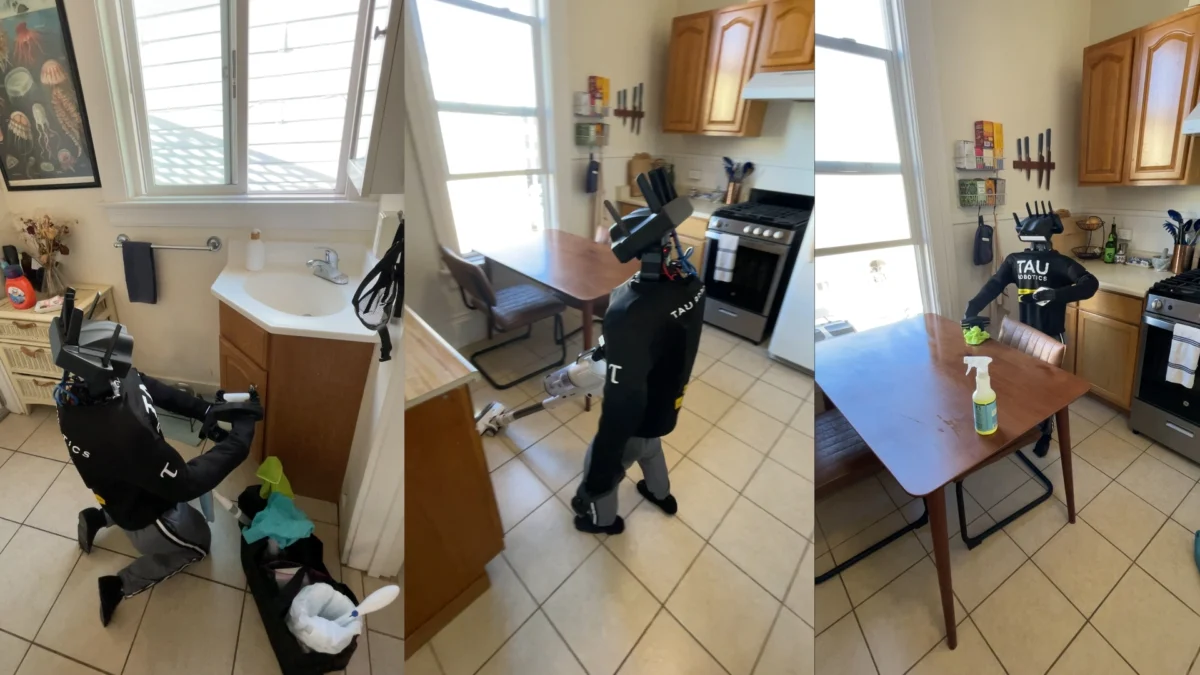
The intersection of robotics, artificial intelligence, and domestic labor has long captured the public imagination, historically relegated to the realm of science fiction and television animation like The Jetsons. Today, that futuristic vision is inching closer to reality in the hilly neighborhoods of San Francisco, California. Tau Robotics, an emerging startup operating in the heart of the tech sector, has begun dispatching bipedal humanoid robots into private residences to perform routine housekeeping chores. While these early-stage machines rely heavily on human intervention and remote supervision, their deployment marks a significant milestone in the commercialization of general-purpose robotics.
The initiative offers a fascinating window into the current state of embodied artificial intelligence. Rather than operating as fully autonomous entities, Tau Robotics’ machines function much like sophisticated telepresence platforms outfitted with actuation capabilities. As these robots vacuum, wipe counters, and fold laundry within residential spaces, they serve a dual purpose: providing a novel cleaning service while harvesting massive datasets. Every successful interaction—from navigating a cramped kitchen to reattaching a fallen cleaning wand—feeds machine-learning models designed to train the next generation of truly autonomous domestic assistants.
The Mechanics of Tele-Operation and Data Collection
At present, Tau Robotics employs a hybrid operational model that bridges the gap between remote human control and autonomous execution. Standing approximately four and a half feet tall, the humanoid units are equipped with 3D-printed heads featuring specialized antennae for maintaining high-bandwidth connections with company headquarters. Instead of delicate, highly articulated hands—which currently lack the long-term durability required for rigorous manual labor—the robots utilize robust 3D-printed claw-like end effectors. For flooring protection, the units are outfitted with grippy socks to prevent scuffing on delicate hardwood surfaces.
Despite their physical form factor, these machines are closer in operational architecture to advanced radio-controlled devices than to fully autonomous vehicles like Alphabet’s Waymo fleet. Complex household chores, such as making a bed or folding garments, require a technique known as kinematic guidance. During this process, a human operator at headquarters performs the necessary physical motions, and onboard sensors transmit those movement profiles directly to the robot, which replicates them in real time.
According to company representatives, tasks requiring kinematic guidance generate exceptionally valuable training data. While current artificial intelligence models have not yet mastered dynamic laundry folding or intricate obstacle navigation independently, learning from real-world demonstrations executed by tele-operated hardware provides the foundational data necessary to refine neural networks for future autonomy. Conversely, more generalized, highly repetitive operations—such as basic floor vacuuming and flat-surface mopping—can already be executed by the robots with minimal human intervention.
Pricing Structures and Consumer Economics
The business model underpinning Tau Robotics reflects the immense value of real-world operational data to AI developers. By utilizing customer apartments as living laboratories, the startup can subsidize the cost of the service far below traditional market rates for cutting-edge engineering prototypes. Early adopters have encountered varying pricing tiers, ranging from introductory promotional rates of thirty dollars per hour for a single unit to standardized packages charging sixty dollars weekly for dual-robot deployment or one hundred dollars for single visits.
Despite the relatively low cost of entry, consumer utility remains a subject of debate. The robots currently operate at a deliberate, methodical pace. Consequently, homeowners who choose to observe the entire cleaning cycle often find that the time spent supervising the machine could have been more efficiently utilized performing the chores independently. Furthermore, the operational limitations of beta-stage technology frequently manifest as minor mishaps: dripping faucets, displaced household items, and occasional navigation stalls due to hardware overheating or environmental conditions.
Nevertheless, early customer reception has been largely favorable, driven largely by the novelty and perceived charm of the machinery. Observers note a psychological parallel to the early days of commercial robot taxis, where riders experienced a mix of apprehension and affection toward automated vehicles navigating public streets.
Chronology of a Residential Deployment
The deployment of a cleaning robot into a standard urban apartment involves a carefully orchestrated logistical sequence. Typically arriving via transport vehicles accompanied by company personnel, the bipedal units immediately encounter real-world architectural hurdles that laboratory testing environments rarely replicate fully.
Upon arrival at residential buildings, the robots must navigate exterior and interior stairwells. During early trials, these transitions frequently highlighted the challenges of remote operation. Latency in signal transmission between headquarters and the physical hardware can introduce subtle coordination delays, causing the robot to exhibit an unsteady, staggered gait when climbing stairs. While balance algorithms successfully prevent catastrophic falls, the physical ascent often resembles an uncoordinated stumble rather than fluid motion.
Inside the residence, environmental factors—ranging from unseasonably high ambient temperatures that strain remote monitoring equipment to narrow, carpeted hallways—can temporarily halt operations. In previous iterations of the service, company engineers remained physically present throughout the entire visit to manage troubleshooting. As connectivity and reliability have improved, onsite oversight has decreased, though remote operators maintain constant vigilance through cameras mounted within the robot’s head and wrists.
Once situated within a kitchen or bathroom, the machines demonstrate surprising dexterity. In documented residential cleanings, the units successfully sanitized surfaces and tackled difficult tasks such as toilet maintenance. Instances where cleaning wands detached and were subsequently reattached through iterative trial-and-error maneuvering illustrate the adaptability afforded by continuous remote adjustments.
Industry Implications and Labor Market Considerations
The expansion of domestic robotics companies like Tau Robotics into residential cleaning raises broader economic and social questions regarding the future of work. The commercial cleaning sector is characterized by high turnover rates, physically demanding labor, and elevated risks of occupational injury. Industry advocates argue that introducing robotic automation into these environments could alleviate labor shortages in fields where recruitment remains consistently difficult. Furthermore, proponents suggest that foundational robotics technology developed for apartment cleaning could eventually be adapted for hazardous or physically challenging vocations, including mold remediation, industrial maintenance, and home health care.
Conversely, labor economists and policymakers express concern over the potential displacement of low-wage service workers. As artificial intelligence and robotics companies refine their models to achieve full autonomy, the economic pressures traditionally absorbed by human domestic workers could shift toward automated systems. Critics point out that current social safety nets and regulatory frameworks in the United States are insufficiently prepared to address structural unemployment resulting from rapid advancements in artificial intelligence and physical automation.
Data privacy also emerges as a central consideration. Because residential cleaning robots rely on cameras and sensor suites to map living spaces and transmit video feeds to remote operators, homeowners effectively trade personal privacy within their private quarters in exchange for discounted labor and the novelty of technological participation. Companies operating in this space must navigate complex regulatory environments concerning consumer data collection, video retention, and domestic surveillance.
Future Outlook for Domestic Automation
Tau Robotics remains in the early phases of its developmental roadmap. Company leadership acknowledges that the volume of data required to train neural networks to handle the infinite variability of domestic environments is immense. Having completed only a few hundred residential visits to date, the startup represents a fraction of the scale required for mainstream commercial viability.
Yet, the mere existence of bipedal humanoid robots capable of traversing private residences, mopping floors, and scrubbing facilities marks a tangible step forward in applied robotics. As engineering teams continue to optimize signal latency, hardware durability, and machine learning architectures, the boundary between speculative fiction and domestic reality continues to narrow. Whether these machines transition from experimental novelties to ubiquitous household appliances will depend not only on technological breakthroughs in autonomy and cost reduction, but also on society’s willingness to integrate embodied artificial intelligence into the private spaces of everyday life.