
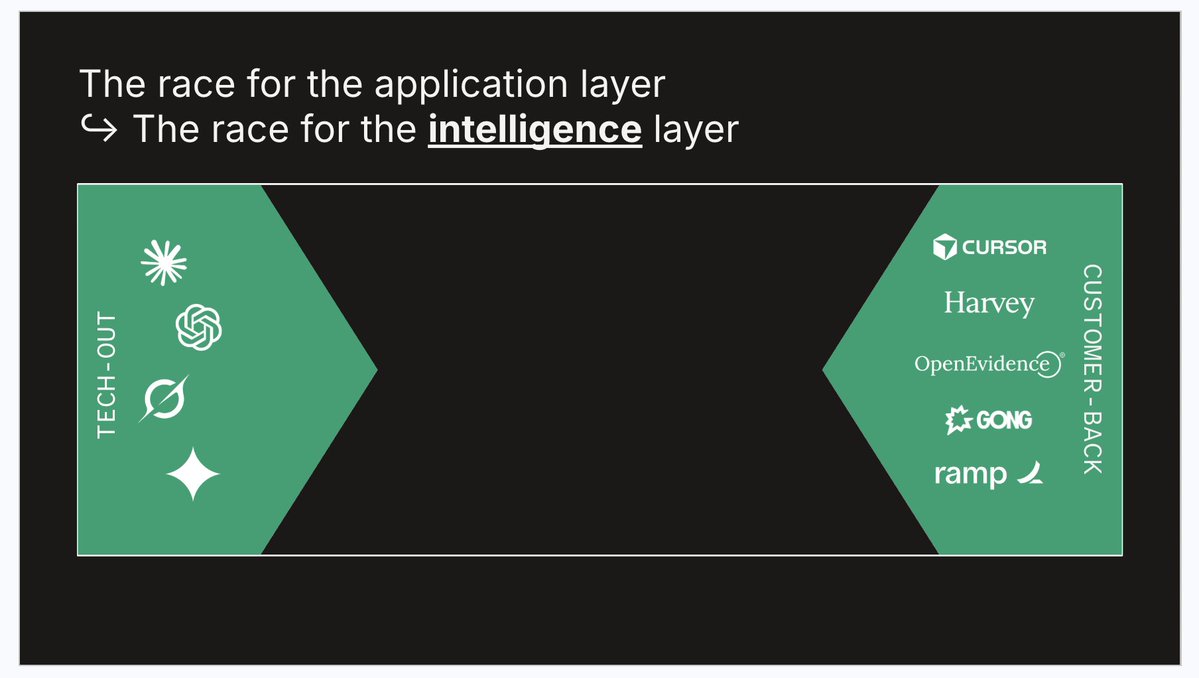
Published August 19, 2026, the ongoing maturation of artificial intelligence has transitioned from a race driven primarily by user interfaces, workflow integrations, and go-to-market strategies into an intense foundational battle for the intelligence layer itself. Industry leaders are increasingly warning that relying entirely on external frontier labs creates structural dependencies, prompting a growing segment of the enterprise market to vertically integrate and take control of their own AI models.
This strategic pivot was crystallized recently when Palantir CEO Alex Karp urged enterprises to "own the means of production," a sentiment echoed shortly after by Microsoft CEO Satya Nadella. Nadella cautioned that purchasing intelligence directly from a frontier lab amounts to a double payment: one rendered in capital, and the other in the proprietary operational knowledge surrendered to make that intelligence useful to the business.

The central question now facing corporate boards and technology executives is determining who should ultimately own the intelligence at the core of their operations. While renting capacity via frontier application programming interfaces (APIs) remains a viable and frequently optimal choice for broad, generalized workloads, a significant shift is underway. Across venture portfolios and enterprise ecosystems, organizations are increasingly building custom AI capabilities for core product segments, actively shaping and owning their model weights.
The Catalyst: An Accelerated Open-Weight Ecosystem and Mature Post-Training Stack
To examine this shifting paradigm, venture capital firm Sequoia recently convened a gathering of prominent AI founders and technical builders for an exclusive summit dedicated to owning the AI stack. The event featured a comprehensive overview of customer perspectives from legal tech firm Harvey, alongside deep technical dives into the post-training stack from industry players such as Mercor, LangChain, Trajectory, and Fireworks.
Discussions at the summit highlighted two primary technological catalysts driving this movement: the rapid advancement of open-weight models and the stabilization of the independent post-training ecosystem.

Historically, attempting to train or fine-tune models on open-weight bases was viewed as a Sisyphean treadmill. Enterprises would invest months of engineering effort into fine-tuning a model, only for a subsequent frontier release from an external lab to instantly render their gains obsolete. However, by mid-2026, baseline open models have evolved dramatically. Advanced offerings such as Kimi K3 and GLM 5.2 have narrowed the performance gap, providing open baselines that sit remarkably close to closed frontier models.
Concurrently, the independent post-training stack has achieved commercial and technical maturity. Companies now have turnkey access to the end-to-end technological infrastructure previously exclusive to elite research labs, encompassing data pipelines, synthetic data generation, rigorous evaluation frameworks, and high-performance inference engines. Supported by advanced harness engineering and online learning loops, domain-specific open models are now frequently outperforming general-purpose frontier models within targeted verticals.
Consequently, what was once viewed as a performance compromise a year ago has swiftly morphed into an existential and strategic imperative.
Strategic Drivers: Cost, Speed, Proprietary Data, and Destiny Control
Adopting a sovereign AI strategy is far from a one-size-fits-all mandate. Enterprises are weighing the decision to build versus rent based on four critical operational vectors:
- Cost and Margin Protection: As AI products scale, inference costs scale linearly with user adoption. For high-volume applications, rising AI Cost of Goods Sold (COGS) can severely compress margins, making model ownership a vital financial defense mechanism.
- Latency and Specialized Speed: In time-sensitive domains such as automated code completion or real-time cybersecurity threat detection, smaller, highly distilled custom models routinely outperform massive general-purpose models where latency can bottleneck user experience.
- Data Sovereignty: For industries managing sensitive intellectual property, stringent regulatory data, or proprietary user feedback loops, keeping telemetry and evaluation data strictly within organizational boundaries is a strict requirement.
- Controlling Corporate Destiny: As application-layer companies and foundational labs increasingly encroach upon each other’s territories, owning the product lifecycle requires controlling the learning loops that dictate how software reasons and adapts. Leaders across Harvey Research, RampLabs, Glean, and Factory emphasize that mastering the underlying intelligence is becoming synonymous with mastering the product itself.
The Implementation Playbook: From Zero to One
For organizations choosing to claim ownership of their AI stack, industry experts recommend a disciplined, methodical roadmap spanning team composition, technical execution, and continuous optimization.
Building specialized, high-performing internal teams is the foundational first step. Rather than delegating AI initiatives to bloated platform engineering organizations, successful companies are deploying lean, agile "de novo" teams. For instance, legal AI leader Harvey successfully conducted cutting-edge domain research with a core team of just seven specialists, collaborating strategically with ecosystem partners. Furthermore, organizations are increasingly publishing their technical research and benchmarks to establish market credibility and attract top-tier engineering talent.

The technical execution of sovereign intelligence relies on a four-tier architecture:
- Rigorous Evaluations (Evals): As Harvey’s Gabe Pereyra noted during the summit, "If you don’t have a good benchmark, you can’t train models." Establishing repeatable, task-based rubrics—such as Harvey’s Legal Agent Benchmark, which evaluates over 1,200 distinct agent tasks across 24 practice areas—allows teams to make objective, data-driven decisions regarding model selection.
- Harness and Context Engineering: The harness manages the operational product logic surrounding the core model, including routing, tool execution, retrieval-augmented generation (RAG), and memory management. As LangChain’s Harrison Chase emphasized, the primary function of a robust harness is to deliver the correct contextual data to the model precisely when needed, ensuring transparency and inspectability across complex agent workflows.
- Strategic Post-Training: Organizations must select the lightest intervention necessary to achieve desired performance gains. Lin Qiao outlines a clear hierarchy: missing facts can be addressed via standard RAG; formatting or behavioral issues require supervised fine-tuning; product taste and alignment dictate preference tuning; specialized task mastery demands reinforcement learning (RL); and cost-reduction or latency bottlenecks require distillation.
- Production Online Learning: Models deployed into enterprise environments frequently suffer from a lack of operational context—akin to placing a brilliant mathematician into an accounting firm on their first day without historical records. By capturing interaction trajectories (user prompts, tool calls, model outputs, and manual corrections) using tracing infrastructure like LangChain’s LangSmith, companies can convert production failures into immediate evaluation benchmarks and continuous learning loops.
Implications and Future Outlook
The choice to build sovereign AI infrastructure introduces a distinct operational trade-off. Relying exclusively on closed, out-of-the-box frontier models provides a high operational floor with minimal friction, but ultimately caps long-term product differentiation. Conversely, owning the stack introduces a lower initial floor requiring significant engineering overhead, but shatters performance ceilings by embedding domain-specific intelligence directly into the product core.
Ultimately, market analysts observe that the future of enterprise technology will not be a zero-sum game dominated exclusively by mega-labs or isolated startups. While massive foundational labs will continue developing general-purpose frontier brains, the most competitive product companies are cultivating nimble, specialized models deeply tuned to their operational verticals. In this emerging ecosystem, decentralized ownership of intelligence promises to drive unprecedented levels of industry innovation and differentiation.