
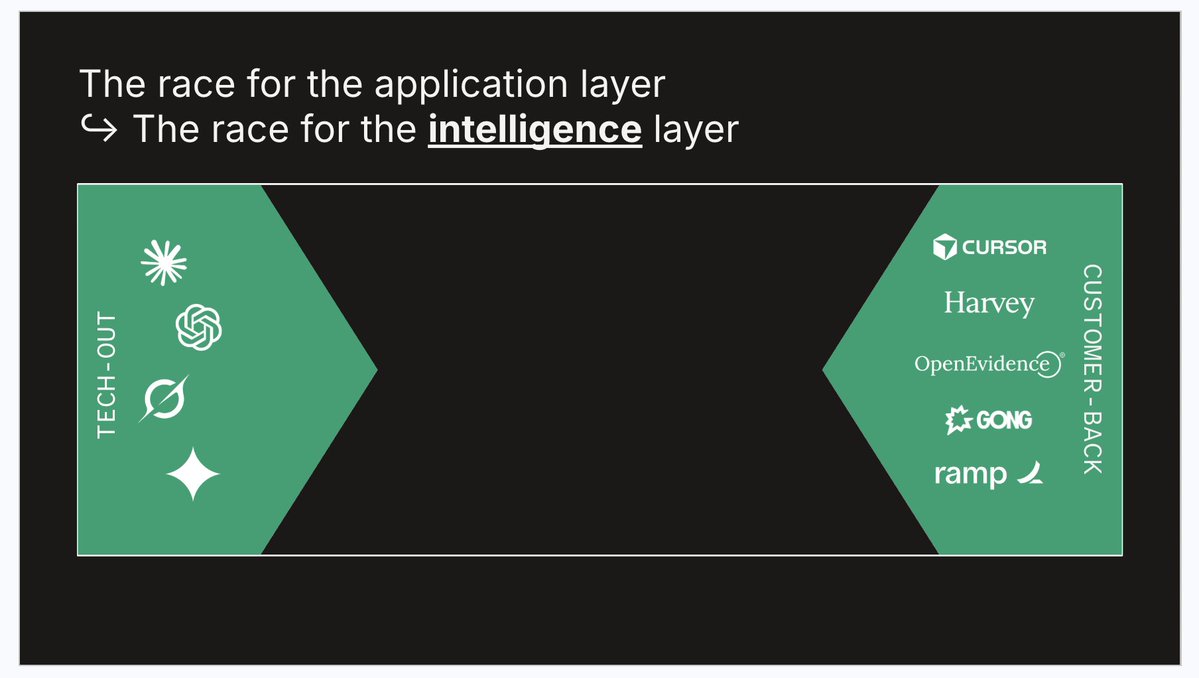
Published August 19, 2026, the modern artificial intelligence landscape is witnessing a structural migration. The historic debate over the AI application layer—traditionally centered on user interfaces, workflow optimization, and go-to-market execution—has expanded into a fundamental battle for control over the intelligence layer itself. For years, the prevailing enterprise playbook relied on renting cognitive capabilities from frontier lab APIs. Today, however, industry leaders, venture capital firms, and fast-growing technology startups are re-evaluating that dependency, sparking a broad corporate movement toward internal ownership of custom AI models and post-training infrastructure.
The momentum behind this shift has accelerated following high-profile warnings from prominent industry figures. Palantir CEO Alex Karp recently issued a call for enterprises to "own the means of production," challenging the long-term viability of outsourcing core cognitive assets. Shortly thereafter, Microsoft CEO Satya Nadella cautioned that purchasing intelligence directly from a frontier lab carries a hidden toll: paying once with capital and a second time with the proprietary knowledge and operational data exposed to make that intelligence functional. These declarations have forced executive boards to confront a critical strategic question: Who should truly own the intelligence at the core of commercial operations?
This evolving consensus does not imply an immediate or total abandonment of foundational AI labs. For numerous general workloads, frontier APIs and off-the-shelf agents remain practical and efficient. Yet, across venture portfolios and corporate innovation labs, a distinct architectural trend is emerging. Companies are increasingly building native AI capabilities for key segments of their product suites, vertically integrating their technology stacks to shape and own their model weights.

The Genesis of the Movement: A Special Industry Gathering
The strategic shift toward proprietary model ownership crystallized weeks ago when venture capital firm Sequoia hosted an exclusive summit convening top-tier AI founders, infrastructure builders, and technical researchers. The event, dedicated entirely to the mechanics of owning the modern AI stack, provided a comprehensive operational view of the challenges and opportunities facing tech companies today.
During the event, legal tech pioneer Harvey delivered a vital customer-centric perspective on operational scaling. Following this, technical leaders from Mercor, LangChain, Trajectory, and Fireworks presented deep dives into the post-training infrastructure stack. The presentations outlined a cohesive playbook for enterprises looking to transition from renting general intelligence to cultivating domain-specific expertise.
Why Now? The Convergence of Open-Weight Maturity and Infrastructure
The timing of this industry-wide migration is driven by two pivotal developments in the AI ecosystem: the rapid maturation of the open-weight frontier and the stabilization of independent post-training infrastructure.
Historically, fine-tuning open-source models resembled a moving treadmill. Engineering teams would spend months adapting an open baseline, only for a subsequent frontier release to instantly render their customized gains obsolete. That dynamic has radically shifted. Recent advancements in open-weight models—such as the strong performance demonstrated by Kimi K3 and GLM 5.2—have elevated baseline capabilities close to parity with proprietary frontier models. Organizations no longer have to sacrifice baseline performance to secure open architecture.

Concurrently, the independent post-training stack has matured significantly. Companies like Mercor and Fireworks now provide enterprise access to an end-to-end research-grade infrastructure, spanning data curation, synthetic data generation, fine-tuning, and scalable inference. Supported by robust evaluation frameworks, harness engineering, and online learning loops, open models can now outperform general frontier models within specialized vertical domains.
What was once viewed merely as a compromise for cost-conscious organizations has transformed into an existential and strategic imperative. The primary battleground for competitive advantage has officially shifted from the product wrapper to the underlying intelligence layer.
Strategic Triggers: When Do Enterprises Make the Move?
Adopting an in-house intelligence strategy is not a universal mandate, and organizations must weigh several economic and operational catalysts before committing resources. Industry analysts and technical leaders point to four primary drivers prompting companies to bring model training in-house:
-
Cost and Unit Economics: As AI products achieve commercial success, inference costs scale proportionally with usage. For applications processing millions of queries daily, relying exclusively on third-party APIs creates unsustainable AI Cost of Goods Sold (COGS). Owning and distilling smaller, efficient models protects long-term gross margins.
-
Latency and Speed: In time-sensitive domains such as real-time code autocomplete or automated cybersecurity defense, low latency is non-negotiable. Specialized, distilled custom models frequently outperform massive general-purpose models simply because smaller architectures execute inferences faster.
-
Proprietary Data Protection: Enterprises operating in regulated sectors or handling sensitive intellectual property are increasingly reluctant to expose proprietary feedback loops, evaluation datasets, and customer interaction logs to third-party servers. Keeping data retention localized ensures compliance and preserves competitive moats.
-
Controlling Corporate Destiny: The traditional boundary separating the application layer from the intelligence layer is actively dissolving. Frontier labs are increasingly moving upward into end-user products, while application companies are pushing downward into model training loops. Controlling the product increasingly requires governing the learning mechanisms that dictate how the software reasons.
The Zero-to-One Implementation Roadmap
For enterprises deciding to reclaim ownership of their AI models, executing a successful transition requires careful organizational restructuring and technical discipline. Industry builders recommend a structured four-phase roadmap.

Building Lean, Domain-Obsessed Teams
Organizations frequently fail when they delegate AI ownership to generic platform teams. Successful execution requires dedicated, nimble engineering groups playing active offense—building evaluations, refining data pipelines, experimenting with open-source baselines, and tuning harnesses. Strikingly, industry leaders have demonstrated that massive teams are unnecessary; legal tech platform Harvey achieved significant research breakthroughs with a core research team of just seven people. Furthermore, publicizing technical research and benchmarks helps establish industry credibility and attracts top engineering talent.
Phase One: Rigorous Evaluations (Evals)
As Gabe Pereyra of Harvey famously noted, "If you don’t have a good benchmark, you can’t train models." An evaluation framework measures whether a system successfully executes specific domain tasks, consisting of structured prompts, contextual guidelines, and automated or expert graders. Most evaluation frameworks originate from qualitative founder assessments before being standardized into repeatable test suites. For instance, Harvey constructed its proprietary Legal Agent Benchmark by translating complex legal work into over 1,200 discrete agent tasks across 24 distinct legal practice areas, backed by more than 75,000 expert-written rubric criteria. Establishing comprehensive evaluations prior to selecting model weights replaces guesswork with measurable metrics.
Phase Two: Harness and Context Engineering
An autonomous AI agent comprises three foundational components: the core model, the operational context, and the execution harness. Harrison Chase, founder of LangChain, emphasizes that the primary function of a harness is delivering the right context to the model at the exact moment it is needed. Out-of-the-shelf harnesses often struggle with specialized out-of-distribution tasks. A customized harness governs product logic, routing queries to optimal models, standardizing evaluation criteria, managing memory, and ensuring complete system inspectability through detailed execution traces.
Phase Three: Post-Training Interventions
Post-training encompasses multiple distinct techniques, and selecting the correct methodology depends entirely on the specific performance deficit being addressed. Lin Qiao outlines a clear diagnostic approach: if a model lacks factual knowledge, fine-tuning is unnecessary—standard Retrieval-Augmented Generation (RAG) suffices. If output formatting or behavioral consistency is flawed, supervised fine-tuning is required. When the challenge involves subjective product quality or tone, preference tuning is applied. If a model must master a specialized operational workflow, reinforcement learning is deployed. Finally, if the system is computationally prohibitive, distillation creates a lightweight, high-speed variant.

Phase Four: Continuous Online Learning
Deploying an AI system into production is merely the beginning. Arjun Karanam notes that while foundational models continuously grow more intelligent, every session in production inherently resembles an initial day on the job. Without ongoing adaptation, even the most advanced intelligence lacks institutional context. By capturing execution trajectories—tracking the context observed, tool calls executed, and user edits made—platforms like LangChain’s LangSmith establish a continuous improvement loop. Failed tasks automatically convert into new evaluation benchmarks, missing data populates context memory, and faulty tool responses inform harness modifications.
Broader Implications and Industry Outlook
Adopting an in-house intelligence strategy opens what many characterize as Pandora’s box. The conventional closed-model stack—relying on a frontier API, standard off-the-shelf harnesses, and basic prompting—offers a high operational floor with minimal friction, but ultimately imposes a restrictive performance ceiling.
Conversely, owning the AI stack demands significantly more engineering overhead, introducing a potentially lower initial operational floor. However, it removes artificial performance caps entirely. The modern development stack shifts from simple API calls toward proprietary evaluation suites, domain-specific data curation, and continuous online learning loops.
As the artificial intelligence market matures, the industry is settling into a symbiotic dual-track reality. Major research laboratories will continue constructing massive, generalized foundational intellects that serve as robust baseline engines for the tech sector. Simultaneously, agile product companies are cultivating specialized, highly opinionated, domain-obsessed cognitive models tailored precisely to their unique operational workflows. In this emerging paradigm, corporate individuality triumphs, setting the stage for a more diverse, resilient, and competitive technological ecosystem.