
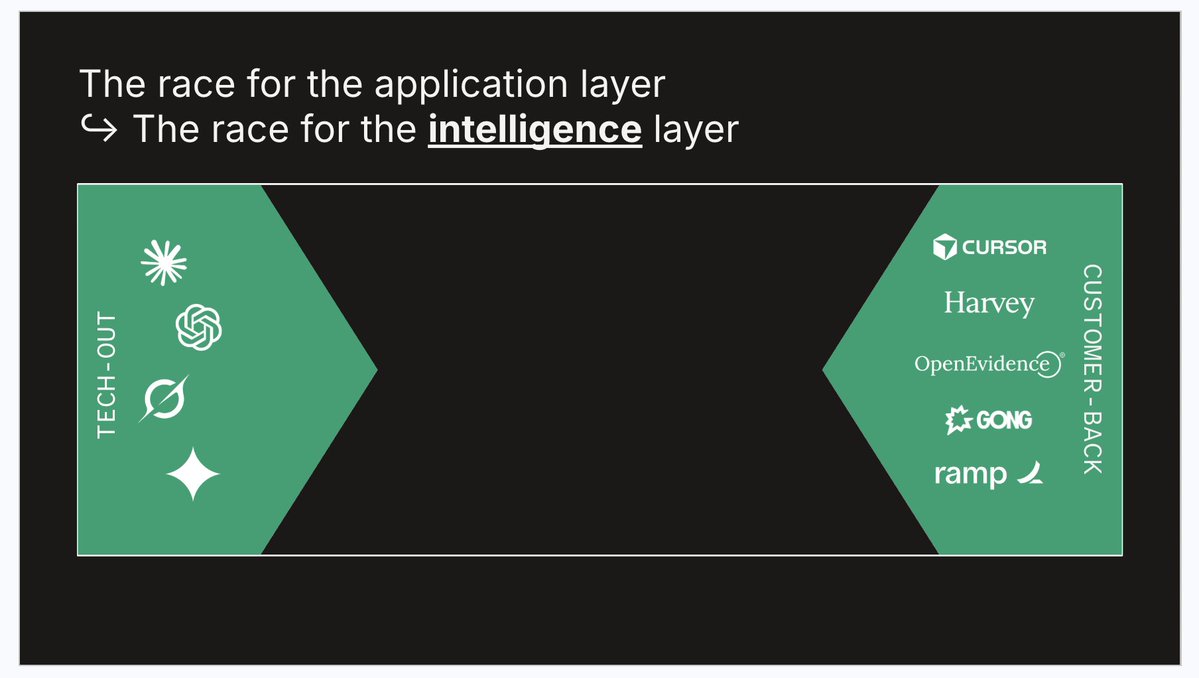
Published August 19, 2026, the modern technological landscape is witnessing a fundamental re-evaluation of how businesses build, deploy, and scale artificial intelligence. The race for the AI application layer has long been framed as a contest of user interfaces, workflow integrations, and go-to-market strategies. However, industry leaders are increasingly signaling that the true battleground is the intelligence layer itself.
The calls for organizations to seize control of their underlying cognitive capabilities are intensifying. Palantir CEO Alex Karp recently urged enterprises to "own the means of production," a sentiment echoed shortly after by Microsoft CEO Satya Nadella. Nadella cautioned that relying entirely on intelligence purchased from frontier labs carries a hidden tax: companies pay once with capital, and a second time by surrendering the proprietary institutional knowledge required to make those general-purpose models useful.
This tension between renting intelligence from third-party frontier labs and building custom, vertically integrated models has become the defining strategic question for technology companies. While frontier application programming interfaces (APIs) and general-purpose agents remain appropriate for many routine enterprise workloads, a growing cohort of organizations is moving aggressively to shape their own model weights.
Background Context and the Sequoia AI Summit
To examine this paradigm shift, venture capital firm Sequoia recently convened a gathering of prominent AI founders, researchers, and builders in Silicon Valley to explore the mechanics of owning the enterprise AI stack. The summit featured a comprehensive cross-section of industry leaders, including legal tech pioneer Harvey, developer tooling platform LangChain, infrastructure provider Fireworks, and automation startups like Mercor and Trajectory.

Presentations from these organizations illuminated a nascent playbook for how modern companies can transition from renting black-box intelligence to cultivating customized, domain-specific models. The consensus among builders at the event was clear: the technology stack supporting independent post-training has reached a critical threshold of maturity, making in-house model customization a viable alternative to pure API dependency.
Several structural catalysts are driving this movement. First, the open-weight frontier has evolved at a pace that far exceeded historical projections. Advanced open-weight models—exemplified by recent iterations such as Kimi K3 and GLM 5.2—have narrowed the performance gap with proprietary frontier models. Previously, organizations attempting to train or fine-tune open models found themselves on a precarious technological treadmill; months of expensive fine-tuning could be rendered obsolete overnight by the release of a new foundational model from a major lab. Today, companies can begin their customization work from a baseline that sits remarkably close to the technological frontier.
Second, the ecosystem of independent post-training tools has matured exponentially. Through specialized infrastructure providers, engineering teams can access an end-to-end research lab stack—spanning high-performance training, ultra-low-latency inference, and the generation of synthetic or human-curated evaluation data. Armed with robust evaluation frameworks, harness engineering, and online learning loops, open models can now outperform general-purpose frontier systems within vertical domains.
Strategic Drivers: Cost, Speed, Data, and Destiny
Transitioning toward an owned intelligence model is not a universal mandate, nor does it imply that businesses should completely abandon third-party frontier labs. Rather, companies are selectively carving out portions of their product architecture where rented intelligence introduces operational bottlenecks. Industry analysts have identified four primary drivers compelling businesses to internalize their AI stacks:
1. Cost Optimization and Margins
As artificial intelligence applications scale, the cost of goods sold (COGS) tied to inference can escalate rapidly. When inference expenses scale directly with user engagement, depending exclusively on commercial API providers can compress profit margins. Owning and distilling models allows high-growth companies to decouple their operational costs from third-party pricing structures.

2. Latency and Speed Requirements
In latency-sensitive domains such as real-time code autocompletion and enterprise cybersecurity threat detection, microseconds matter. Smaller, highly distilled custom models frequently outperform massive, generalized language models simply because their reduced footprint enables rapid execution speeds essential for user workflows.
3. Data Sovereignty and Security
Enterprises operating in regulated sectors are increasingly reluctant to expose sensitive customer interactions, proprietary feedback loops, and internal domain data to external labs. By keeping training loops and evaluation data strictly within organizational boundaries, companies mitigate data leakage risks.
4. Strategic Autonomy
The traditional boundary separating the application layer from the intelligence layer is dissolving. Frontier AI labs are increasingly moving downstream into consumer and enterprise applications, while application developers are pushing upstream into model training and fine-tuning. Controlling the product experience increasingly requires direct command over the underlying learning loop. Organizations such as Harvey, RampLabs, Glean, and Factory are pioneering this vertical integration, ensuring they retain absolute control over how their software reasons.
The Technical Playbook: A Four-Step Architecture
For organizations that decide to build out their own intelligence layer, the transition from conception to production requires a structured, multi-phase technical approach. Industry experts outline four core pillars necessary for executing an in-house AI strategy:
Rigorous Evaluation (Evals)
A foundational principle shared by AI architects is that model training is impossible without robust measurement. As Gabe Pereyra of Harvey noted during the Sequoia summit, "If you don’t have a good benchmark, you can’t train models."
An evaluation framework consists of standardized tasks containing prompts, contextual data, and automated or expert-driven graders. While evaluations often begin as informal qualitative assessments by founders, scaling them requires transforming subjective judgment into rigorous, repeatable benchmarks. Harvey, for instance, developed a proprietary Legal Agent Benchmark comprising over 1,200 agent tasks spanning 24 distinct legal practice areas, validated by more than 75,000 expert-written rubric criteria. Establishing reliable evals allows organizations to make data-driven decisions regarding model selection rather than relying on guesswork.
Harness and Context Engineering
An AI agent architecture typically comprises three distinct components: the foundational model, the contextual data, and the harness. Harrison Chase, CEO of LangChain, emphasizes that the primary function of the harness is to supply the correct context to the model at precisely the right moment in a workflow.
The harness governs critical product logic, including model routing, information retrieval, tool execution, memory management, fallbacks, and execution tracing. Standard off-the-shelf harnesses often struggle when applied to specialized, out-of-distribution enterprise tasks. A well-designed custom harness enables engineering teams to route specific tasks to the most cost-effective or performant model, maintain uniform evaluations across different models, and inspect execution traces to diagnose where an agent fails.
Post-Training Methodologies
Post-training encompasses a spectrum of techniques designed to align a model with specific operational requirements. The appropriate technique depends entirely on the identified deficiency:
- Missing Facts: Addressed through Retrieval-Augmented Generation (RAG) and dynamic context injection rather than costly model retraining.
- Incorrect Formatting or Behavior: Corrected using Supervised Fine-Tuning (SFT).
- Product Taste and Alignment: Refined through preference tuning.
- Specialized Task Competence: Enhanced via Reinforcement Learning (RL).
- Speed and Cost Constraints: Solved through model distillation.
The objective is always to deploy the lightest possible intervention that measurably improves the model against established benchmarks, followed by rigorous testing for quality, latency, and cost.

Production Online Learning
Deploying an initial model is merely the starting point. As Arjun Karanam of the AI ecosystem notes, foundation models may possess immense generalized intelligence, but every new operational session resembles a first day on the job. Without domain-specific experience, even the most capable intelligence can struggle with localized accounting, legal, or administrative workflows.
Modern agents generate valuable experiential data during production execution. By capturing the complete trajectory of a task—including the contextual data reviewed, the tools invoked, the final output, and any user corrections or retries—organizations can build a continuous improvement loop. Utilizing observability platforms like LangSmith, failed tasks can be converted directly into new evaluation benchmarks, missing data can be integrated into system memory, and inefficient tool responses can be resolved at the harness level.
Implications and Industry Outlook
The deliberate choice to own the intelligence layer introduces significant organizational trade-offs. The traditional closed-model stack offers simplicity: an enterprise calls a frontier model API, integrates an out-of-the-box harness, adds basic prompt engineering, and ships the product. This approach provides a high operational floor but imposes a strict ceiling on long-term differentiation.
Conversely, embracing an owned-stack strategy demands a higher degree of technical sophistication and internal resource allocation. It introduces operational friction and a potentially lower initial baseline, but it unlocks an unlimited performance ceiling.
As the artificial intelligence market matures, industry analysts predict a bifurcated ecosystem. Hyperscale labs will continue to construct monumental foundational models suitable for general-purpose reasoning, and enterprises will continue to leverage them for broad workloads. Simultaneously, however, innovative product companies will cultivate their own agile, domain-obsessed models tailored explicitly to their operational environments.

In a landscape where a growing number of enterprises take charge of their own cognitive capabilities, the broader technology ecosystem stands to benefit from increased diversity, specialized efficiency, and true competitive differentiation.