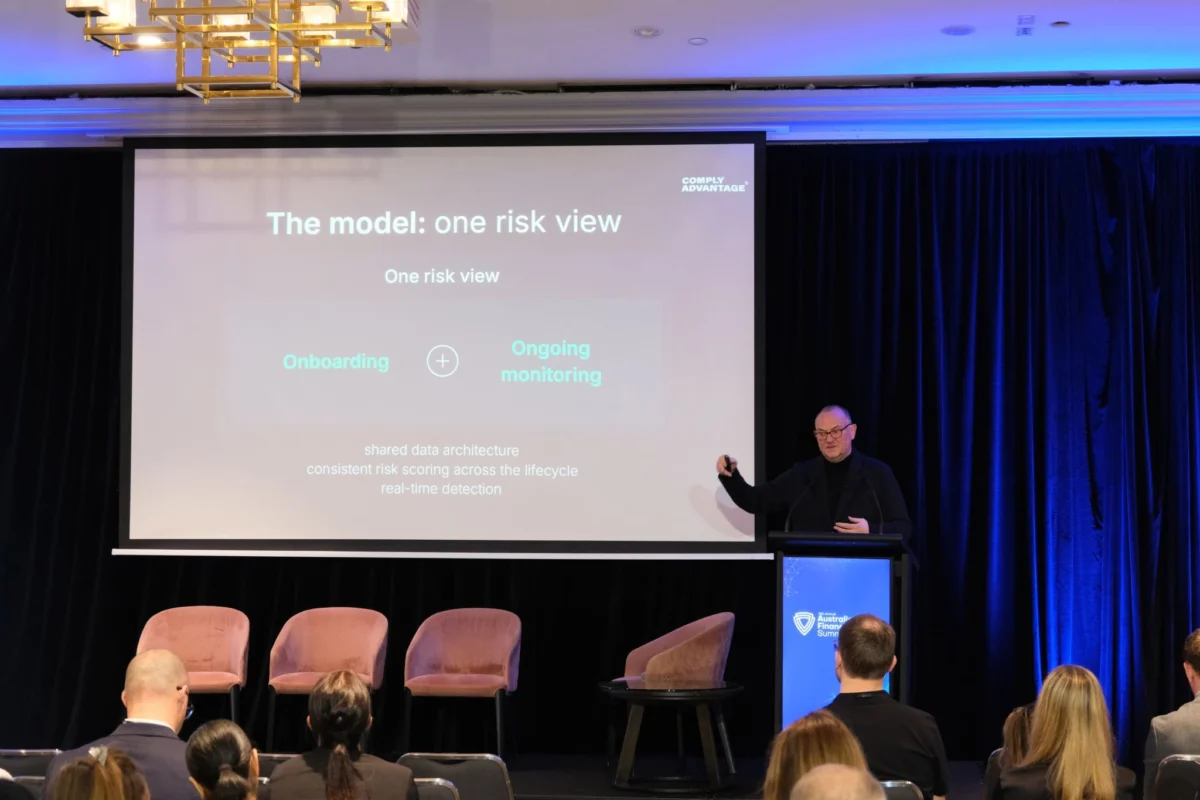
Effectiveness has emerged as the definitive benchmark for modern regulatory compliance, transcending mere box-ticking exercises to become the core metric by which financial institutions are judged. At the Australian Financial Crime Summit (AFCS) held in Sydney on September 1, 2026, industry experts and regulators converged to address a critical systemic failure: the continued reliance on siloed technology architectures. Andrew Davies, Global Head of Financial Crime Compliance (FCC) Strategy at ComplyAdvantage, underscored a sobering reality during his keynote address: compliance teams currently lack the capacity to prove their effectiveness as long as customer onboarding and ongoing monitoring remain tethered to disparate, disconnected systems.
The urgency of this transition is underscored by a volatile landscape of financial crime. Data from the National Anti-Scam Centre (NASC) indicates that Australia faced a staggering $2.18 billion in scam-related losses throughout 2025, a figure derived from over 274,000 loss-bearing reports. These figures are not merely historical markers; they represent a sustained assault on the integrity of the Australian financial system. The Australian Transaction Reports and Analysis Centre (AUSTRAC), in its Money Laundering Update 2026, has warned that the sophistication of criminal actors is outpacing legacy defense systems, particularly through the widespread adoption of AI-generated document fraud and synthetic identities.
A Chronology of Regulatory Pressure
The regulatory environment in Australia has undergone a rapid evolution, necessitated by the increasing complexity of transnational crime. The following timeline outlines the key milestones defining the current compliance climate:
July 1, 2026: The implementation of Tranche 2 AML/CTF obligations brought approximately 80,000 additional businesses under the purview of federal anti-money laundering regulations, significantly expanding the scope of reporting entities.
September 1, 2026: The Australian Financial Crime Summit serves as the primary forum for discussing the "effectiveness" mandate, highlighting the gap between regulatory requirements and current technological capabilities.
March 31, 2027: The mandatory enforcement date for the Scams Prevention Framework, which imposes strict detection and reporting obligations on banking, telecommunications, and digital platform sectors.
This regulatory trajectory suggests that the burden of proof is shifting from the regulator to the firm. It is no longer sufficient to show that a process exists; firms must now demonstrate that these processes effectively intercept criminal activity in real-time.
The Myth of FRAML and the Network Reality
For years, the industry relied on the "FRAML" approach—an attempt to unify fraud detection and anti-money laundering controls under a single operational umbrella. However, as Davies pointed out during the AFCS, limiting a defensive strategy to these two poles is increasingly reductive. The modern threat actor operates across a fluid spectrum that includes human trafficking, modern slavery, bribery, and the financing of illicit supply chains.
The International Labour Organization (ILO) estimates that roughly 50 million people are currently trapped in conditions of modern slavery. The proceeds generated by these operations do not exist in a vacuum; they filter through standard payment networks, often masquerading as legitimate commercial transactions. Furthermore, Global Financial Integrity research suggests that transnational criminal enterprises generate between $1.6 trillion and $2.2 trillion in illicit proceeds annually. When examining cases such as the global fentanyl supply chain—which moves precursors from East Asia through Mexico to the United States—it becomes evident that these are not isolated criminal acts, but rather sophisticated, multi-national supply chain operations.
"Financial crime is fundamentally a network problem," Davies stated during the summit. "If the criminals are operating as a network, we cannot hope to solve the problem using fragmented, siloed defenses. We have to match their network capabilities with our own."
Data Fragmentation as an Operational Vulnerability
The core operational failure identified by experts at the summit is the "handoff gap." In most traditional financial institutions, onboarding is treated as a static event. A customer is verified, a risk score is generated, and that data is often archived or relegated to a system that does not communicate with the institution’s transaction monitoring platform.
This creates a dangerous information vacuum. If a customer’s risk profile changes—perhaps through a change in employment, a shift in transaction behavior, or a new association with a sanctioned entity—that information may never reach the systems tasked with ongoing monitoring. The State of Financial Crime 2026 report by ComplyAdvantage confirms this trend, finding that over 50% of compliance leaders manage their workflows across eight to ten separate systems. This fragmentation is not just an inefficiency; it is a critical vulnerability. Every silo acts as a firewall against institutional intelligence, allowing risk to accumulate in the shadows.
Implementing an Orchestration Layer
The resolution to this problem does not necessarily require the immediate and costly decommissioning of legacy systems. Instead, industry leaders are increasingly looking toward an "orchestration layer." This technological overlay sits above existing systems, serving as a centralized hub that unifies identity and risk signals. By consolidating data, institutions can maintain the integrity and continuity of their risk profiles, ensuring that the initial due diligence performed at onboarding directly informs the ongoing surveillance of that customer’s behavior.
Measuring Effectiveness: A Tri-Dimensional Approach
To satisfy regulators and protect the organization, compliance leaders must move toward a unified measurement framework. According to Davies, effectiveness must be quantified across three distinct dimensions:
- Risk Exposure: A clear, quantifiable view of the institution’s total risk surface, derived from a single customer view. This allows executives to speak accurately about their risk appetite and potential liabilities.
- Operational Remediation: The ability to track and resolve alerts across the entire compliance lifecycle. By linking onboarding, screening, and transaction monitoring, firms can ensure that an investigation in one area leads to a policy adjustment in another.
- Business Impact: Understanding how effective crime mitigation contributes to commercial value. Protecting the customer relationship is a business imperative; when users feel secure, their lifetime value increases, reinforcing the overall health of the financial institution.
Implications for the Future of Compliance
The shift toward an integrated compliance model represents a fundamental change in the identity of the compliance function. It is no longer a cost center tasked with "keeping the regulator away," but rather the "vanguard" of the organization. By protecting the most vulnerable populations from exploitation and ensuring the security of the financial system, compliance teams are performing a public service that is vital to the stability of the global economy.
Looking toward the March 2027 deadline for the Scams Prevention Framework, the pressure on firms to modernize their infrastructure will only intensify. Institutions that fail to address the systemic silos within their organizations will likely find themselves at a competitive and regulatory disadvantage. The mandate is clear: the era of fragmented compliance has ended, and the era of the integrated, data-driven defense has begun.
As the industry moves forward, the primary challenge will be the cultural and technical shift required to connect these disparate dots. However, as evidenced by the insights shared at the AFCS, the path is no longer a matter of debate. The integration of risk mitigation and commercial strategy is the only way forward for firms that intend to remain relevant in an increasingly dangerous, network-based financial landscape. The technology exists to bridge these gaps; the next year will determine which institutions have the foresight to implement these changes before the regulatory deadline arrives.