
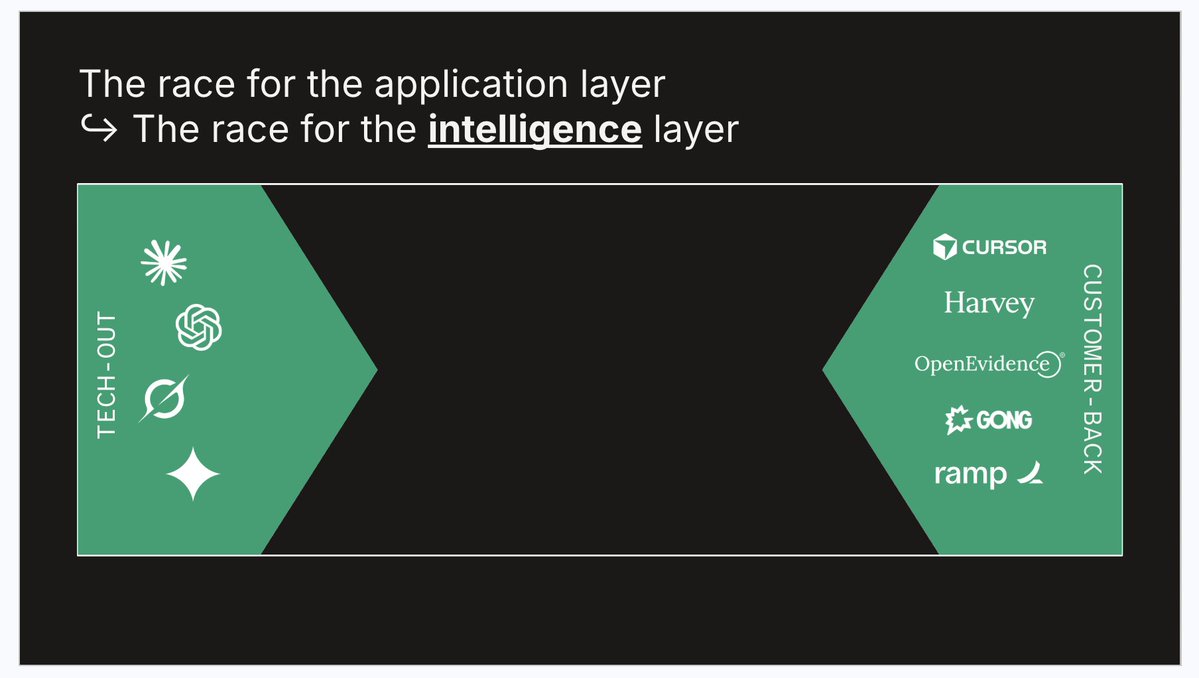
The modern corporate landscape is undergoing a fundamental architectural shift, transitioning from a heavy reliance on rented proprietary application programming interfaces (APIs) toward the vertical integration of custom artificial intelligence capabilities. This movement is no longer merely about refining user interfaces, optimizing corporate workflows, or sharpening go-to-market strategies; it has escalated into a fierce, foundational competition for the intelligence layer itself. Industry leaders are increasingly recognizing that depending exclusively on external frontier labs for core decision-making introduces long-term economic and strategic vulnerabilities.
This growing sentiment was encapsulated by Palantir CEO Alex Karp, who recently urged enterprises to "own the means of production." Shortly thereafter, Microsoft CEO Satya Nadella echoed a similar cautionary note, warning that purchasing intelligence from a third-party frontier lab amounts to paying twice: once in direct monetary costs, and a second, more critical time through the surrender of proprietary institutional knowledge exposed during the interaction. These high-profile warnings have forced executive boards across the global economy to confront a pivotal strategic dilemma: who should truly own the intelligence that drives the core of their business operations?
The Evolution of the Open-Weight Ecosystem
For years, building custom models in-house was viewed as an inefficient and Sisyphean endeavor. Companies that attempted to fine-tune their own models often found themselves trapped on a perpetual technological treadmill. Organizations would invest months of engineering capital and specialized labor into training a model, only for an external frontier lab to release a vastly superior base model days later, instantly erasing months of hard-won progress. Consequently, choosing open weights was traditionally perceived as a compromise—a sacrifice of cutting-edge performance accepted primarily for reasons of data privacy or cost control.

However, the technological calculus experienced a dramatic inflection point throughout 2025 and into 2026. The open-weight frontier advanced at a pace that significantly exceeded industry projections, driven by the rapid maturation of foundational releases like Kimi K3 and GLM 5.2. These models shattered the performance ceiling traditionally associated with open-source alternatives, offering robust baselines that rivaled or closely approximated proprietary frontier offerings.
Simultaneously, the independent post-training stack matured into a reliable, enterprise-grade ecosystem. Companies can now leverage comprehensive toolchains—encompassing data synthesis, advanced fine-tuning, rigorous evaluation frameworks, and scalable inference infrastructure—previously accessible only to elite, well-capitalized research laboratories. Through strategic combinations of robust evaluations (evals), sophisticated harness engineering, targeted post-training, and continuous online learning, open models can now outperform generic frontier models when deployed within specific, high-stakes domain verticals.
Inside the Sequoia AI Stack Summit
To examine these seismic shifts firsthand, venture capital firm Sequoia Capital convened a high-profile gathering of artificial intelligence founders, researchers, and enterprise builders in mid-2026. The event focused explicitly on the emerging mechanics of owning the AI stack, bringing together pioneers from across the software ecosystem to map out a reproducible technical playbook.
The day featured operational insights from leading legal tech innovator Harvey, which presented a customer-centric perspective on the practical applications of proprietary model alignment. Technical deep dives were subsequently led by engineering executives and founders from Mercor, LangChain, Trajectory, and Fireworks, who dissected the intricate building blocks of the modern post-training stack. The consensus emerging from the summit was definitive: the strategic battleground has permanently shifted away from mere application wrappers and user interfaces, concentrating instead on the foundational weights and learning loops that dictate how systems reason.

Strategic Drivers: Cost, Speed, Data, and Control
While renting intelligence via API remains a pragmatic choice for numerous general-purpose enterprise workloads, a growing cohort of market leaders is vertically integrating. Four primary pressures are accelerating this transition away from external dependency:
- Escalating Costs and COGS: As AI-native products achieve mainstream commercial success, inference costs scale directly with active usage. For high-volume applications, the cost of renting intelligence from external labs can severely compress operating margins. Owning and hosting optimized, domain-specific models offers companies a predictable cost structure to safeguard long-term profitability.
- Operational Speed and Latency: In latency-sensitive domains such as real-time code autocompletion or cybersecurity threat detection, milliseconds matter. Bulky, general-purpose frontier models are frequently too slow for instantaneous execution. Smaller, heavily distilled custom models, tailored precisely to specific functional syntax, consistently deliver superior response times.
- Protection of Proprietary Data: Enterprise feedback loops, evaluation datasets, customer interaction histories, and proprietary domain knowledge represent the true crown jewels of modern corporations. Routing this sensitive information through external API endpoints risks data leakage and exposes strategic IP to third-party model trainers. Keeping data strictly within corporate boundaries mitigates compliance risks and preserves competitive moats.
- Controlling Strategic Destiny: The boundary lines between the application layer and the intelligence layer are rapidly blurring. Frontier labs are increasingly pushing upward into finished software products, while successful application companies are simultaneously moving downward into the training loops that define model behavior. To maintain ultimate control over product evolution and prevent platform marginalization, companies must own the learning loops that shape their underlying intelligence.
The Zero-to-One Technical Roadmap
For enterprises electing to take ownership of their intelligence layer, navigating the transition from conception to production requires a structured, multi-phase technical roadmap. Industry experts emphasize that this initiative cannot be treated as a secondary task for general platform IT teams; it demands dedicated, forward-deployed units operating with clear domain focus. Notably, legal tech pioneer Harvey successfully advanced substantial proprietary research with a lean, highly specialized team of just seven individuals, demonstrating that organizational agility outweighs sheer headcount.
1. Establishing Rigorous Evaluations (Evals)
As Gabe Pereyra of Harvey frequently notes, building a model without a reliable benchmark is fundamentally impossible. An evaluation framework consists of a standardized collection of tasks designed to objectively measure system performance. Each task incorporates a prompt, necessary contextual data, and a programmatic or expert-driven grader.
While most initial evals begin as subjective "vibe checks" conducted by founders reviewing model outputs, operationalizing this judgment into repeatable, automated tests is mandatory. For instance, Harvey constructed its proprietary Legal Agent Benchmark by translating real-world legal workflows into more than 1,200 distinct agent tasks spanning 24 specialized practice areas, backed by upwards of 75,000 expert-authored rubric criteria. Establishing these evals prior to model selection transforms purchasing and training decisions into quantitative, metrics-driven operations.
2. Harness and Context Engineering
An autonomous AI agent fundamentally comprises three interacting components: the core model, the operational context, and the execution harness. Harrison Chase, CEO of LangChain, defines the primary responsibility of the harness as the precise delivery of relevant context to the model at the exact moment it is required.
The harness governs the overarching product logic, managing complex routing, retrieval-augmented generation (RAG), tool invocation, memory retention, error fallbacks, and execution tracing. When tasks fall outside a model’s primary training distribution, generic off-the-shelf harnesses frequently fail. A customized, high-performance harness allows organizations to dynamically route specific tasks to the most efficient model, maintain consistent evaluations across disparate model versions, and inspect execution traces to diagnose where an agent encounters bottlenecks.
3. Precision Post-Training
Post-training methodologies offer a versatile suite of techniques designed to adapt open-weight models to specific enterprise requirements. According to Lin Qiao, selecting the appropriate post-training intervention depends entirely on the specific performance deficit identified by enterprise evals:
- Missing Facts: If a model lacks specific factual knowledge, expensive post-training is unnecessary; standard RAG or augmented context injection resolves the gap.
- Format or Behavioral Deviations: When output structures or stylistic behaviors are misaligned, supervised fine-tuning (SFT) is deployed.
- Product Taste and Alignment: For subjective qualities such as tone, nuance, or formatting preferences, preference tuning is utilized.
- Specialized Task Mastery: When models require advanced proficiency in complex, multi-step workflows, reinforcement learning (RL) is applied.
- Efficiency Optimization: If a model is excessively slow or costly to run, distillation techniques are employed to compress capabilities into smaller, faster architectures.
4. Continuous Online Learning Loops
Deploying a static model into production is analogous to hiring a brilliant academic on their very first day on the job; high intelligence does not automatically translate to operational familiarity. Arjun Karanam emphasizes that agents generate the missing institutional experience dynamically as they execute real-world tasks.

Every operational trajectory—comprising the context presented to the model, the tools and sub-agents invoked, the final output generated, and subsequent human edits or retries—represents valuable training data. By capturing these trajectories using observability platforms like LangSmith, organizations construct a continuous production feedback loop. Failed tasks are converted into new evaluation benchmarks, missing information is integrated into context retrieval systems, and flawed tool responses trigger immediate harness corrections.
Broader Implications and Industry Outlook
Embracing the ownership of enterprise intelligence undeniably introduces operational complexity. The traditional closed-model stack offers a high operational floor with minimal friction: developers simply call a frontier API, couple it with an out-of-the-box harness, inject basic prompts, and ship the product. However, this convenience carries a hard ceiling on customization, differentiation, and long-term cost control.
Conversely, transitioning to an owned intelligence stack requires deep technical competence, custom harness maintenance, rigorous evaluation pipelines, and active online learning loops. While this approach introduces a lower initial operational floor, it dramatically elevates the long-term performance ceiling, enabling enterprises to build defensible, highly specialized AI systems tailored precisely to their operational DNA.
Ultimately, the future of artificial intelligence will not be dictated by a monolithic winner-take-all paradigm. Frontier laboratories will continue pushing the boundaries of massive foundational reasoning engines, providing indispensable high-level capabilities for the broader digital economy. In parallel, however, forward-thinking product companies will cultivate their own agile, domain-obsessed models tuned explicitly to their specific industrial workflows. As more organizations seize control of their underlying intelligence, the global technology ecosystem will experience a profound diversification, proving that enterprise individuality and domain expertise remain the ultimate competitive advantages in the age of artificial intelligence.