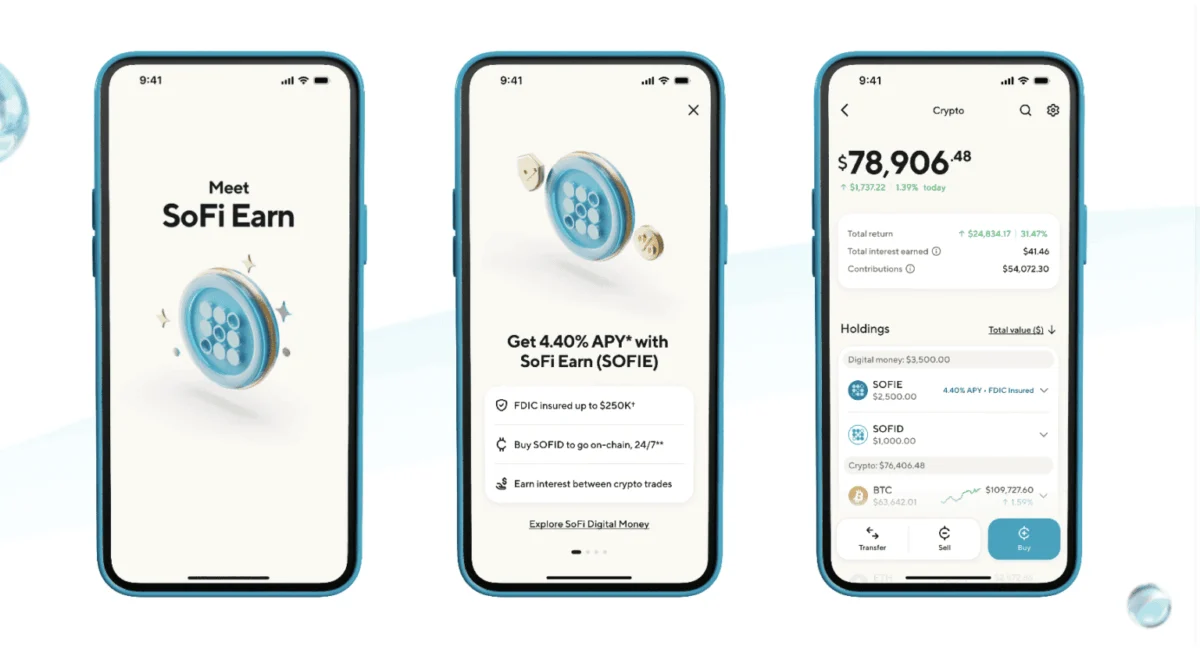
Financial technology titan SoFi has officially introduced SoFi Earn, trading under the ticker SOFIE, marking a pioneering moment in the evolution of digital money by introducing the first national bank-issued tokenized deposit designed specifically for everyday consumers. This innovative financial instrument bridges the gap between traditional banking yields and the high-speed utility of blockchain-based networks. By offering a competitive 4.40% Annual Percentage Yield (APY) coupled with Federal Deposit Insurance Corporation (FDIC) protection, SoFi is tackling a persistent inefficiency in the digital asset ecosystem: capital sitting idle in non-interest-bearing stablecoins.
The introduction of SOFIE arrives at a pivotal juncture for the fintech and cryptocurrency sectors. It comes mere hours after regulatory bodies finalized sweeping new compliance rules, highlighting an aggressive push by traditional financial institutions to capture market share in the burgeoning digital asset economy. As digital currency adoption accelerates globally, SoFi’s latest product launch underscores a fundamental shift in how financial institutions view the intersection of fiat currency and decentralized finance architectures.
The Mechanics of SoFi Earn and Digital Dollar Integration
At its core, SoFi Earn allows eligible members to hold digital dollars within a secure, interest-bearing tokenized bank deposit framework. While maintaining the rigorous safety standards of traditional banking—including standard consumer protections and FDIC eligibility—these deposits are engineered to interact seamlessly with blockchain ecosystems.
When a consumer decides to venture beyond traditional savings to purchase cryptocurrencies, execute decentralized finance transactions, or execute high-speed cross-border and domestic money transfers over a blockchain network, they are not forced to forfeit their accumulated interest prematurely. Instead, holders can convert their SOFIE deposits into SoFiUSD—SoFi’s proprietary stablecoin—at a reliable one-to-one ratio instantly.
This dual-layer mechanism solves a major pain point for digital asset holders. Historically, individuals navigating the crypto markets had to choose between keeping their capital in secure, yield-generating bank accounts that lacked blockchain native utility, or moving funds into stablecoins that offered immediate transactional capabilities but yielded zero percent interest. By fusing these two financial paradigms, SoFi allows digital dollars to remain productive until the exact second they are deployed for transactional purposes.
According to the initial rollout schedule, SoFi Earn is expanding rapidly to members of the SoFi Crypto platform in a phased release spanning through November, positioning the product for widespread adoption among tech-forward retail investors.
Regulatory Catalyst: The GENIUS Act and the Yield Prohibition
The timing of SoFi’s strategic rollout is deeply intertwined with recent legislative and regulatory updates in the United States financial sector. The launch of SOFIE occurred just hours after the Office of the Comptroller of the Currency (OCC) finalized crucial implementing rules for the GENIUS Act, a legislative framework that places a strict statutory prohibition on payment stablecoin issuers from distributing yield or interest directly to token holders.
Scheduled to take effect on January 18, 2027, the GENIUS Act has drawn significant scrutiny and debate across both traditional banking circles and the cryptocurrency industry. While the legislation explicitly bars issuers of payment stablecoins from paying returns solely for holding the tokens, it has left ambiguous gray areas regarding third-party reward programs, exchange-driven staking incentives, and decentralized intermediary yields.
This regulatory restriction on stablecoin issuers creates a profound market opening for chartered banking institutions. Because tokenized bank deposits like SOFIE are fundamentally classified as regulated bank liabilities rather than payment stablecoins, they fall completely outside the restrictive parameters of the GENIUS Act. Consequently, banking institutions possessing appropriate regulatory charters can legally offer interest-bearing digital dollars directly to consumers, neatly sidestepping the yield bans imposed on standalone stablecoin projects.
Executive Perspectives and the Broader Digital Strategy
Addressing the launch, SoFi Chief Executive Officer Anthony Noto emphasized the economic inefficiency plaguing contemporary digital finance portfolios.
"Too much money in the digital asset ecosystem is sitting idle, leaving massive potential earnings on the table for millions of people," stated Noto. "We believe your money should keep working for you until the moment you need it. SoFi Earn combines the earning power and protections of a bank deposit with the speed and utility of digital assets, giving people more value, flexibility, and control over their money."
This strategic deployment is not an isolated event but rather the centerpiece of an aggressive, multi-pronged product expansion strategy. The introduction of SOFIE represents SoFi’s fifth major cryptocurrency and digital asset offering launched in a compressed window of less than twelve months.
Over the past year, the company has systematically assembled a comprehensive digital money infrastructure. This ecosystem now encompasses robust retail crypto trading capabilities, the launch of the SoFiUSD stablecoin, and the development of Big Business Banking—an integrated corporate platform designed to grant commercial clients a single, highly regulated environment to seamlessly manage both traditional fiat reserves and emerging digital assets side-by-side.
Chronology of SoFi’s Digital Asset Evolution
The path toward the creation of SOFIE reflects a calculated, step-by-step integration of blockchain technology within a strictly regulated national banking charter:
- Early Phase: SoFi establishes its foundational retail banking footprint, scaling its digital-first checking and savings products to millions of members nationwide.
- Mid-Phase Expansion: The company reintroduces and expands retail cryptocurrency trading services, aligning with growing consumer demand for diversified digital asset portfolios.
- Stablecoin Integration: SoFi develops and deploys SoFiUSD, laying the foundational cryptographic architecture required for fast, native blockchain transactions.
- Corporate Solutions: The rollout of Big Business Banking extends digital asset management capabilities to institutional and corporate clients, proving the viability of dual fiat-crypto operational platforms.
- Regulatory Adaptation and SOFIE Launch: Following the finalization of OCC rules governing the GENIUS Act, SoFi debuts SoFi Earn (SOFIE) to capitalize on the regulatory distinction between payment stablecoins and tokenized bank deposits.
Market Implications and Competitive Dynamics for Commercial Banking
The introduction of national bank-issued tokenized deposits carries profound implications for the future architecture of money and the competitive balance between traditional financial institutions and decentralized finance entities.
For decades, traditional commercial banks have expressed mounting concern over the steady migration of customer deposits into digital assets and stablecoins, which threaten to disintermediate traditional banking models by pulling liquidity out of the banking system. SoFi’s approach offers a compelling counter-strategy. Rather than fighting the inevitable digitization of money or attempting to wall off traditional deposits from blockchain networks, SoFi has actively chosen to embrace tokenization as an organic extension of its deposit-taking capabilities.
By combining the security of FDIC insurance and a 4.40% APY with the frictionless speed of stablecoin conversions, SoFi creates a powerful economic incentive for consumers to consolidate their capital within its financial ecosystem. From an analytical perspective, if everyday users can earn competitive yields on tokenized deposits while retaining the instant ability to transform those funds into stablecoins for blockchain transactions, the rationale for holding non-interest-bearing commercial stablecoins diminishes significantly.
Industry analysts suggest this move could spark a broader trend across the global banking sector. Traditional financial institutions are likely to reevaluate their digital asset roadmaps, recognizing that compliance-friendly tokenized deposits can serve as a powerful retention tool. By building bridges rather than barriers between fiat currency and decentralized rails, forward-looking banks can successfully retain core deposits while satisfying modern consumer demands for speed, programmatic utility, and blockchain connectivity. As regulatory frameworks continue to mature heading toward 2027, the success of SoFi Earn may well serve as the operational blueprint for the next generation of digital banking worldwide.