The United States Department of Defense is seeking a substantial federal investment of $30.3 million over the next five years to develop and deploy a next-generation lie detection system. Known officially in defense budget documentation as Polygraph+ or Polygraph Next, the initiative aims to overhaul outdated credibility assessment technologies by integrating advanced artificial intelligence, machine learning algorithms, and non-contact sensing methodologies. Spearheaded by the Defense Counterintelligence and Security Agency, the program arrives at a moment of heightened institutional anxiety inside the Pentagon, where defense leadership has increasingly turned to physiological screening to combat internal information leaks and secure classified military assets.
Despite the significant financial commitment and the promise of modern algorithmic processing, the project has drawn sharp criticism from legal scholars, cybersecurity researchers, and scientific authorities. Critics argue that the fundamental flaws of lie detection technology cannot be resolved through computational upgrades alone, raising serious ethical, legal, and operational concerns about the deployment of automated systems in federal vetting and security screening environments.
The Technology: Moving Beyond the 1920s Polygraph
Conventional polygraph examinations have remained largely unchanged since their invention in the 1920s. Standard procedures require human examiners to monitor and record a subject’s physiological responses—specifically blood pressure, pulse, respiration rate, and electrodermal activity—while the individual answers a series of baseline and target questions. The administrator then evaluates these physical fluctuations to determine whether the respondent is being truthful.
Polygraph+ intends to modernize this nearly century-old paradigm through two primary technological pillars: algorithmic scoring powered by machine learning and "standoff sensing." Unlike traditional methodologies that require cumbersome pneumatic tubes, blood pressure cuffs, and galvanic skin response sensors attached directly to the subject’s body, standoff sensing utilizes remote technologies to capture physiological metrics without physical contact.
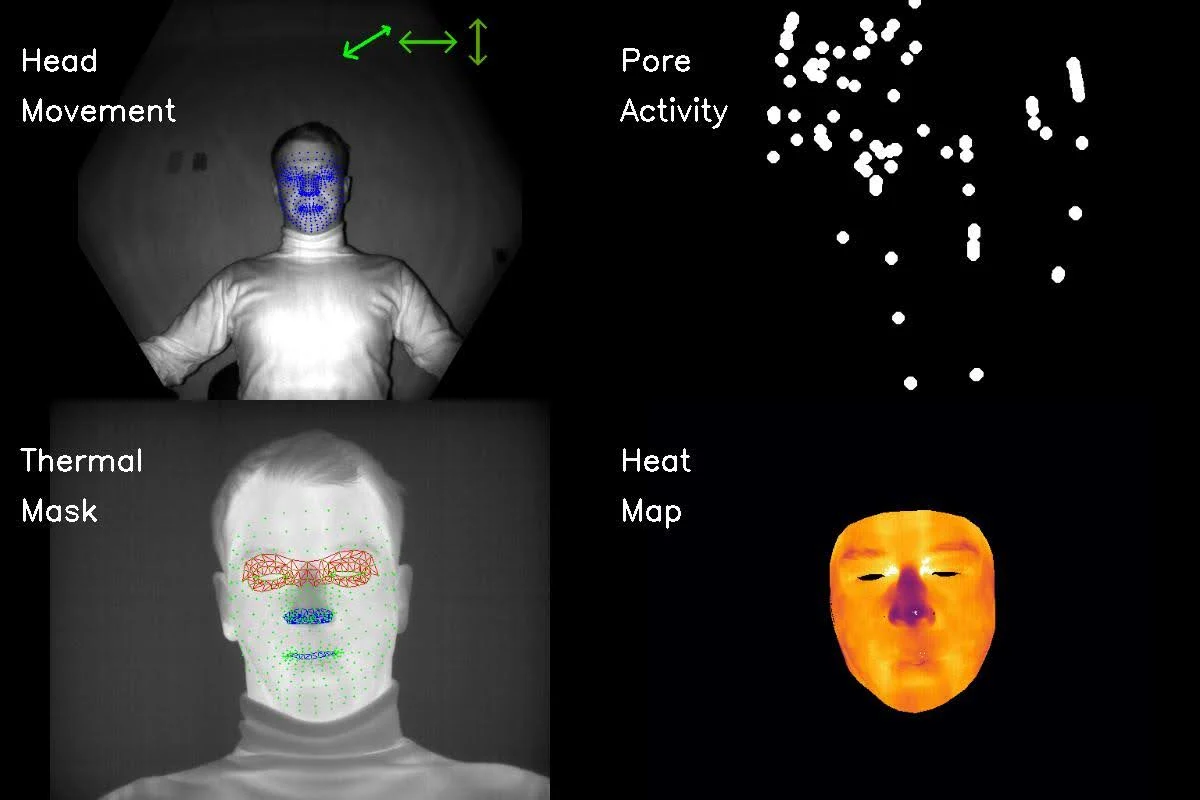
While the Defense Counterintelligence and Security Agency has not publicly disclosed specific vendor contracts for the Polygraph+ program, recent solicitations and prototype selections by the Defense Innovation Unit offer a clear window into the targeted technologies. In 2023, the Defense Innovation Unit launched an open competition to identify commercial deception-detection prototypes. The agency ultimately selected two private entities: Presage Technologies, which asserts an ability to measure heart rate and breathing frequencies using standard optical cameras, and Altec Research, a medical sensor firm specializing in non-contact monitoring. Documentation released by the Defense Innovation Unit indicates that Altec’s prototype system evaluates subtle physiological indicators including head movement tracking, facial skin temperature variations, and microscopic pore activity.
Chronology and Institutional Context
The push for advanced credibility assessment tools is deeply intertwined with recent security breaches and leadership directives within the Department of Defense. Under the administration of Defense Secretary Pete Hegseth, the Pentagon has grappled with high-profile disclosures of sensitive military information to mainstream media organizations.
The urgency behind these measures intensified significantly in September, when investigative reporting by major news outlets revealed that approximately 50 high-ranking officers on the Joint Staff had been subjected to mandatory polygraph examinations. These tests were ordered in direct response to news coverage detailing severely depleted United States weapons stockpiles amid ongoing strategic engagements and regional conflicts, including tensions involving Iran.
The $30.3 million budget request, detailed in fiscal year budget justification documents for the Defense Counterintelligence and Security Agency, outlines a multi-year deployment strategy. Subject to congressional approval, the newly developed technologies will be integrated directly into routine federal background investigations, prospective employee vetting procedures, and ongoing insider threat detection protocols. The Defense Counterintelligence and Security Agency, which conducts millions of background checks and security clearances across the federal apparatus, views algorithmic enhancements as a critical path toward scaling its vetting capabilities.
Scientific Skepticism and Historical Precedent
The scientific community has long expressed skepticism regarding the validity of polygraph technology, noting a profound disconnect between commercial claims and empirical reality. Decades of independent research and government-commissioned reviews have consistently challenged the foundational science of lie detection.
In 1983, the United States Congress Office of Technology Assessment published a comprehensive evaluation concluding that there was severely limited scientific evidence supporting the validity of polygraphs in personnel security screening. Two decades later, in 2003, the United States National Research Council released a landmark report stating that the scientific evidence regarding the efficacy of polygraphs was "weak at best."

Empirical studies indicate that untrained human observers can detect deception at rates hovering just above 50 percent—effectively matching random chance. Although the American Polygraph Association asserts that traditional polygraphs maintain an accuracy rate between 80 and 94 percent, critics emphasize that even minor statistical error rates carry devastating consequences when applied at institutional scale. The Department of Defense workforce encompasses approximately 2.8 million active-duty military personnel, civilian employees, and contractors. Operating an imperfect screening mechanism across an organization of this magnitude risks producing thousands of false-positive results, leading to the wrongful accusation, professional marginalization, or clearance revocation of innocent individuals.
Furthermore, traditional polygraphs remain highly susceptible to subjective interpretation. Studies demonstrate that different examiners reviewing the same physiological data frequently arrive at contradictory conclusions. Additionally, demographic disparities persist, with research indicating that individuals from certain minority groups are disproportionately judged as deceptive due to baseline physiological variations.
Subjects can also deliberately compromise test validity by employing physical or mental countermeasures. Interviewees frequently learn techniques designed to artificially elevate physiological responses during baseline questioning—such as concealing a tack inside a shoe and pressing down on it—to skew the comparative analysis. As deception researchers frequently observe, the psychological impact of a polygraph often relies entirely on the subject’s belief in its infallibility. Once an individual understands the mechanics of the device, the deterrent effect diminishes rapidly.
The AI Dilemma: A Modern Solution to an Unsolved Problem
Proponents of the Polygraph+ initiative argue that artificial intelligence and machine learning can resolve these historical shortcomings by identifying complex, multi-dimensional patterns in physiological data that human examiners are incapable of detecting. Theoretically, algorithmic models can process multi-modal data streams, synthesizing signals related to physiological stress, cognitive load, and deliberate concealment efforts into a unified deception score.
Similar initiatives have been attempted in the past with limited long-term success. During the 2000s, academic researchers at Manchester Metropolitan University developed "Silent Talker," an automated system designed to generate deception scores from video recordings of facial movements. This concept later influenced iBorderCtrl, an experimental, European Union-funded automated border control pilot program. In the United States, a project known as AVATAR integrated eye-tracking, acoustic analysis, and automated body movement detection for security checkpoints. Despite substantial investment, these projects ultimately failed to achieve widespread adoption or proven reliability outside controlled laboratory environments.
Legal scholars and deception experts contend that merging artificial intelligence with polygraph testing creates a compounding layer of unreliability. Kyri Kotsoglou, a professor at Northumbria Law School who specializes in the legal application of polygraph systems, characterizes the initiative as a misguided effort to reduce complex human behavior into quantifiable metrics.
"It’s a misguided effort to reduce the complex to something that is tangible," Kotsoglou notes, emphasizing that machine learning algorithms require reliable ground truth data to train effectively. Because true deception cannot be definitively verified in real-world operational scenarios, AI models trained on polygraph data ultimately learn to replicate the inherent flaws and subjective biases of human examiners.
Marion Oswald, a professor of law who has collaborated extensively on research concerning credibility assessment in the justice system, echoes these concerns. Oswald suggests that the renewed focus on technological lie detection serves a psychological and punitive function rather than a scientific one, acting as an institutional instrument of deterrence and intimidation.
"It seems very much a response to the concern of the current administration to leaks and perceived lack of loyalty," Oswald observes. "It is being used as a threat, to intimidate and force people to confess to things, as opposed to anything that’s actually getting valid information."
Broader Implications for National Security and Civil Liberties
The allocation of $30.3 million toward Polygraph+ highlights a broader, systemic trend within modern defense infrastructure: the increasing reliance on algorithmic surveillance and automated security vetting to manage internal dissent and protect classified networks. As the Pentagon moves forward with its budgetary requests, lawmakers in Congress will face mounting pressure to evaluate not only the fiscal prudence of the investment, but the profound civil liberties implications associated with continuous, non-contact physiological monitoring.
If deployed across federal agencies, standoff sensing and AI-driven credibility assessments threaten to institutionalize opaque, scientifically disputed technologies into the foundation of national security clearances. For millions of federal employees and military personnel, the future of employment and professional standing may soon rest upon algorithmic interpretations of facial temperature, micro-movements, and autonomic nervous system responses—technologies built upon a century-old premise that human truth can be reliably reduced to a computational score.