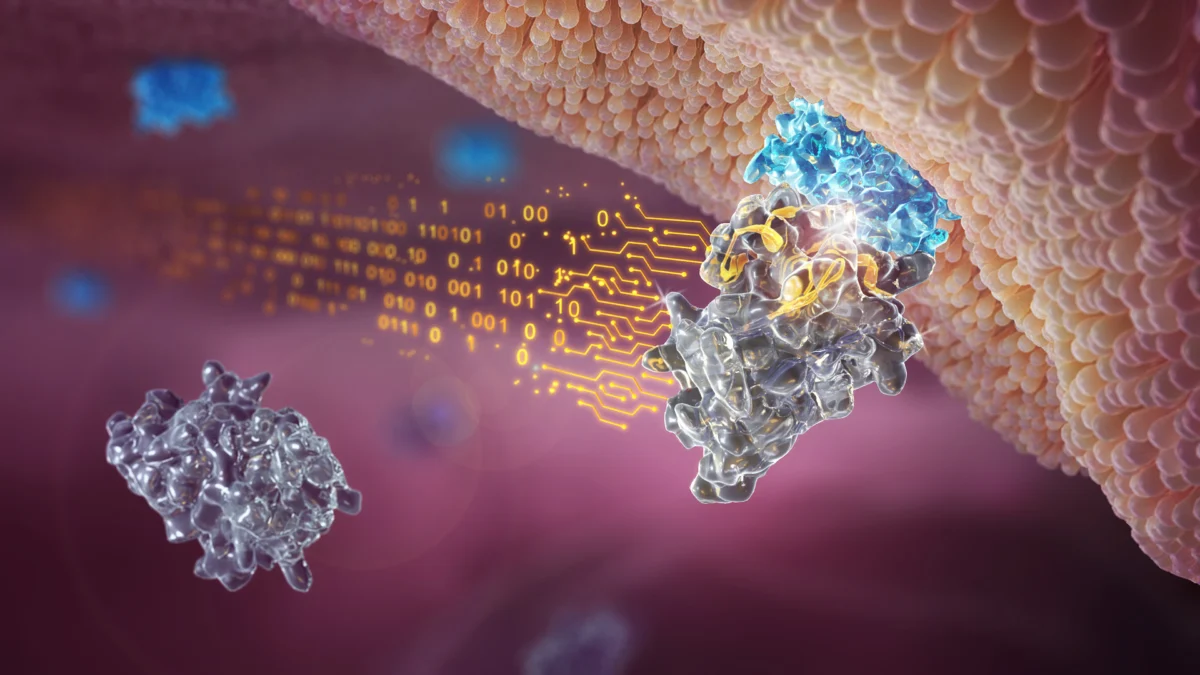
The intricate and costly journey of designing and developing a new medicine, particularly biologic therapies, is undergoing a profound transformation driven by the rapid integration of Artificial Intelligence (AI). Historically, this scientific endeavor has been characterized by high failure rates, lengthy development cycles, and substantial financial investment. Biologics, which are complex therapies derived from engineered proteins and used to treat a wide spectrum of acute and chronic diseases, present even greater challenges due to their inherent complexity. Researchers meticulously examine vast libraries of potential molecules, seeking those rare few that can effectively target specific biological mechanisms, maintain stability within the human body, and be reliably manufactured at scale. In this demanding landscape, AI has emerged as a pivotal tool, accelerating these multifaceted processes and becoming an indispensable component of pharmaceutical research and development (R&D) infrastructure.
This paradigm shift is exemplified by the proactive adoption of AI-assisted design within the biologics sector. Leading pharmaceutical companies like AstraZeneca are significantly investing in their engineering teams to push the boundaries of AI integration. Puja Sapra, Senior Vice President and Head of R&D Biologics Engineering and Oncology Targeted Discovery at AstraZeneca, articulates this transformative impact: "Everything we do, whether it’s design, make, test, or analyze, is now computationally enhanced. The cycle times are getting shorter while productivity and innovation increase." This sentiment underscores a fundamental reorientation of R&D, where computational power is no longer an adjunct but a core driver of scientific progress.
The AI-Powered "Build-Measure-Learn" Loop in Biologics Development
AstraZeneca’s approach to leveraging AI in biologics drug discovery is rooted in a continuous "build-measure-learn" feedback loop. AI algorithms are employed to generate or prioritize candidate molecules computationally, predicting their likelihood of success based on intricate data models. This predictive capability allows scientists to strategically allocate precious laboratory resources, focusing only on the most promising candidates. This focused approach significantly reduces the number of "dead ends" encountered during the research process, enabling faster iteration and the exploration of disease targets previously considered intractable. The sheer magnitude of potential molecular combinations – far exceeding the capacity of human teams to systematically evaluate – makes AI’s role in narrowing down and refining options for experimental testing a critical advancement in biologics drug design.
This AI-driven process is not merely about optimizing existing methodologies; it is also opening doors to entirely new classes of medicines. While traditional biologics often target a single disease pathway, the next generation of therapies is designed to address multiple targets concurrently or deliver therapeutic payloads with unprecedented precision to specific cells. Achieving such sophisticated therapeutic modalities necessitates optimizing a complex interplay of numerous variables simultaneously.
Navigating Complex Drug Design: Towards Multi-Specific and Precisely Targeted Therapies
Looking ahead, AI-driven models are poised to play a crucial role in designing these increasingly intricate, multi-specific biologics. As Puja Sapra explains, "For example, such models could help identify which two or three targets to prioritize based on the underlying biology, then optimize across multiple parameters to balance a molecule’s potency, stability, manufacturability, and safety." This capability moves beyond single-target interventions, enabling a more holistic and potent approach to disease management. The aspiration is to "drug the undruggable," as Sapra puts it, referring to the potential to develop medicines against targets that were once deemed unreachable. The implications for patient benefit are, by all accounts, remarkable.
The successful deployment of AI in drug discovery hinges on a critical resource: data. McKinsey estimates that generative AI, in conjunction with other computational tools, has the potential to reduce drug discovery timelines by as much as 50%. However, the efficacy of any AI model is directly proportional to the quality and quantity of its training data. In the realm of drug discovery, this translates to an imperative for extensive, high-quality biological data. Every experiment, regardless of its outcome, provides invaluable signals about what works and what does not, contributing to the rich datasets that fuel AI models.
The "Data Moat": AstraZeneca’s Competitive Advantage in AI-Driven Discovery
"Data is our differentiator," emphasizes Sapra, detailing how AstraZeneca has cultivated proprietary, multimodal datasets. These datasets encompass a wide array of information, including molecular structures, binding measurements, safety profiles, and manufacturing outcomes. "We’ve built an intentionally diverse portfolio across multiple disease areas and drug types. All of that data empowers us to fine-tune frontier AI models with richer, more representative training sets." Furthermore, the company’s strategic investment in deep screening technologies generates the substantial volumes of additional data necessary for continuous model refinement and validation. This strategic accumulation of high-quality, diverse data forms a formidable "data moat," providing a significant competitive advantage in the rapidly evolving AI drug discovery landscape.
Building an Autonomous Discovery Engine: The "Lab of the Future"
To consolidate and harness this wealth of data, AstraZeneca is constructing a state-of-the-art "lab of the future" facility in Kendall Square, Cambridge, Massachusetts. This facility is envisioned as a fully integrated discovery system where AI and robotic automation work in concert, forming a continuous, closed-loop discovery process. "Where a self-driving car uses sensors and models to navigate its environment, this system uses AI to make predictions, robotic systems to execute experiments, and instruments to generate data," Sapra illustrates. The data generated by the robotic systems is fed directly back into the AI models, creating an accelerated cycle of learning and refinement.
Despite the advanced automation, human expertise remains central to this endeavor. Sapra stresses, "Scientists will remain central to the process, providing the oversight, judgment, and strategic direction that ensure outputs are explainable, tolerable, and directed toward potential patient benefit." This human-in-the-loop approach ensures that AI-driven discoveries are guided by scientific rigor and ethical considerations.
Looking further ahead, automated high-throughput systems will be capable of conducting and evaluating thousands of molecular interactions on a weekly basis. "This will generate AI-ready data at a scale that traditional workflows cannot match," Sapra projects. The integration of robotic sample handling, automated quality checks, and streamlined data pipelines holds immense potential for significantly accelerating early drug development timelines.

The Next Frontier: Generating Medicines De Novo with AI
The ultimate vision for AI in biologics drug discovery, according to Sapra, is "de novo" design – the generation of entirely novel protein sequences from scratch that precisely match desired drug properties. This ambitious goal encompasses designing the molecular structure, accurately predicting safety profiles, understanding in-body behavior, and ensuring manufacturability.
"The field is making great progress toward a completely AI-generated biologic, designed from scratch all the way to a clinical candidate," Sapra states. "As we continue to leverage frontier models and fine-tune them with the right datasets, we bring ourselves closer to this reality. I believe it will come. It’s a matter of time."
Achieving this "de novo" design capability requires several key advancements. Firstly, the industry needs richer and more standardized training data. Secondly, robust evaluation benchmarks for AI-generated candidates are essential. And thirdly, fostering teams with expertise at the intersection of machine learning and biology is paramount. Among these prerequisites, the ability to predict safety with high accuracy may be the most consequential, and often the least discussed, challenge.
"One of the hardest problems in de novo design is predicting whether a computationally generated molecule will be safe in the human body," Sapra explains. AstraZeneca is addressing this challenge through a novel approach that simulates virtual clinical trials. These involve advanced cell systems and micro-scale organ models that function as sophisticated testbeds, coupled with AI that learns from their outputs. "These systems have the potential to generate enhanced biological signals without traditional testing bottlenecks, and they’re a critical missing piece in closing the loop between AI-generated designs and clinical-ready candidates."
A significant trend emerging is the development of agentic AI systems capable of simultaneously generating molecule candidates and predicting their efficacy and safety. These autonomous workflows can directly link disease-level insights to molecule design, bridging previously disparate data silos. "The complexity of the biology goes hand-in-hand with the design of the molecule," Sapra summarizes.
Human Talent: The Indispensable Catalyst for AI Potential
The profound transformation occurring in biologics R&D is not solely a technological revolution; it is also deeply intertwined with human expertise. "With more autonomous systems, human oversight remains at the heart of this approach—ensuring explainable and ethical AI for the benefit of patients," asserts Sapra. For scientists, the integration of AI represents a collaborative evolution of their roles. "Scientists will work hand-in-hand with these model systems," she explains. "There will be a world where models will design molecules, then scientists will work with the systems to test those molecules and put all that data together." This iterative process of human review, critical judgment, and strategic decision-making will continuously refine the AI models, ultimately maximizing their potential to benefit patients.
For engineers, the task of designing and building effective systems that facilitate human-AI collaboration necessitates a focus on high levels of model transparency and explainability. AstraZeneca’s engineering teams, comprised of data scientists, automation specialists, and AI engineers, are developing systems that function as "thinking partners" rather than opaque "black boxes." "Engineers are designing systems that generate, validate, and learn at speed. And the problems are genuinely hard: multimodal data fusion, closed-loop optimization, uncertainty quantification, and interpretability at the point of clinical decision-making," Sapra elaborates.
By confronting these technically demanding challenges, engineers and scientists are contributing to the development of potentially life-changing treatments for a vast array of diseases. "The biologic medicines we can develop today, and those we’ll design tomorrow, depend on combining world-class AI and engineering talent with deep scientific expertise," Sapra concludes. This symbiotic relationship between cutting-edge AI, robust engineering, and profound scientific understanding promises to usher in a new era of pharmaceutical innovation, bringing hope and novel therapeutic solutions to patients worldwide.
This article was initiated and funded by AstraZeneca. Z4-85058, July 2026.
This content was produced by Insights, the custom content arm of MIT Technology Review. It was not written by MIT Technology Review’s editorial staff. It was researched, designed, and written by human writers, editors, analysts, and illustrators. This includes the writing of surveys and collection of data for surveys. AI tools that may have been used were limited to secondary production processes that passed thorough human review.