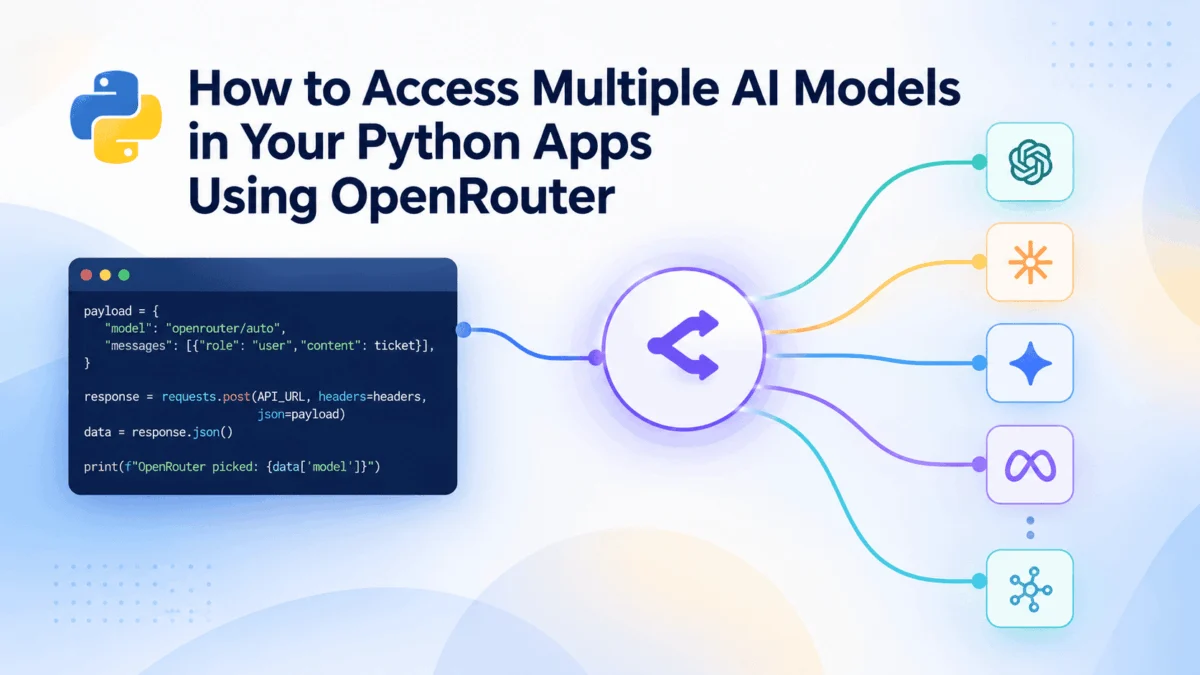
The rapid proliferation of Large Language Models (LLMs) has transformed software development, yet it has simultaneously created a fragmentation challenge for engineers. Developers building AI-powered applications, such as automated support-ticket assistants or content summarization tools, are frequently forced to navigate a labyrinth of disparate APIs. Integrating OpenAI’s GPT-4, Anthropic’s Claude, and Meta’s Llama typically requires managing multiple authentication protocols, varying request structures, and distinct billing models. OpenRouter has emerged as a centralized solution to this technical overhead, providing a unified API layer that allows developers to access dozens of leading AI models through a single, consistent interface. By abstracting the complexities of individual provider integration, OpenRouter enables seamless model switching and robust fallback strategies within standard Python applications.
The Evolution of Model Agnostic Development
In the early stages of the generative AI boom, the industry relied heavily on single-vendor ecosystems. Developers would build their applications around a specific provider’s SDK, effectively locking their software into that provider’s roadmap, pricing, and latency constraints. However, as the market matured, the emergence of high-performing open-source and proprietary alternatives—such as Mistral and Qwen—rendered single-provider strategies increasingly rigid.
The necessity for a "model-agnostic" architecture became clear during the 2023-2024 period, as businesses sought to optimize for cost, performance, and uptime. OpenRouter, founded on the premise of interoperability, acts as a middleware layer. It standardizes the request-response cycle by mapping diverse provider inputs into a unified schema that mimics the industry-standard OpenAI chat completion format. This design choice allows developers to migrate from one model to another by modifying only a single string of code rather than refactoring entire modules of an application.
Technical Implementation and Infrastructure Requirements
For developers looking to integrate OpenRouter, the barrier to entry is intentionally low. The platform does not strictly require proprietary SDKs; because it exposes a standard HTTP API, it can be utilized with common libraries like Python’s requests or httpx.
The implementation workflow generally follows a standard pattern:
- Account Provisioning: Users register via the OpenRouter dashboard to generate an API key. Security best practices dictate that this key should be stored as an environment variable rather than hard-coded into the application logic to prevent unauthorized access or repository exposure.
- Environment Configuration: By setting the
OPENROUTER_API_KEYin the local development environment, the application can authenticate requests dynamically. - API Request Structure: All requests are sent to a singular endpoint (
https://openrouter.ai/api/v1/chat/completions). The payload requires a model identifier (e.g.,meta-llama/llama-3.2-3b-instruct:free) and a list of messages structured in thesystem,user, orassistantformat.
This approach provides a significant advantage for rapid prototyping. For instance, developers can test multiple models—comparing a specific Llama iteration against a Mistral variant—simply by iterating through a list of model strings within a loop.
Financial and Operational Considerations
A significant hurdle for developers entering the AI space is the cost of experimentation. High-end models often carry per-token costs that accumulate quickly during the testing phase. OpenRouter addresses this by providing a curated list of free-to-use models, marked with a :free suffix. These models allow developers to test their application’s architecture, prompt engineering, and response handling without the risk of incurring financial debt.
Beyond cost-effectiveness, the platform introduces sophisticated routing capabilities:
- The "Free Router": By setting the model parameter to
openrouter/free, the platform automatically directs the request to a functioning free model. This is particularly useful for production environments where the developer requires a baseline of functionality without needing to manually manage model updates. - Intelligent Provider Sorting: For paid models, OpenRouter allows developers to prioritize providers based on specific operational needs, such as
sort: pricefor cost efficiency orsort: latencyfor high-performance requirements. - Automated Fallback Logic: One of the most critical features for enterprise-grade reliability is the ability to pass a list of models rather than a single string. If the primary model fails—whether due to provider outages, rate limits, or content filtering—the platform automatically attempts to process the request through the next model in the list. This "failover" mechanism significantly reduces the need for custom, complex retry logic within the application code.
Industry Implications and Future Outlook
The rise of unified API layers like OpenRouter signifies a broader shift toward "commodity AI." As more organizations adopt generative tools, the actual model underlying the application is increasingly viewed as a swappable component rather than a defining feature of the software. This decoupling of the application logic from the AI provider allows for greater architectural resilience.
From an economic perspective, the democratization of access to various models fosters healthy competition among model developers. When switching costs are near zero, the providers are incentivized to maintain high uptime, lower latency, and competitive pricing. This environment benefits the developer community by ensuring that they are not beholden to the uptime of a single vendor.
Looking forward, the integration of these tools into standard development workflows is expected to accelerate. As of late 2024, the trend among data scientists and software engineers is moving toward hybrid deployments—utilizing smaller, faster models for routine tasks and reserving large-scale, high-cost models for complex reasoning. The ability to manage these hybrid systems through a single, clean codebase is not merely a convenience; it is becoming a requirement for scalable AI operations.
Best Practices for Deployment
While the ease of use is a primary draw, developers are encouraged to follow rigorous deployment standards:
- Model Versioning: Always specify the full model name including the provider and version. Relying on generic tags can lead to unpredictable behavior if the underlying model is updated or deprecated.
- Latency Monitoring: When utilizing the
sortfunctionality, developers should log the response times of various providers. Different hosting providers may offer varying levels of throughput for the same model. - Error Handling: Even with robust fallback lists, applications should implement comprehensive error logging to capture why a request may have switched to a backup model. This data is invaluable for identifying bottlenecks in the AI pipeline.
- Data Privacy: Although OpenRouter facilitates the connection, developers must ensure that sensitive user data sent to these models complies with local and international privacy regulations (such as GDPR or CCPA), regardless of which provider ultimately processes the request.
By centralizing the interaction with LLMs, developers can shift their focus from managing infrastructure and authentication to refining the prompts and logic that drive value for their users. As the landscape of artificial intelligence continues to evolve at a breakneck pace, tools that offer modularity and stability will remain essential for the next generation of software development. Whether building a simple support-ticket assistant or a complex agentic system, the ability to pivot between models ensures that the application remains adaptable to the rapidly changing capabilities of modern AI.