The political landscape of Argentina underwent a seismic shift in late 2023 with the inauguration of Javier Milei, a self-described anarcho-capitalist whose campaign was defined by the symbolic wielding of a chainsaw. This imagery served as a visceral promise to the electorate: a commitment to hack away at the thicket of state bureaucracy, slash public subsidies, and dismantle environmental regulations that Milei argues have stifled the nation’s economic potential. Central to this "chainsaw" doctrine is the aggressive exploitation of Argentina’s natural resources, with a specific focus on revitalizing a mining sector that has remained largely stagnant for nearly a decade.
Since taking office, the Milei administration has identified copper as the cornerstone of its economic recovery plan. As the global community pivots toward an energy transition dependent on electrification, the demand for copper—a primary conductor used in electric vehicle (EV) batteries, wind turbines, and solar grids—is projected to skyrocket. Argentina sits atop some of the world’s largest untapped copper deposits, yet it has not exported the mineral in significant quantities since 2018. To bridge this gap, Milei has moved to weaken the National Glacier Protection Law, a move that has sparked a fierce confrontation between international mining interests and environmental advocates.
The Economic Imperative and the Copper Deficit
Argentina’s economic history over the last two decades has been defined by a cycle of sovereign debt defaults, triple-digit inflation, and chronic currency devaluation. In this context, the mining sector represents a potential lifeline. While neighboring Chile has utilized its portion of the Andes Mountains to become the world’s leading copper producer, accounting for roughly 24% of global output, Argentina’s side of the same geological formation remains underdeveloped.
According to data from the Argentine Chamber of Mining Companies (CAEM), the country currently has 76 copper projects in various stages of development. If even a fraction of these projects reach the production phase, they could generate upwards of $10 billion in annual export revenue. For a government desperate for foreign currency reserves to stabilize the peso and repay the International Monetary Fund (IMF), the logic for rapid expansion is undeniable.
However, the primary obstacle for investors has historically been the National Glacier Protection Law (Law 26.639), enacted in 2010. This legislation established "minimum standards" for the protection of glaciers and the periglacial environment—areas of frozen ground that act as critical water regulators for the arid regions of western Argentina. By declaring these zones public assets and prohibiting mining activity within them, the law effectively placed some of the country’s richest mineral deposits out of reach.
A Chronology of Legislative Reform
The push to unlock Argentina’s mineral wealth reached a turning point in April 2024, when the Argentine Congress, under heavy pressure from the Milei administration and provincial governors, voted to reform the 2010 law.
2010: The National Glacier Protection Law is passed, following a veto by then-President Cristina Fernández de Kirchner that was eventually overturned. It remains one of the most stringent environmental laws in the world.
2011–2018: Mining exports, particularly gold and silver, continue but face increasing legal challenges. In 2018, the Alumbrera mine, Argentina’s last major copper-producing site, ceases operations, bringing copper exports to zero.
2023: Javier Milei wins the presidency on a platform of radical deregulation. He introduces the "Omnibus Law," a massive legislative package aimed at privatizing state industries and weakening environmental oversight.
April 2024: Congress approves reforms that decentralize the authority to protect glaciers. The responsibility shifts from the federal Argentine Institute of Snow, Ice and Environmental Sciences (IANIGLA) to the individual provinces.
This reform allows provincial governments to determine whether a periglacial area is "hydrologically relevant" before granting mining permits. Critics argue this creates a conflict of interest, as provincial governments are often the primary beneficiaries of mining royalties and are thus incentivized to prioritize extraction over conservation.
McEwen Copper and the Los Azules Project
The face of this new "copper rush" is Rob McEwen, a veteran Canadian mining magnate and founder of Goldcorp. His company, McEwen Copper Inc., is developing the Los Azules project in the San Juan province, located in a remote mountain bowl at an elevation of 3,500 meters.
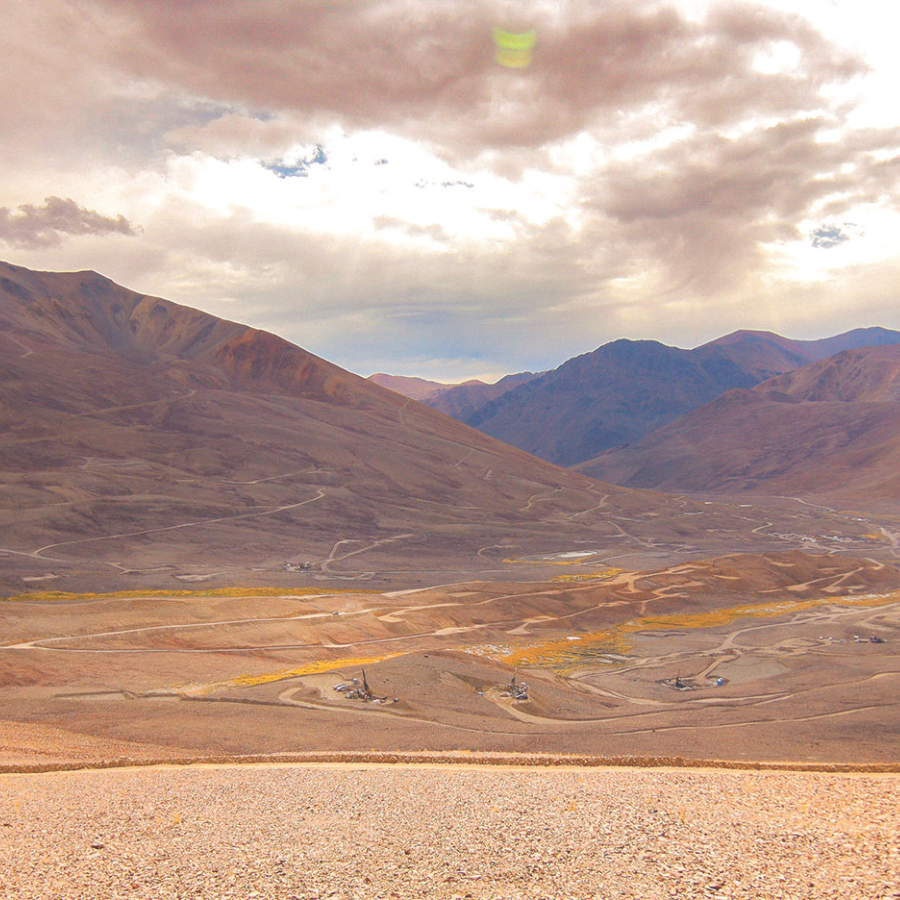
Los Azules is currently ranked as one of the top ten largest undeveloped copper deposits in the world. A 2023 preliminary economic assessment (PEA) suggested the mine could produce 327 million pounds of copper cathode annually over a 27-year lifespan. The project’s after-tax net present value (NPV) is estimated at $2.9 billion, with an internal rate of return (IRR) of 21.2%.
McEwen, known for his unconventional approach to the industry, is attempting to position Los Azules as a "green" mining model. The project intends to utilize heap leaching technology, which uses significantly less water than traditional milling and produces no wet tailings—the toxic waste ponds that have historically plagued the industry. Furthermore, McEwen has commissioned Jason McLennan, a leader in the "Living Building Challenge," to design a futuristic, sustainable camp for workers that features glass-encased gardens and renewable energy integration.
Despite these promises of sustainability, the project has faced legal challenges from environmental NGOs. Critics point out that Los Azules is located in an area containing "rock glaciers"—masses of ice covered by debris that are protected under the original 2010 law. McEwen has denied that his project will impact active glaciers, but the shift in legislative oversight has undoubtedly cleared a path for the project to proceed toward a planned 2030 production start.
Supporting Data: The Global Demand for Copper
The urgency of the Milei administration’s reforms is tied to global market dynamics. The International Energy Agency (IEA) reports that to reach net-zero emissions by 2050, the world will need to double the current supply of copper by 2035.
- Electric Vehicles: A single EV requires approximately 85 kilograms of copper, compared to just 20 kilograms for a traditional internal combustion engine vehicle.
- Renewable Energy: Wind and solar power plants require three to six times more copper than fossil-fuel-based power generation.
- Supply Shortfalls: Analysts at Goldman Sachs have predicted a "chronic deficit" in copper supply by the late 2020s, with prices expected to remain well above historical averages.
For Argentina, this represents a unique window of opportunity. However, the country’s mining sector must also contend with the "reputational baggage" left by previous operations.
Environmental Backlash and Industry Reputation
The opposition to Milei’s mining push is rooted in a history of environmental disasters. Toronto-based Barrick Gold Corp, which operates the Veladero mine in San Juan, has become a symbol of the industry’s risks in Argentina. Between 2015 and 2017, the Veladero mine suffered three separate cyanide solution spills, leading to massive fines and temporary suspensions.
"The mining industry has no conscience," says Juan Pablo Milana, a professor of geological science at the Universidad Nacional de San Juan. Milana and other experts argue that the destruction of periglacial environments will have irreversible consequences for Argentina’s water security. In a country currently grappling with prolonged droughts that threaten its vital agricultural sector, the trade-off between copper and water is a point of national contention.
By late April 2024, the provinces of Santa Cruz and La Pampa filed injunctions to block the implementation of the new glacier reforms. A coalition including Greenpeace and the Argentine Association of Environmental Lawyers has gathered nearly one million signatures for a petition declaring the reforms unconstitutional. They argue that the law violates the principle of "non-regression" in environmental law, which prohibits the government from weakening existing protections.
Broader Impact and Implications
The situation in Argentina is a microcosm of a larger global tension: the conflict between the local environmental costs of mining and the global necessity of the energy transition. This is often described as a "green sacrifice zone" dynamic, where the Global South provides the raw materials for the Global North’s decarbonization at the cost of its own ecosystems.
Leandro Gómez, of the Environment and Natural Resources Foundation (FARN), emphasizes that the current model of the energy transition often ignores the rights of local communities. "The race to decarbonize cannot be a race to the bottom for environmental standards," Gómez stated.
From a geopolitical perspective, the Milei administration’s pivot is also an attempt to reduce China’s dominance in the critical minerals supply chain. Currently, China controls a significant portion of global copper processing. By courting Canadian and American firms like McEwen Copper and Rio Tinto, Argentina is positioning itself as a strategic partner for Western nations seeking to secure their own green energy supply chains.
Conclusion and Future Outlook
The success of Javier Milei’s copper strategy depends on whether his administration can maintain political stability long enough for these multi-billion-dollar projects to break ground. While the legislative path has been cleared, the "crisis of representation" cited by academics like Milana suggests that social license for mining remains fragile.
As McEwen Copper prepares for construction to begin in 2025, the eyes of the global mining industry are on San Juan. If Los Azules succeeds in becoming a high-yield, low-impact mine, it could provide a blueprint for future projects in the Andes. However, if the project leads to the degradation of water resources or faces continuous legal gridlock, it may serve as a cautionary tale of the limits of "chainsaw" deregulation in the face of ecological reality. For now, Argentina remains a nation divided—balancing the promise of a golden age of copper against the preservation of its most essential resource: water.