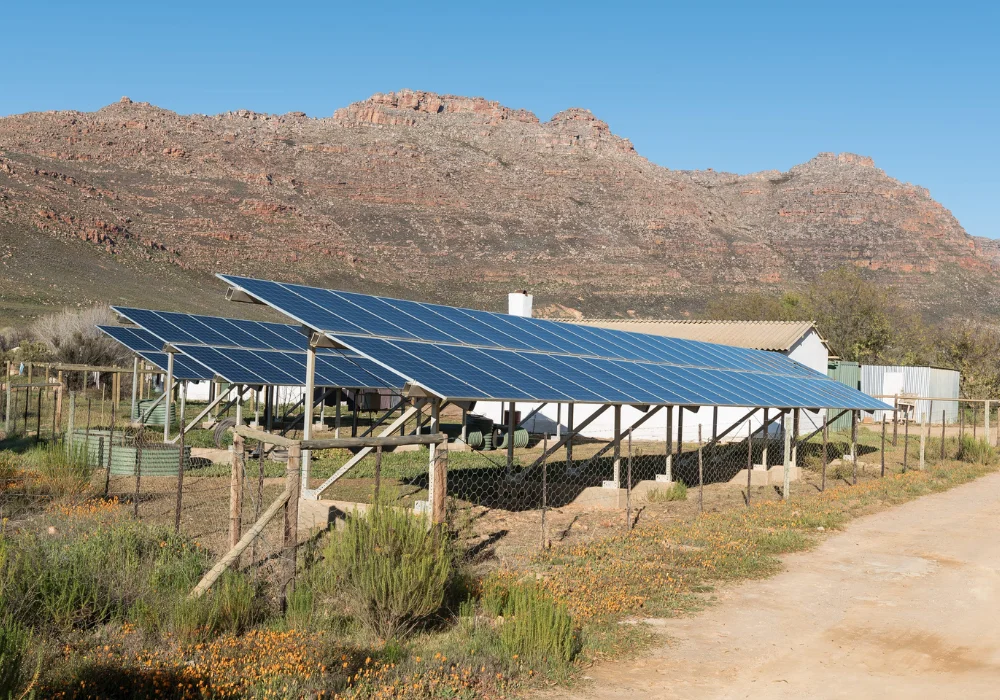
In a remote agricultural village in Syria named Khirais, 24 households pay a modest US$0.20 a month for round-the-clock power, a stark contrast to the crippling energy shortages that have plagued the country for over a decade. When villagers began returning to rebuild Khirais in 2021, they faced a landscape devastated by armed conflict. The local infrastructure was severely damaged, leaving the community with access to public electricity for just one hour a day. Refrigerated food spoiled rapidly, children were unable to study after dark, and local farmers and producers could no longer rely on the basic electrical equipment required to sustain their livelihoods.
The turning point for Khirais came when a regional nonprofit organization intervened, installing solar panels bolted directly to the community center. Today, the village operates on a 24/7 clean energy microgrid. This decentralized system powers lighting, refrigeration, and essential domestic and agricultural appliances, successfully supporting a revival of the local rural economy. Yet, Khirais is not merely an isolated feel-good story; it serves as a micro-cosmic case study with significant global implications. The project demonstrates the vital utility of locally organized solar infrastructure when conventional state budgets, public grids, and traditional energy financing mechanisms fail. It delivers not just electricity, but the crucial continuity of daily life, income generation, and essential community services.
The experience of Khirais raises critical questions for regions undergoing reconstruction across Syria and throughout the wider developing world. When traumatized communities are forced to construct their own improvised energy systems because formal state networks have collapsed, how can international public policy and development finance integrate these assets into a sustainable, equitable recovery?
Energy Resilience and Fragile States on a Global Scale
The predicament faced by Syrian villages reflects a broader international crisis. According to data compiled by the Council on State Fragility, more than 80 percent of the estimated 800 million people worldwide who currently live without access to electricity reside in settings classified as fragile and conflict-affected. These regions are projected to account for a significant share of future global electricity-demand growth, yet capital investment in these high-risk areas remains critically scarce. In 2025, the Green Climate Fund approved only around US$500 million for fragile and conflict-affected states out of a record US$3.26 billion in new project approvals—representing roughly 15 percent of total funding.
Experts at the Council on State Fragility argue that fragile areas urgently require energy systems that are robust enough to withstand ongoing conflict and uncertainty, while remaining affordable and environmentally sustainable. Distributed renewable energy systems—such as rooftop solar panels, small-scale wind turbines, and localized mini-grids—offer a viable solution. By generating and distributing power in close proximity to the end-users, these technologies can operate either in tandem with the national grid or entirely independently when the central infrastructure is offline. Crucially, distributed systems disperse systemic risk, reducing a society’s dangerous dependency on a centralized handful of large generation plants, vulnerable fuel supply lines, and easily targeted transmission corridors.
This decentralized approach is not intended as a wholesale rejection of traditional public grids. The International Energy Agency maintains that national grids remain essential for transmitting heavy power to major industries, urban citizens, and large-scale public services, acting as a primary source of flexibility as modern power systems integrate variable renewables. Microgrids and energy storage will complement rather than replace large-scale grid development.
However, this distinction carries profound weight in post-conflict states like Syria, where the complete reconstruction of national grids will inevitably take years, if not decades. Distributed solar installations, advanced battery storage, and localized micro-grids provide an indispensable operational bridge, keeping critical public infrastructure such as water pumps, medical facilities, and small businesses functioning in the interim. Evidence from other fragile contexts reinforces this strategic reality. A recent study examining a solar-and-battery system deployed in Yangon, Myanmar, found that decentralized solar photovoltaic technology and storage could provide meaningful energy resilience in fragile-grid contexts, supplying 47.1 percent of annual electricity demand and covering approximately 77 percent of peak-demand hours through solar-plus-storage configurations.
The Chronology of Syria’s Off-Grid Solar Boom
Before the outbreak of armed conflict in 2011, Syria possessed approximately 9.5 gigawatts of installed electricity generation capacity, a figure that provided relatively stable, albeit centralized, power to its population. By the end of 2023, however, continuous warfare and economic sanctions had reduced available generation capacity to a mere 1.6 gigawatts. This severe deficit left millions of citizens with less than two hours of public electricity each day, paralyzing both domestic life and commercial enterprise.
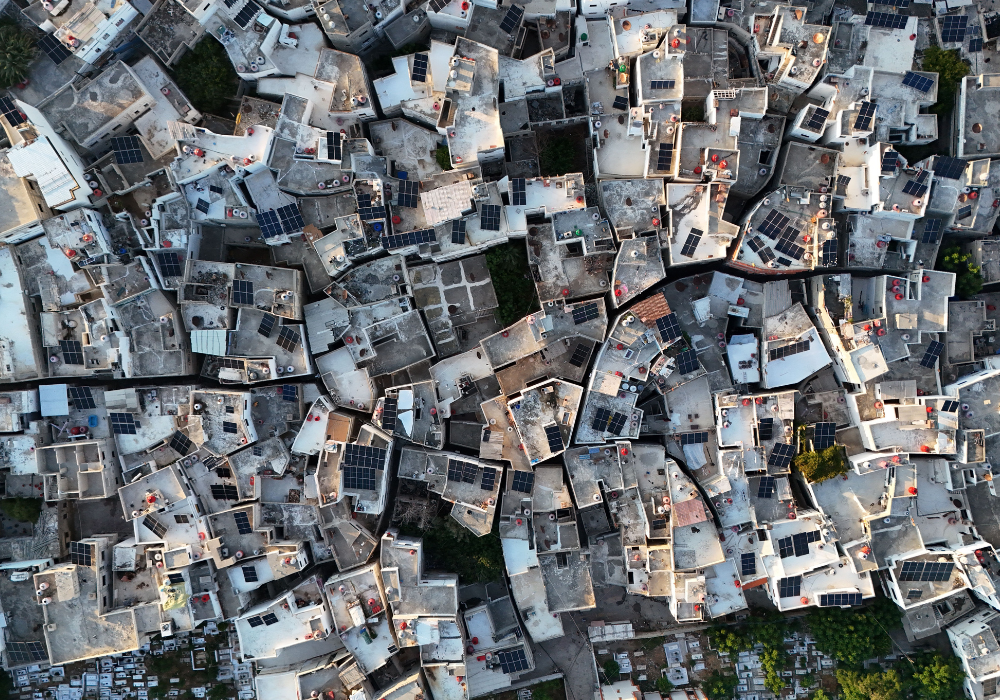
Into this profound infrastructural vacuum stepped self-installed, private solar technology. The exact scale of Syria’s off-grid solar economy remains difficult to quantify with absolute precision because the vast majority of the sector is privately financed, informal, and unregistered. Nevertheless, industry estimates indicate that nominal capacity surged from approximately 250 megawatts in 2022 to more than 2 gigawatts by 2025. Contemporary market estimates suggest that roughly one-quarter of Syrian households now utilize some form of solar equipment to manage persistent power outages.
While analysts advise caution regarding these figures—noting that nominal panel capacity does not automatically equate to stable public power availability—the overarching macroeconomic direction is unmistakable. Syrian citizens have constructed a massive volume of decentralized renewable capacity, driven not primarily by environmental idealism, but by pure economic necessity and a complete lack of viable alternatives.
Shafiqul Alam, lead analyst for Bangladesh energy at the Institute for Energy Economics and Financial Analysis, observed in interviews that when energy becomes completely unaffordable or unavailable, populations inevitably take matters into their own hands. Academic research supports this observation, with one study revealing that a 1 percent increase in local conflict intensity in Syria correlated directly with a 9.71 percent short-term increase in regional renewable-energy production, acting as a bottom-up shock absorber against the deepening energy crisis.
This phenomenon does not prove that warfare inherently fosters a green transition; rather, it underscores that severe grid degradation and chronic fuel scarcity exponentially amplify the local demand for localized, self-generated power. Distributed systems possess a distinct operational advantage: they can be constructed rapidly. Rebuilding traditional high-voltage grid connectivity, by contrast, requires immense financial capital and protracted timelines.
This temporal gap cements the strategic value of decentralised solar. While it cannot single-handedly power a national economy at scale, it provides the essential foundation upon which economic recovery begins—powering agricultural irrigation, maintaining telecommunications, keeping retail shops open, and enabling small-scale food processing. In specialized instances, it has even been deployed to power electric vehicles used for medical aid distribution at a fraction of the cost of conventional fossil-fuel-powered transport.
The Emerging Risk of a Two-Tier Energy Market
Despite the dramatic expansion of solar technology, access across Syria remains deeply unequal. The country’s organic solar boom has birthed a stratified energy market dictated heavily by individual access to foreign currency, international financial remittances, and upfront capital reserves.
Hayley Schuler-McCoin, a senior research fellow at the Carboun Institute specializing in energy policy and geopolitics in Southwest Asia and North Africa, notes that the households best positioned to purchase expensive solar panels and storage batteries were those receiving regular wages pegged to foreign currencies, primarily because all solar hardware must be imported. International non-governmental organizations and households with robust remittance networks were similarly equipped to absorb the steep initial costs. Conversely, citizens lacking these financial lifelines remain largely relegated to expensive, polluting diesel generators, rationed public supply, or total darkness.
In the Syrian economic context, startup costs running into thousands of dollars represent a prohibitive barrier, even when low-income families attempt to pool their collective resources. Furthermore, the proliferation of poor-quality equipment, inadequate technical regulation, unregulated battery disposal, and ongoing maintenance requirements introduce severe financial risks. Some vulnerable households may rationally calculate that purchasing a single hour of diesel generator power when urgently needed is more manageable than committing to a long-term microgrid subscription they cannot reliably afford.
Without deliberate policy intervention and inclusive financial planning, decentralized energy solutions risk cementing a deeply entrenched two-tier energy system. Families with access to hard currency, remittances, or suitable urban rooftops can purchase dependable energy resilience and insulate themselves against volatile fossil fuel prices, while marginalized populations remain trapped in energy poverty. Schuler-McCoin emphasizes that this danger extends equally to larger commercial and agricultural investments. If a commercial factory or farming enterprise installs solar generation utilizing public or concessional international finance, it must be legally and structurally paired with mandatory power-sharing provisions for surrounding residential neighborhoods. Without such equitable frameworks, socioeconomic disparities within recovering communities will widen dangerously.
Lessons from International Development Models
Addressing these structural hurdles requires innovative financial architecture, a lesson drawn from successful deployments in other developing nations. Shafiqul Alam highlights the framework utilized by Bangladesh’s Infrastructure Development Company Limited, which successfully combined capital-buildup subsidies with grassroot delivery mechanisms executed through trusted local partner organizations, entirely bypassing the inefficiencies of conventional commercial lending.
While several central banks in developing regions have instituted specialized green refinancing schemes designed to stimulate solar investments, Alam cautions that these programs are frequently misaligned with the realities of small household systems. Traditional commercial lenders typically mandate that a borrower secure a private loan first before applying for refinancing—a bureaucratic delay that systematically excludes low-income applicants who lack formal credit histories, steady employment verification, or physical collateral.
For these marginalized demographics, targeted capital subsidies that absorb a fraction of the initial equipment cost make decentralized energy genuinely accessible. Concurrently, credit guarantees, pre-financing models, and localized lending intermediaries can bridge the gap where traditional commercial banks lack the means to evaluate risk profiles. The overarching lesson is not that Syria must blindly replicate Bangladesh’s model, but that domestic financing mechanisms must directly reflect local realities—prioritizing affordability, realistic repayment capacities, and trusted community delivery channels.
Balancing Decentralization with National Grid Restoration
Above all, energy experts emphasize that international reconstruction finance must not fund decentralized solutions at the direct expense of national grid rehabilitation. The immediate priority for international investors must be the structural restoration of transmission lines, substations, metering infrastructure, and technical maintenance capacity—the less visible, capital-intensive investments that private equity routinely avoids.
The World Bank’s $146 million Syria Electricity Emergency Project, designed to support the repair of vital high-voltage interconnectors and substations near major urban demand centers while building institutional sectoral capacity, represents a positive step forward. However, such initiatives remain insufficient on their own to fully revive the national grid.
Integrating decentralized systems with centralized infrastructure offers a path forward. According to Alam, implementing structured net-metering provisions would allow households and commercial enterprises with surplus solar generation to feed excess power back into the national grid while earning a financial return. If properly engineered, this mechanism could create a predictable revenue stream for larger residential, agricultural, and small-business systems, simultaneously mitigating the widespread wastage of locally generated electricity that cannot be immediately consumed on-site.
Experts do not present distributed solar as an ideological alternative to grid reconstruction, but rather as an essential, complementary pillar. While modernization of the national grid requires immense, long-term capital injection, distributed systems alleviate the immediate infrastructural burden, lowering the cost of survival and recovery in the interim.
Ultimately, analysts stress that any domestic tariff regime, pricing structure, or subsidy program must be preceded by rigorous, country-specific empirical analysis covering local electricity pricing, granular household demand profiles, network capacity, backup generator usage, rooftop potential, battery depreciation, and public utility finances. Conducting this foundational analysis transforms scattered, ad-hoc survival mechanisms into a synchronized engine for national recovery. Small systems have already triggered a decentralized energy revolution from the bottom up; with coordinated public and international support, the multiplier effect for Syria’s future could be profound.