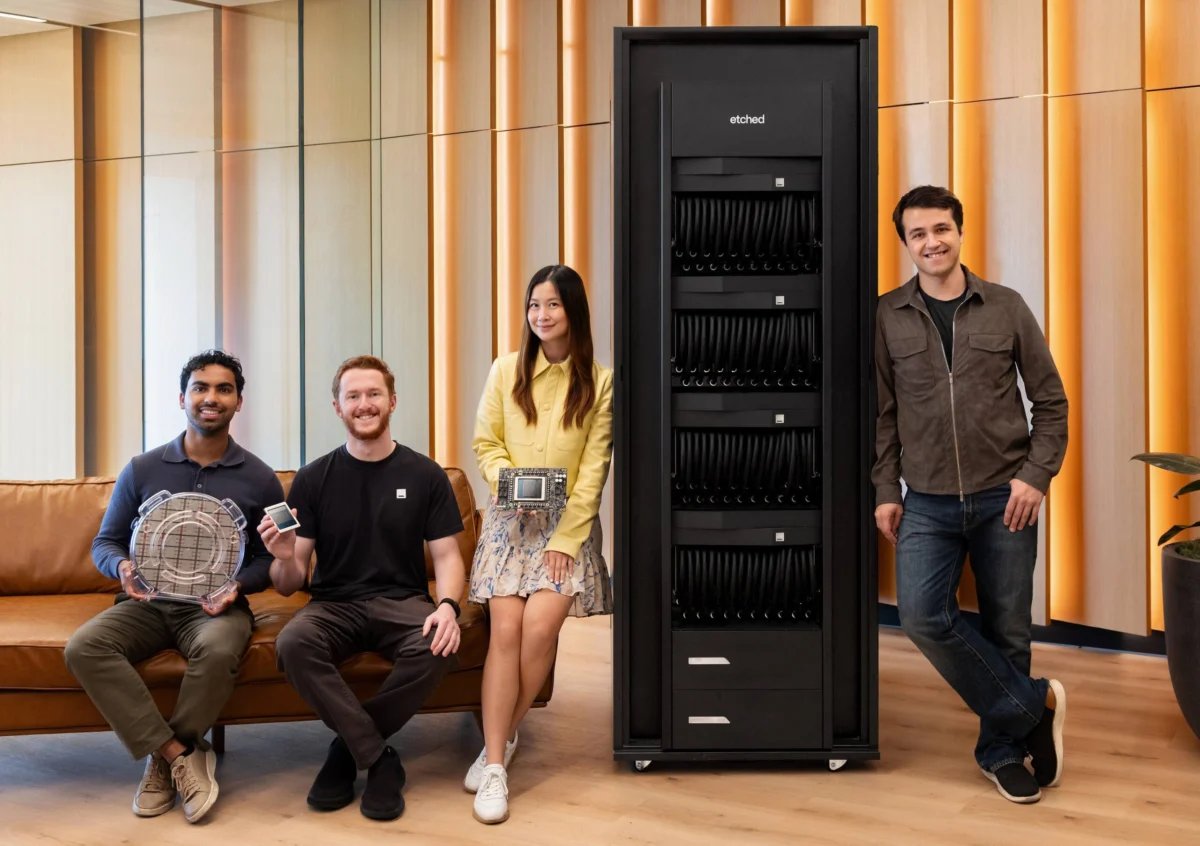
Etched, a pioneering hardware startup focused on optimizing artificial intelligence inference, has successfully closed a $300 million Series C funding round, propelling its valuation to $10 billion pre-money. The round was led by Sequoia Capital, with significant participation from industry heavyweights including Jane Street, Andreessen Horowitz, Diffusion, and SK Hynix. This substantial investment underscores the escalating demand for specialized hardware solutions capable of handling the immense computational demands of modern AI, particularly in the rapidly expanding inference market.
The Ascendancy of AI Inference and Etched’s Strategic Position
The global market for AI inference is experiencing unprecedented growth, with projections indicating it will soon become the largest segment within the broader artificial intelligence industry. Inference, the process of deploying trained AI models to make predictions or decisions on new data, is becoming integral to virtually every aspect of digital life. From powering personalized recommendations in e-commerce and streaming services to enabling sophisticated diagnostics in healthcare, driving immersive experiences in video games, and automating complex legal analyses, the pervasive nature of AI inference necessitates a fundamental shift in computing infrastructure.
Traditionally, AI hardware development has been heavily geared towards training large, complex models. However, the sheer scale of AI deployment means that the cumulative computational cost of inference is rapidly eclipsing that of training. This paradigm shift has created a critical bottleneck: existing hardware, often optimized for general-purpose computing or training, is proving inefficient and cost-prohibitive for widespread inference applications. Etched has strategically positioned itself to address this challenge by developing custom silicon and cluster-scale systems specifically engineered for maximum intelligence per flop – a metric representing the computational efficiency of AI processing.
The company’s foundational bet on inference-specific hardware, made when founders Gavin, Chris, and Rob were still undergraduates at Harvard in 2022, was considered contrarian at the time. The prevailing sentiment in the hardware startup ecosystem favored more general-purpose AI accelerators. However, Etched’s foresight has paid off. As of its Series C announcement, Etched stands as one of the few post-ChatGPT-era hardware companies to have developed production-ready custom silicon, slated for shipment in 2026. This positions them at the forefront of a market that is now widely recognized for its immense potential.
A Timeline of Innovation and Production Readiness
Etched’s journey from dorm room concept to production-ready hardware is marked by a series of strategic milestones and significant technological breakthroughs:
- 2022: Founders Gavin, Chris, and Rob identify the burgeoning inference market as a critical area for specialized hardware innovation. They begin conceptualizing and designing custom silicon architectures.
- Early 2023: Etched pioneers foundational research in low-voltage inference and cluster-scale memory solutions. These architectural choices are crucial for enhancing throughput and reducing latency, key performance indicators for inference workloads.
- Mid-2023: Recognizing that inference is not just about individual chips but about networked systems, Etched shifts its design philosophy towards building cluster-scale inference solutions. This involves optimizing hardware for inter-chip communication and distributed processing.
- Late 2023 – Early 2024: The company establishes a live lab in San Jose to facilitate early hardware testing and integration. Simultaneously, an office is opened in Taiwan to ensure close proximity and rapid iteration with key semiconductor manufacturing partners.
- Early 2024: Etched achieves a significant milestone by taping out its first-generation chip at TSMC, utilizing the foundry’s leading-edge nodes. This marks the company as the first post-ChatGPT-era firm to successfully complete a full-reticle A0 chip tape-out on such advanced manufacturing processes.
- April 2024 (40-day Sprint): In a remarkably compressed timeframe, the Etched team successfully brings up its first cluster of chips. This cluster demonstrates the ability to run inference on a wide array of frontier AI models, achieving "Pareto dominant" performance on industry-standard throughput-interactivity curves. This means Etched’s system offers a superior balance of processing speed and responsiveness compared to existing solutions across a broad spectrum of AI models.
- Mid-2024: Early access programs commence, allowing select customers to experience the performance and capabilities of Etched’s inference systems firsthand.
- July 2024: Etched announces its $300 million Series C funding round, led by Sequoia Capital, at a $10 billion pre-money valuation, signaling strong investor confidence in the company’s technology and market potential.
This chronological progression highlights Etched’s rapid development cycle and its ability to translate ambitious research into tangible, production-ready hardware within an exceptionally competitive and fast-moving industry.
Architectural Innovations Driving Performance Gains
Etched’s success is rooted in its commitment to fundamental architectural innovations designed to tackle the unique challenges of AI inference. Two key breakthroughs have been central to their strategy:
- Low-Voltage Inference: By optimizing their silicon design for significantly lower operating voltages, Etched dramatically reduces power consumption. This is paramount for large-scale inference deployments, where energy costs can become a substantial operational expense. Lower voltage also translates to reduced heat generation, allowing for denser compute configurations and improved system reliability. This approach challenges conventional wisdom in chip design, which often prioritizes raw clock speeds over power efficiency for inference.
- Cluster-Scale Memory: As AI models continue to grow in size and complexity, efficient memory management becomes a critical factor in inference performance. Etched has developed novel memory architectures that scale seamlessly across clusters of chips. This ensures that data can be accessed and processed with minimal latency, regardless of whether it resides on a single chip or is distributed across multiple nodes. This is particularly important for large sparse Mixture-of-Experts (MoE) models, which require vast amounts of memory to store and access their numerous parameters.
These innovations are not merely theoretical. They have been architected into Etched’s systems to deliver tangible improvements in both throughput (the number of inferences processed per unit of time) and latency (the time taken to complete a single inference). The company’s systems are engineered to excel across a diverse range of frontier AI models, including large sparse MoEs, dense transformers, and emerging architectures like Mamba, which offer different computational profiles and memory access patterns. This versatility ensures Etched’s hardware can adapt to the evolving landscape of AI model development.
The Crucible of Hardware Development: Navigating a Dynamic Landscape
Developing novel computing hardware is widely recognized as one of the most complex engineering endeavors. The challenge is amplified in the AI domain, where the underlying software – the AI models themselves – are in a constant state of flux. The landscape shifts rapidly, with models undergoing iterative improvements every few weeks, context lengths expanding dramatically, novel attention mechanisms being invented, and the optimal balance between dense and sparse computation continuously evolving.
To succeed in this environment, Etched has demonstrated an exceptional ability to operate on two critical fronts simultaneously:
- Rapid Iteration: The company must iterate on its hardware designs quickly enough to keep pace with the relentless evolution of AI models. This requires agile development processes, efficient prototyping, and close collaboration with AI researchers and developers.
- Pushing Hardware Frontiers: Concurrently, Etched must push the boundaries of what is physically possible with silicon technology. This involves deep expertise in semiconductor physics, advanced manufacturing processes, and innovative architectural design.
This dual imperative demands a rare combination of talent and organizational structure. Etched’s leadership, comprised of visionary engineers and strategists, has cultivated a team that embodies this duality. The company emphasizes a culture of relentless execution, epitomized by their mantra: "Production is the product. Shipping is all that matters." This focus on delivering tangible, working hardware is a key differentiator in an industry where many promising concepts fail to reach commercial viability.
The company’s operational agility is evident in its proactive measures: establishing a live lab to test and validate hardware in real-world conditions, and setting up an office in Taiwan to maintain direct oversight and collaboration with critical semiconductor fabrication and packaging partners. This hands-on approach, coupled with a willingness to question fundamental assumptions, such as the feasibility of ultra-low voltage inference, has allowed Etched to overcome significant technical hurdles and accelerate its path to market.
Investor Confidence and the Future of Compute
The substantial Series C funding round, led by Sequoia Capital, signals robust investor confidence in Etched’s vision and execution. Sequoia Capital, known for its early-stage investments in category-defining technology companies, has a history of backing transformative hardware ventures. Their lead role in this round underscores the perceived significance of Etched’s contribution to the future of AI infrastructure.
"We are delighted to be partnering with Etched and leading their $300 Million Series C at a $10 Billion pre-money valuation," stated a representative from Sequoia Capital. "The intelligence race is fundamentally compute constrained. Pushing the limits of physics to deliver the maximum intelligence per flop is both an insanely fun engineering and operations problem, and an incredibly noble mission for humanity. Etched has built a beautiful machine in Gen 1. We expect it will do very well in the market. But we are partnering with Etched because we believe they have built the rarest thing in this industry: the machine that builds the machine. This is a team that has the taste and the relentless execution to keep shipping the next generation of inference machines, faster and more ambitious each time."
The participation of Jane Street, a prominent quantitative trading firm and significant technology investor, suggests a recognition of the critical role high-performance computing plays in financial markets, a sector increasingly reliant on sophisticated AI models. Andreessen Horowitz, a venture capital firm with a deep understanding of the software and AI landscape, further solidifies the investment syndicate’s belief in Etched’s potential to disrupt the hardware market. Diffusion and SK Hynix, a major semiconductor supplier, bring valuable industry expertise and strategic partnerships, potentially facilitating Etched’s access to advanced manufacturing capabilities and supply chain resources.
The implications of Etched’s success extend beyond its own market position. By providing more efficient and cost-effective inference hardware, Etched has the potential to democratize access to advanced AI capabilities. This could accelerate the adoption of AI across a wider range of industries and applications, driving innovation and economic growth. As AI becomes more deeply embedded in society, the efficiency and scalability of its underlying infrastructure will be a critical determinant of its ultimate impact. Etched’s focus on maximizing "intelligence per flop" directly addresses this fundamental need, positioning them as a key enabler of humanity’s continued progress in artificial intelligence.