When individuals engage with financial planning platforms like Betterment, the ability to define and pursue specific investment goals is paramount. Betterment empowers users to establish an unlimited number of investment goals, each meticulously calibrated to their unique financial aspirations and timelines. During the creation of a new investment goal, users are prompted to specify the anticipated time horizon for that objective and to select from a predefined set of goal types. This foundational step is critical, as it informs the platform’s sophisticated allocation methodology, designed to optimize the balance between risk and potential return.
While the core investment allocation advice pertains to traditional investment goals, Betterment also offers specialized products such as Cash Reserve for cash goals and a Crypto ETF portfolio for cryptocurrency objectives. These distinct offerings operate outside the purview of the standard investment allocation advice, reflecting the different risk profiles and market dynamics associated with each asset class.
The time horizon and goal type selected by a user are instrumental in shaping Betterment’s strategy for all investment goals, with the notable exception of Emergency Funds. These parameters signal when the user intends to access the invested capital and the preferred method of withdrawal. For instance, a goal designated for a major purchase might anticipate a full, immediate liquidation of assets, whereas a retirement goal often implies a strategy of partial, periodic withdrawals over an extended period.
Emergency Funds, by their very nature, are designed to address unforeseen financial exigencies, making it impossible to assign a fixed time horizon. Betterment acknowledges this inherent unpredictability by assuming a default time horizon for Emergency Funds, primarily to guide initial saving and deposit recommendations. However, this assumed horizon is editable and does not influence the platform’s recommended investment allocation for these critical funds. This approach underscores Betterment’s commitment to ensuring that emergency savings are accessible while still offering some potential for growth. Furthermore, Betterment maintains a modest operational cash allocation within automated investment portfolios across taxable accounts, health savings accounts, and individual retirement accounts, a detail that users can find elaborated in their portfolio-specific disclosures.
The Science Behind Betterment’s Allocation Recommendations
For all investment goals, excluding Emergency Funds, Betterment formulates a recommended investment allocation by projecting a diverse spectrum of potential market outcomes. The platform then identifies the optimal risk level by averaging the performance across the 5th to 50th percentiles of these projected scenarios. This data-driven methodology aims to provide an allocation that is robust across various market conditions.
For Emergency Funds, the recommended allocation seeks a delicate equilibrium, aiming to provide growth potential while simultaneously mitigating the risk of a drawdown that would significantly deplete the essential buffer. This dual objective is crucial for ensuring that emergency funds are both accessible and capable of weathering minor market fluctuations without compromising their primary purpose.
Navigating Goal Types and Investment Allocations
Betterment categorizes investment goals into several distinct types, each with a corresponding range of recommended investment allocations. These ranges, presented in the table below, illustrate how the allocation shifts based on the goal’s nature and the user’s proximity to achieving it.
| Goal Type | Most Aggressive Recommended Allocation | Most Conservative Recommended Allocation |
|---|---|---|
| Major Purchase | 90% stocks (33+ years) | 0% stocks (time horizon reached) |
| Education | 90% stocks (33+ years) | 0% stocks (time horizon reached) |
| Retirement | 90% stocks (20+ years until retirement age) | 56% stocks (retirement age reached) |
| Retirement Income | 56% stocks (24+ years remaining life expectancy) | 30% stocks (9 years or less remaining life expectancy) |
| General Investing | 90% stocks (20+ years) | 56% stocks (time horizon reached) |
As the data clearly indicates, a fundamental principle guiding Betterment’s recommendations is the relationship between a goal’s time horizon and its risk profile. Longer time horizons generally permit a more aggressive investment allocation, allowing for greater exposure to equities and their associated growth potential. Conversely, shorter time horizons necessitate a more conservative approach, prioritizing capital preservation by increasing the allocation to less volatile assets like bonds. This dynamic adjustment process is often referred to as a "glidepath," a carefully designed trajectory that guides the recommended asset allocation for a given goal as it matures over time.
The Glidepath in Action: Visualizing Allocation Shifts
Betterment provides visual representations of these glidepaths for various goal types, offering users a clear understanding of how their investment allocation is expected to evolve.
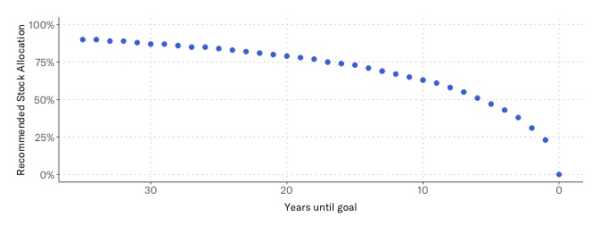
Major Purchase and Education Goals Glidepath:
The glidepath for Major Purchase and Education goals typically exhibits a sharp decline in stock allocation as the target date approaches. This is predicated on the expectation of a complete liquidation of the investment to fund the purchase or educational expenses. The aggressive allocation in the early stages aims to maximize growth potential over the long term, while the rapid shift to conservatism as the goal nears ensures that the accumulated capital is protected from significant market downturns immediately prior to its intended use.
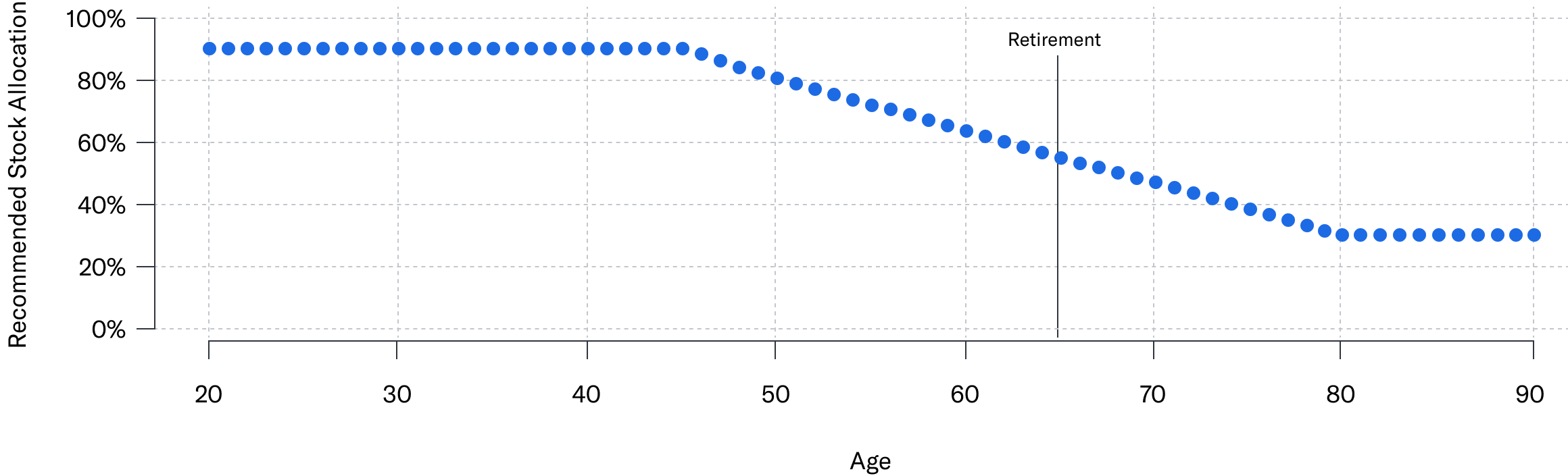
Retirement and Retirement Income Goals Glidepath:
The glidepath for Retirement and Retirement Income goals is designed with a longer-term perspective. For individuals planning for retirement, the allocation remains relatively aggressive for an extended period, reflecting the decades-long nature of retirement and the potential for continued growth. As retirement age is reached, the allocation gradually becomes more conservative, but it typically does not reach zero stock exposure. This is because retirement often involves drawing income from the portfolio over many years, necessitating a continued balance between growth and preservation. The "Retirement Income" glidepath, specifically, adjusts more dynamically based on life expectancy, aiming to sustain income generation throughout retirement.
General Investing Goals Glidepath:
The glidepath for General Investing goals shares similarities with retirement planning, emphasizing a long-term growth strategy. While the aggressive allocation may be sustained for a considerable period, it gradually becomes more conservative as the user-defined time horizon is reached, providing a degree of capital protection as the funds are intended for use.
The Auto-Adjust Feature: Proactive Risk Management
A key feature within Betterment’s allocation strategy is the "auto-adjust" functionality. This option allows the platform to automatically modify a goal’s allocation to manage risk as the investing timeline nears its conclusion. The adjustments are made incrementally, creating a smooth and predictable glidepath.
The auto-adjust feature is available for investment goals with a defined time horizon, excluding Emergency Funds, the Target Income portfolio, and the Goldman Sachs Tax-Smart Bonds portfolio. It can be applied to several of Betterment’s core portfolio offerings, including the Betterment Core portfolio, SRI portfolios, Innovation Technology portfolio, Value Tilt portfolio, and the Goldman Sachs Smart Beta portfolio. When users accept Betterment’s recommended allocation, they have the option to enable auto-adjust. This feature employs a combination of reactive and proactive rebalancing techniques to ensure the goal’s allocation remains aligned with the recommended glidepath.
Adjusting for Individual Risk Tolerance
While Betterment’s recommended allocations and glidepaths are rooted in the concept of "risk capacity"—the ability of a goal to withstand financial setbacks given its time horizon and liquidation strategy—users retain the autonomy to deviate from these recommendations. Betterment acknowledges that financial planning is a deeply personal endeavor, and individual comfort levels with risk can vary significantly.
To facilitate this personalization, Betterment employs an interactive slider. This tool allows users to visually adjust the allocation between stocks and bonds, enabling them to select an allocation that aligns with their personal risk tolerance and their expectations for potential growth outcomes. Betterment categorizes risk tolerance into five distinct levels, offering a spectrum of choices to suit diverse investor profiles. This empowers users to actively participate in shaping their investment strategy, ensuring that their portfolio not only aligns with their financial objectives but also their psychological comfort with market volatility.
The development of these sophisticated allocation strategies by Betterment reflects a broader trend in the fintech industry towards personalized and data-driven financial advice. By combining quantitative analysis of market behavior with an understanding of individual user needs and risk profiles, platforms like Betterment aim to democratize access to professional-grade investment management, making it more accessible and adaptable for a wider range of investors. The continuous refinement of these methodologies, including the incorporation of features like auto-adjust and personalized risk sliders, underscores a commitment to evolving alongside the dynamic financial landscape and the diverse aspirations of their clientele.