
Betterment, a leading digital investment advisor, has significantly expanded its commitment to socially responsible investing (SRI) by enhancing its SRI portfolio offerings. Building on the launch of its first SRI portfolio in 2017, the firm now provides a diversified suite of SRI options designed to align investor values with their financial goals. These expanded portfolios, including a Broad Impact portfolio and more specialized Social Impact and Climate Impact options, leverage exchange-traded funds (ETFs) to offer a relatively low-cost and continuously improving investment solution. This strategic move reflects a growing investor demand for financial products that consider environmental, social, and governance (ESG) factors alongside traditional financial metrics.
The Evolution of Values-Driven Investing
The concept of values-driven investing, traditionally known as Socially Responsible Investing (SRI), has evolved considerably over the past decade. Many experts now prefer the term "sustainable investing" to encompass the broader category. Betterment’s approach to SRI is rooted in the widely adopted ESG framework, which assesses companies based on their performance in Environmental, Social, and Governance aspects. However, Betterment extends this framework by incorporating complementary shareholder engagement tools, aiming to actively influence corporate behavior through investment choices.
The firm’s SRI portfolios are not constructed through direct stock selection. Instead, Betterment identifies ETFs that have been classified as ESG-compliant by third-party data providers. These ETFs are then evaluated against Betterment’s internally developed "SRI mandates." These mandates serve as sustainable investing objectives that guide the selection process, alongside other qualitative and quantitative factors, ensuring a diversified and cost-effective approach. Additionally, Betterment’s SRI portfolios strategically include a small allocation for operational cash in taxable accounts, health savings accounts, and individual retirement accounts (IRAs).
Defining SRI: Betterment’s Mandate-Driven Approach
Betterment’s definition of SRI is underpinned by three fundamental dimensions that shape its portfolio construction:
- Environmental (E): Focuses on a company’s impact on the planet, including its use of energy, waste production, pollution, and natural resource management.
- Social (S): Examines how a company manages relationships with its employees, suppliers, customers, and the communities in which it operates. This includes labor practices, diversity and inclusion initiatives, and product safety.
- Governance (G): Pertains to a company’s leadership, executive pay, audits, internal controls, and shareholder rights. Strong governance ensures accountability and ethical business practices.
Betterment’s SRI mandates are designed to either mitigate exposure to companies engaged in undesirable activities or promote investments that align with specific values. Undesirable activities can include the sale of tobacco, involvement in military or civilian firearms, and engagement in recent or ongoing ESG controversies. However, the firm emphasizes that SRI is more than just a negative screen; it’s about proactively seeking out investments that contribute positively to society and the environment.
The core SRI mandates employed by Betterment include:
- ESG Mandate: This mandate focuses on ETFs that track indices optimized for Environmental, Social, and Governance pillars. This forms the bedrock of Betterment’s Broad, Climate, and Social Impact portfolios.
- Fossil Fuel Divestment Mandate: Specifically integrated into the Climate Impact portfolio, this mandate targets ETFs that exclude companies with significant fossil fuel holdings.
- Carbon Footprint Mandate: Also crucial for the Climate Impact portfolio, this mandate selects ETFs that aim to minimize exposure to carbon emissions across the broader economy, rather than solely focusing on the energy sector.
- Green Financing Mandates: These mandates, exclusive to the Climate Impact portfolio, focus on ETFs that finance environmentally beneficial activities directly.
- Gender Equity Mandate: A key component of the Social Impact portfolio, this mandate prioritizes ETFs tracking companies that actively advance gender equality.
- Social Equity Mandate: This broader mandate within the Social Impact portfolio seeks investments that support vulnerable, disadvantaged, or underserved social groups, with the Gender Equity mandate contributing to its fulfillment.
The Power of Shareholder Engagement
Beyond specific ESG criteria, Betterment’s SRI portfolios also incorporate a Shareholder Engagement Mandate. This recognizes that investors can influence corporate behavior not just through their investment choices but also through active participation in corporate governance. While individual ETF investors do not directly vote on shareholder proposals, the ETF fund issuers act on behalf of their shareholders. As investor interest in ESG engagement grows, more ETF issuers are actively engaging with underlying companies through proxy voting and shareholder proposals to advocate for more responsible corporate practices. Betterment’s inclusion of this mandate allows investors to signal their commitment to ESG issues, even if specific campaigns are not immediately successful.
Navigating the Complexities of SRI Portfolio Construction
Building effective SRI portfolios presents several challenges that Betterment actively addresses:

1. Addressing Shortcomings in Existing SRI Offerings
A significant hurdle in the SRI market is that many existing offerings compromise on diversification or lack robust avenues for collective action to drive ESG change. Betterment’s SRI portfolios are designed to maintain global diversification, mirroring the principles of their core investment strategies. To ensure comprehensive exposure across asset classes, including domestic and international bonds, Betterment strategically allocates to some funds that may not have explicit ESG mandates until more suitable SRI options become available. Crucially, all three of Betterment’s SRI portfolios feature an allocation to an engagement-based socially responsible ETF, utilizing shareholder advocacy to promote ESG improvements in corporate behavior. These engagement-based ETFs offer expressive value, allowing investors to signal their commitment to ESG issues to companies and the broader market.
2. Aligning Values with Investor Expectations
Integrating values into an ETF portfolio may not always perfectly align with every investor’s specific expectations, particularly for those prioritizing absolute exclusion of certain company types. For instance, many large ESG funds focused on U.S. large-cap stocks may still include energy companies involved in oil and natural gas exploration. While such companies might not meet stringent environmental criteria, they could still perform well on social and governance metrics.
Recognizing this nuance, Betterment offers three distinct SRI portfolios:
- Broad Impact Portfolio: Aims to balance all three ESG dimensions without diluting the impact of any single aspect of social responsibility.
- Social Impact Portfolio: Sharpens the focus on social equity by allocating to funds emphasizing gender diversity and veteran impact.
- Climate Impact Portfolio: Prioritizes controlling carbon emissions and fostering green solutions.
This tiered approach allows investors to choose the portfolio that best reflects their specific priorities.
3. Liquidity Limitations in SRI-Oriented ETFs
While SRI-oriented ETFs often boast lower expense ratios compared to traditional SRI mutual funds, Betterment’s analysis has identified liquidity limitations in many available ETFs. Insufficient liquidity can lead to higher execution costs, negatively impacting returns. Liquidity is often gauged by median daily dollar volume, where higher volume signifies the ability to buy or sell assets quickly without significantly influencing prices. Betterment continuously reassesses available funds to balance cost and value, limiting options to specific asset classes such as U.S. stocks, Developed Market stocks, Emerging Market stocks, U.S. Investment Grade Corporate Bonds, U.S. High Quality bonds, and U.S. Mortgage-Backed Securities.
A Deeper Dive into Betterment’s SRI Portfolios
Broad Impact Portfolio Construction
The Broad Impact portfolio invests in socially responsible ETFs to gain exposure to both ESG and Shareholder Engagement mandates. It emphasizes ETFs that consider all three ESG pillars and includes an allocation to an engagement-based SRI ETF. Broad ESG investing solutions are currently among the most liquid, reflecting their popularity. To maintain geographic and asset class diversification, and to meet liquidity requirements, allocations to some non-ESG funds are still made, particularly in bond asset classes, until more suitable SRI options emerge.
Climate Impact Portfolio Construction
For investors prioritizing environmental concerns, the Climate Impact portfolio offers a focused SRI strategy. This portfolio invests in socially responsible ETFs and is constructed using mandates that aim for divestment and engagement, including ESG, carbon footprint reduction, fossil fuel divestment, shareholder engagement, and green financing. The portfolio seeks to provide exposure to climate-conscious investments without sacrificing diversification or balance in costs.
Positive Environmental Impact of the Climate Impact Portfolio:
The Climate Impact portfolio’s environmental focus is evident in its holdings:
- iShares MSCI ACWI Low Carbon Target ETF (CRBN): This ETF tracks the global stock market but biases towards companies with lower carbon footprints. By overweighting these stocks, investors actively support businesses with reduced carbon emissions. Data from MSCI indicates that a 100% stock Climate Impact portfolio has over 47% lower carbon emissions per unit of sales compared to Betterment’s 100% stock Core portfolio (as of March 12, 2025).
- Fossil Fuel Reserve Free Funds: These funds exclude companies owning fossil fuel reserves, actively divesting from entities like oil producers, refineries, and coal miners, which have a significant negative impact on climate change.
- iShares Global Green Bond ETF (BGRN): This ETF invests in investment-grade bonds funding environmentally beneficial projects. These projects, as defined by MSCI, span categories such as alternative energy, energy efficiency, pollution prevention, sustainable water management, green building, and climate adaptation.
Social Impact Portfolio Construction
The Social Impact portfolio caters to investors who wish to focus on the "Social" pillar of ESG investing. It invests in socially responsible ETFs using mandates for ESG, gender equity, social equity, and shareholder engagement. The portfolio aims to provide exposure to investments that promote social empowerment while maintaining diversification and cost-effectiveness.
Promoting Social Empowerment:
While sharing many holdings with the Broad Impact portfolio, the Social Impact portfolio further enhances its social focus through allocations to specific ETFs:
- SHE ETF: This U.S. stock ETF invests in companies with a higher ratio of women in senior leadership positions compared to the broader market, actively supporting gender diversity.
- Academy Veteran Impact ETF (VETZ): This U.S. bond ETF is the first of its kind to primarily invest in loans to U.S. service members, veterans, their survivors, and veteran-owned businesses. It includes investments in mortgage-backed securities guaranteed by government-sponsored enterprises and small business loans backed by the Small Business Administration.
- Goldman Sachs JUST U.S. Large Cap Equity ETF (JUST): This ETF invests in U.S. companies that promote positive change on key social issues, including worker well-being, customer privacy, environmental impact, and community strength, as identified by JUST Capital’s polling of public values.
It is important to note that investment in these specific ETFs may vary by portfolio allocation.
Performance Expectations and Considerations
A common concern is whether SRI portfolios might yield lower returns than comparable portfolios. Historically, there has been a perception of a "premium" for investing based on values. However, a white paper by Rockefeller Asset Management and NYU Stern Center for Sustainable Business, analyzing over 1,000 research papers from 2015-2020, found positive correlations between ESG performance and operational efficiencies, stock performance, and a lower cost of capital. The research suggests improved long-term performance potential and downside protection during crises when ESG factors are considered. Nevertheless, SRI portfolio performance can be influenced by various factors and is not guaranteed to align with study outcomes.
Dividend Yields
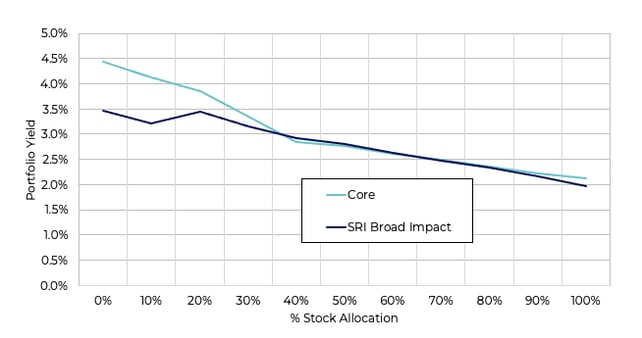
One area where SRI portfolios might differ is in dividend yields. For instance, the SRI Broad Impact portfolio has shown lower income returns at certain risk levels compared to the Core portfolio over a one-year period ending March 31, 2025. This is partly because companies in the oil and gas sector, which often have high dividend yields, are frequently excluded from SRI portfolios. While future dividend yields are uncertain, lower yields can contribute to overall total returns in SRI portfolios being lower than those of traditional Core portfolios.
Comparison of Dividend Yields (One Year Ending March 31, 2025)
| Portfolio | Dividend Yield (%) |
|---|---|
| SRI Broad Impact | [Data Not Provided] |
| Core Portfolio | [Data Not Provided] |
Source: Bloomberg, Calculations by Betterment for one year period ending March 31, 2025. Dividend yields for each portfolio are calculated using the dividend yields of the primary ETFs used for taxable allocations of Betterment’s portfolios as of March 2025.
Conclusion
Despite the inherent challenges in implementing SRI strategies, Betterment remains committed to empowering its customers to align their investments with their values. The firm will continue to monitor the evolving landscape of socially responsible funds, potentially adding new options and refining existing portfolios to offer an increasingly sophisticated and effective SRI investment experience. As the demand for sustainable investing grows, Betterment’s enhanced SRI offerings provide a clear pathway for investors seeking to make a positive impact without compromising their financial objectives.