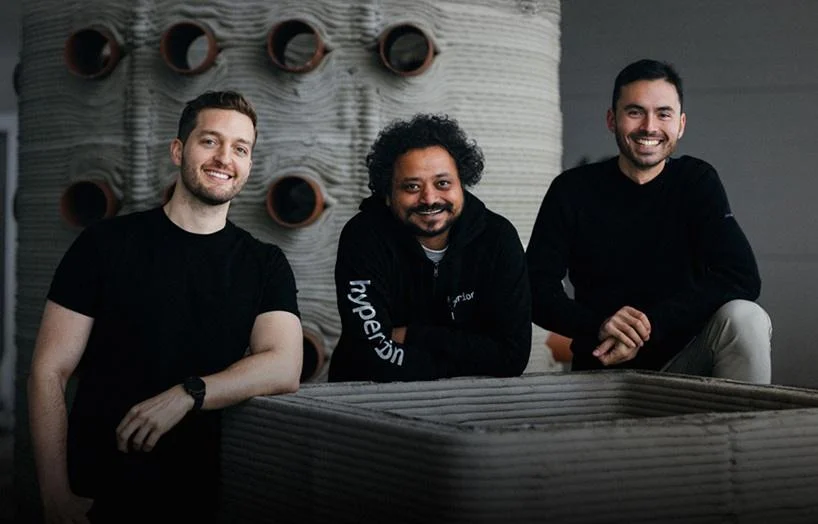
The Finnish technology startup Hyperion Robotics has successfully closed a $7.4 million growth funding round, marking a significant milestone in its mission to decarbonize and digitize the global construction industry. This latest injection of capital is earmarked for the international expansion of the company’s proprietary "Forge" platform, a sophisticated software and hardware integration designed to manufacture critical infrastructure components with unprecedented speed, lower costs, and a drastically reduced environmental footprint. As the construction sector faces mounting pressure to modernize in the face of labor shortages and stringent carbon regulations, Hyperion’s approach represents a shift from traditional, labor-intensive site work toward a decentralized, factory-based manufacturing model.
The funding round was co-led by Course Corrected and the European Innovation Council Fund (EIC Fund), reflecting strong institutional confidence in Hyperion’s ability to scale its technological solutions across the European Union and beyond. Joining the lead investors were RE Ventures and several existing backers, including Lifeline Ventures, Übermorgen Ventures, and PC Rettig Impact & Co. This latest round brings Hyperion’s total capital raised since its inception in 2020 to nearly $20 million, positioning the Helsinki-based firm as a frontrunner in the emerging field of "Physical AI" for heavy industry.
The Technological Core: Integrating Software, Robotics, and Materials Science
At the heart of Hyperion Robotics’ value proposition is its "Forge" platform. Unlike traditional construction methods that rely on manual labor, extensive timber formwork, and significant material waste, Forge integrates structural engineering, design optimization, code compliance, and robotic operations into a unified digital ecosystem. By treating infrastructure as a manufactured product rather than a one-off bespoke project, Hyperion can automate the entire production cycle of concrete components.
The company utilizes large-scale robotic 3D printing technology, which allows for the creation of complex, high-performance concrete structures without the need for molds. This "formwork-free" approach is critical to the company’s efficiency gains. By using 3D printing, Hyperion can deposit material only where it is structurally necessary, a process known as topology optimization. This enables the company to reduce the amount of concrete used in a given foundation or component by up to 75% compared to traditional solid-cast methods.
Furthermore, Hyperion’s technology is designed to work with low-carbon concrete mixes, including those that incorporate industrial by-products and recycled materials. When combined with the material savings inherent in 3D printing, the resulting infrastructure components can boast a CO₂ emission reduction of up to 70%. This is particularly relevant given that the production of cement, the primary ingredient in concrete, is responsible for approximately 8% of global greenhouse gas emissions.
Localized Microfactories: A New Model for Infrastructure Delivery
One of the most distinctive aspects of Hyperion’s business model is the deployment of localized microfactories. Traditional precast concrete manufacturing often involves transporting heavy, bulky components over long distances from a central factory to a construction site, leading to high logistics costs and significant transportation-related emissions. Hyperion circumvents this by establishing mobile, robotic production units close to the project sites they serve.

These microfactories can be set up rapidly, allowing for just-in-time delivery of infrastructure components. This decentralized model not only reduces the carbon footprint of logistics but also helps mitigate the risks associated with global supply chain disruptions. The company’s first major commercial deployment of this model will be "Forge I," a specialized production site in the United Kingdom. Developed in partnership with the Swedish mining and minerals group LKAB, Forge I will focus on producing components for high-growth sectors, including renewable energy, water utilities, data centers, and carbon capture facilities.
The UK launch is strategically timed. The British government has committed to significant infrastructure overhauls as part of its Net Zero 2050 strategy, and the demand for rapid, low-carbon construction solutions in the energy and utility sectors is at an all-time high. By establishing a physical presence in the UK, Hyperion aims to demonstrate that its robotic microfactories can meet the rigorous quality and safety standards required by national grid operators and utility providers.
Addressing the European Infrastructure Renewal Cycle
The expansion of Hyperion Robotics comes at a critical juncture for the European continent. Industry analysts suggest that Europe is entering its most intensive infrastructure renewal cycle in decades. Much of the region’s core infrastructure—including power grids, water treatment systems, and industrial facilities—was built in the mid-20th century and is reaching the end of its operational lifespan. Simultaneously, the transition to a green economy requires the rapid build-out of new assets, such as offshore wind foundations, hydrogen storage facilities, and massive data centers to support the digital economy.
However, the construction industry is ill-equipped to handle this surge in demand using traditional methods. The sector is currently plagued by a chronic shortage of skilled labor, with many experienced tradespeople retiring and fewer young workers entering the field. Additionally, rising material costs and tightening environmental regulations have made traditional concrete construction increasingly expensive and difficult to justify.
Hyperion’s CEO, Fernando De los Rios, emphasizes that the industry cannot continue with "business as usual." He notes that Europe lacks the time, budget, and labor force to rebuild its infrastructure through manual methods. By leveraging Physical AI—the application of artificial intelligence to physical manufacturing and movement—Hyperion intends to close the productivity gap. The company’s robotic systems can operate 24/7, maintaining consistent quality and precision that surpass human capabilities, while significantly shortening project timelines. Hyperion claims its microfactories can produce components up to three times faster than traditional methods, while slashing total costs by as much as 50%.
Investor Perspectives and Strategic Backing
The involvement of the European Innovation Council (EIC) Fund is particularly noteworthy. As the venture arm of the European Commission, the EIC Fund focuses on supporting high-impact, deep-tech startups that contribute to the EU’s strategic autonomy and green transition goals. Minna Leisvuori, Senior Investment Advisor at the EIC Fund, highlighted that Hyperion is tackling one of the world’s least digitized and most carbon-intensive industries. She noted that the integration of robotics and software has the potential to transform infrastructure production not just in Europe, but globally.
Other investors, such as Course Corrected and RE Ventures, bring expertise in climate tech and industrial scaling. Their participation suggests that Hyperion is viewed not just as a 3D printing company, but as a software-led manufacturing platform capable of disrupting the multi-trillion-dollar global construction market. The inclusion of existing investors like Lifeline Ventures and Übermorgen Ventures indicates a high level of satisfaction with the company’s progress since its seed stages.

Chronology of Growth: From Startup to Industrial Player
Since its founding in 2020, Hyperion Robotics has moved rapidly through the stages of technological validation:
- 2020: Founded in Helsinki, Finland, by Fernando De los Rios, Ashish Mohite, and Henry Unterreiner. The founders combined backgrounds in architecture, robotics, and business to address the inefficiencies of the construction sector.
- 2021-2022: Initial R&D and seed funding rounds allowed the company to develop the first iterations of its robotic printing systems and low-carbon material formulations. During this period, the company focused on proof-of-concept projects, demonstrating the structural integrity of its 3D-printed foundations.
- 2023: Hyperion began forming strategic partnerships with industrial giants, including LKAB, to move toward commercial-scale applications. The focus shifted toward the development of the "Forge" software platform to enable end-to-end automation.
- 2024: The company secured $7.4 million in growth funding and announced the launch of Forge I in the UK. This year marks the transition from pilot projects to full-scale commercial delivery for major infrastructure sectors.
Industry Implications and Future Outlook
The broader implications of Hyperion’s growth are profound for the construction and engineering sectors. For decades, productivity in construction has remained stagnant compared to manufacturing and retail. Hyperion’s "productization" of infrastructure suggests a path forward where foundations, pillars, and utility vaults are ordered and manufactured with the same precision and digital traceability as automotive parts.
Furthermore, the environmental benefits of the Hyperion model align with the growing trend of "Green Procurement" in the public sector. Governments across Europe are increasingly requiring contractors to disclose and reduce the "embodied carbon" of their projects. Hyperion’s ability to provide data-backed evidence of 70% lower emissions through its Forge platform gives it a competitive edge in public tenders for energy and water projects.
As Hyperion scales, the next challenge will be navigating the complex regulatory and building code environments of different international markets. However, by embedding code-compliance directly into the Forge software, the company aims to streamline the certification process for its printed components. With the new capital, Hyperion is set to expand its team of engineers and software developers, further refining its Physical AI capabilities and preparing for a broader rollout across the European infrastructure market.
The success of Hyperion Robotics signals a new era where the "hard" world of concrete and steel meets the "soft" world of AI and automation. If the company achieves its targets, the result will be a more resilient, cost-effective, and sustainable backbone for the modern world.