
The pursuit of maximizing investment returns is a cornerstone of financial planning, with strategies like diversification, risk management, and tailored asset allocation playing pivotal roles. Beyond these established methods, investors can further enhance their after-tax returns through a sophisticated technique known as tax-loss harvesting (TLH). Betterment, a prominent digital investment advisor, has integrated this advanced strategy into its offerings, providing clients with a fully automated tool designed to optimize investment performance by leveraging market volatility to their advantage.
Understanding Tax-Loss Harvesting
At its core, tax-loss harvesting involves strategically selling securities that have depreciated in value to realize capital losses. These losses can then be used to offset capital gains, thereby reducing an investor’s overall tax liability. However, the challenge lies in realizing these losses without compromising the long-term investment strategy or triggering adverse tax consequences.
In a well-diversified portfolio, each asset plays a crucial role in achieving broad market exposure. Simply selling a depreciated asset to realize a loss could mean sacrificing potential future returns associated with that asset. Tax-loss harvesting elegantly addresses this dilemma by employing a "sell and replace" strategy. An investor sells a security that has incurred a loss and simultaneously purchases a closely correlated, yet distinct, asset. This maneuver allows the investor to "harvest" the valuable tax loss while maintaining their desired asset allocation and continued market exposure.
The Mechanics of Tax Reduction
The benefits of tax-loss harvesting are primarily realized through its ability to lower an investor’s tax bill. Capital losses can be used to offset capital gains realized from other transactions within the same tax year. If losses exceed gains, up to $3,000 of ordinary income can be offset annually. Any remaining losses can be carried forward indefinitely, providing future tax benefits.
While TLH is often described as a tax deferral strategy, its cumulative impact over time can be significant. The value it adds is a function of several factors, including the investor’s tax bracket, the amount of capital gains generated, and the length of time the portfolio is held. For high-income earners, the ability to offset ordinary income can provide immediate tax savings, particularly in states with high income tax rates.
Navigating the "Wash Sale" Rule: A Critical Hurdle
A fundamental challenge in implementing tax-loss harvesting is adhering to the IRS’s "Wash Sale" rule. This rule disallows the deduction of a loss from the sale of a security if a "substantially identical" security is purchased within 30 days before or after the sale. The rationale behind this rule is to prevent investors from artificially creating losses for tax purposes while maintaining their economic exposure to the asset.

The wash sale rule’s application is broad, encompassing purchases made not only within the same account but also in related accounts, such as IRAs or a spouse’s account. A particularly unfavorable scenario arises when a wash sale involves an IRA or 401(k) account, as the disallowed loss is permanently forfeited, rather than merely postponed.
Effectively managing wash sales is paramount to the success of any TLH strategy. Unsophisticated approaches can diminish the value of harvested losses or impose significant constraints on an investor’s cash flow.
Minimizing the Wash: Strategies and Limitations
The most straightforward method to avoid triggering a wash sale is to hold the proceeds from a sale in cash for 30 days. However, this approach would systematically remove a portion of the portfolio from market exposure, potentially hindering long-term returns and offsetting any tax benefits gained.
More advanced strategies involve repurchasing an asset with similar exposure but one that is not deemed "substantially identical" by the IRS. While repurchasing the exact same stock would clearly violate the rule, the treatment of different but similarly tracking index funds from different issuers can be less clear-cut. A conservative approach often involves repurchasing a fund that tracks a different, albeit highly correlated, index.
Betterment’s TLH system is designed around this index-based logic. It aims to minimize wash sales, though it acknowledges potential limitations, particularly when different tickers track the same index or when assets are held across both taxable and tax-advantaged accounts. For certain portfolios, particularly those constructed by third parties, the absence of readily available tertiary tickers can present challenges in permanently avoiding disallowed losses. Betterment’s approach may permit wash sales if the anticipated tax benefit of the overall harvest transaction is deemed to outweigh the impact of expected washed losses.
The complexity of managing wash sales and tax lot accounting becomes particularly daunting in multi-asset portfolios with frequent transactions like deposits, dividends, and rebalances. Manually implementing TLH is feasible for a small number of securities and infrequent activity, but it quickly becomes overwhelming for more dynamic portfolios. An effective TLH algorithm must maximize harvesting opportunities across a wide range of market volatility without compromising the investor’s global asset allocation.
Existing Strategies and Their Drawbacks
Several common strategies exist for managing tax-loss harvesting, each with its own set of limitations:
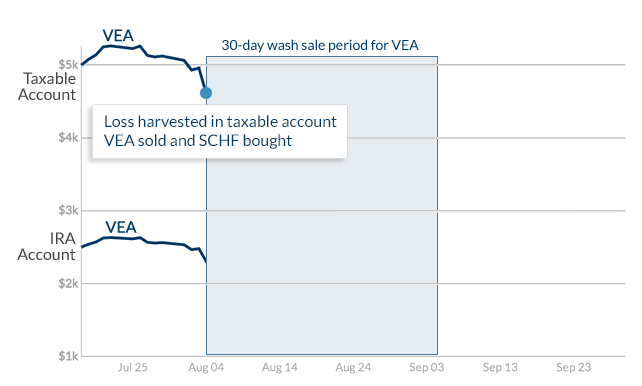
- Delaying Reinvestment: Holding harvested proceeds in cash for 30 days ensures no wash sale is triggered. However, this leads to a lack of market exposure, potentially harming long-term returns and negating tax benefits.
- Reallocating to Different Asset Classes: Shifting harvested proceeds entirely into other asset classes can disrupt an investor’s desired asset allocation. Furthermore, these purchases might create potential wash sales in other asset classes, blocking future harvesting opportunities.
- Switching Back to Original Security: This manual approach, sometimes used by automated services, involves repurchasing the original security after the 30-day window. The primary risk here is triggering short-term capital gains (STCG) when selling the replacement security, which can erode or even negate the tax benefits of the harvest. In some cases, this strategy can result in an investor owing more tax than if no harvesting had occurred.
The Hazards of "Switchbacks" and Negative Tax Arbitrage
The "switchback" strategy, where an investor repurchases the original security after 30 days, carries significant risks. If the replacement security appreciates during this period, the switchback sale can realize short-term capital gains (STCG), which are taxed at higher rates than long-term capital gains (LTCG). This outcome is antithetical to tax-efficient portfolio management and can lead to a net increase in tax liability.
This phenomenon is known as "negative tax arbitrage." For instance, an automatic 30-day switchback can result in STCG that exceeds the initially harvested loss. This can occur when the harvested loss, which would have offset a long-term capital gain (taxed at a lower rate), is instead used to offset short-term capital gains (taxed at a higher rate) generated by the switchback. In such scenarios, the investor might end up paying more in taxes than if they had done nothing.
Negative tax arbitrage can also arise in connection with dividend payments. If a dividend is paid while a position is held in a replacement security, it may not qualify for the favorable tax treatment of "qualified dividends" if the holding period requirement is not met due to the 30-day switchback.
The Betterment Solution: A Holistic Approach
Betterment’s tax-loss harvesting service is engineered to address the complexities and limitations of traditional TLH methods. It adopts a holistic approach to tax efficiency, aiming to optimize not only automated activities like rebalancing but also customer-initiated transactions.
Key Innovations in Betterment’s TLH:
- Parallel Securities: To ensure continuous market exposure and manage wash sales effectively, Betterment utilizes "parallel" or "secondary" securities. These are carefully selected ETFs that exhibit high correlation to the primary securities in the portfolio but are distinct enough to avoid triggering wash sales. The selection process rigorously screens for expense ratios, liquidity, tracking error, and the covariance of the alternate with the primary. While there might be minor cost differences between primary and alternate securities, these are significantly outweighed by the potential tax savings.
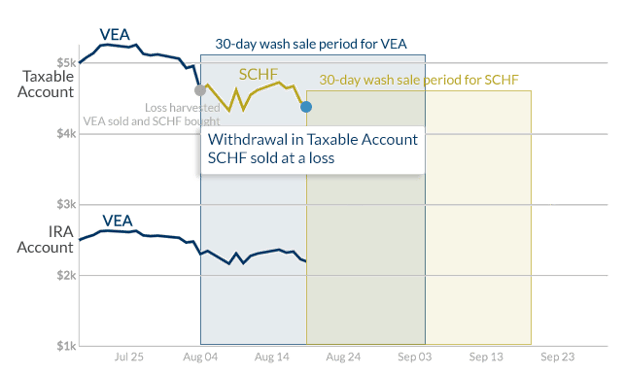
- Tertiary Tickers for IRA/401(k) Protection: Recognizing the permanent disallowance of losses in IRA/401(k) accounts due to wash sales, Betterment employs a "tertiary ticker" system. This involves identifying a third, closely correlated security. When a customer makes a deposit into an IRA/401(k) after a loss has been harvested in a taxable account, the system directs the inflow to the tertiary ticker. This preserves the harvested loss in the taxable account while ensuring the IRA/401(k) maintains desired asset allocation without triggering a wash sale. This mechanism is crucial for protecting valuable realized losses from being permanently forfeited.
- Parallel Position Management (PPM): Betterment’s proprietary PPM system manages transactions to optimize after-tax outcomes. It ensures that both customer-initiated and system-initiated transactions are tax-efficient. For withdrawals and rebalancing, PPM prioritizes selling from alternate positions where feasible, or selling tax lots that minimize STCG. For deposits and dividend reinvestments, inflows are directed to underweight asset classes and, within those classes, to the primary security, unless doing so incurs greater wash sale costs than purchasing the alternate.
- Smart Rebalancing: TLH proceeds are integrated into the rebalancing process. This means that harvested losses are reinvested to bring the portfolio back to its target allocation, further reducing the need for additional selling during volatile periods and minimizing tax liabilities. Fractional shares allow for precise allocation of these inflows.
Tax-Loss Harvesting Model Calibration
The decision-making process for Betterment’s TLH is driven by a sophisticated model calibrated through rigorous Monte Carlo simulations. The model analyzes multiple inputs to determine when the net benefit of a harvest (considering potential gains and costs) exceeds a defined threshold. The "cost" of a harvest, in this context, includes trading expenses, execution costs, and any increased cost of ownership for the replacement asset. Trading costs are typically covered by Betterment’s wrap fee, while execution and ownership costs are factored into the asset-level calibration.
The model’s calibration emphasizes forward-looking simulations rather than solely relying on historical backtesting. This approach aims to optimize effectiveness based on expected future returns and volatility, acknowledging that past performance is not indicative of future results.
Best Practices and Who Benefits Most
Tax-loss harvesting is primarily a strategy of tax deferral, not tax avoidance. A harvested loss today will eventually lead to a higher capital gain when the asset is sold in the future. However, the value of this deferral can be substantial, particularly when reinvested savings have ample time to grow.
Who benefits most from tax-loss harvesting?
- The "Bottomless Gains" Investor: Individuals who consistently realize significant capital gains from selling appreciated assets (e.g., stocks, real estate) can effectively utilize harvested losses to offset these gains, leading to substantial tax savings in the current year.
- High-Income Earners: Even without substantial capital gains, high-income individuals can benefit from offsetting up to $3,000 of ordinary income annually with capital losses. In high tax states, this can translate into significant tax reductions.
- The Steady Saver: While long-term investors in stable assets may experience fewer harvesting opportunities, regular deposits create multiple cost basis points, potentially increasing the frequency of harvestable losses over time.
- The Philanthropist: The tax benefits of TLH are amplified when appreciated securities are donated to charity or passed down to heirs, as the offsetting capital gains can be entirely avoided.
Who benefits least?
- Aspiring Tax Bracket Climbers: Individuals who expect their tax bracket to be significantly higher in the future may find tax deferral less advantageous. In such cases, it might be more beneficial to harvest gains now while tax rates are lower.
- Those with Scattered Portfolios: If an investor holds overlapping assets in non-Betterment accounts or with a spouse’s account, the TLH algorithm cannot account for these external transactions, potentially leading to unintended wash sales.
- Rapid Liquidators: Investors planning to liquidate a large portion of their portfolio within a single year might see the cumulative effect of harvested gains push them into a higher capital gains tax bracket, negating the benefits.
- Imminent Withdrawing Investors: For those planning significant withdrawals within 12 months, it’s advisable to delay activating TLH until after the withdrawal is complete to avoid realizing short-term capital gains on harvested losses.
Estimating Tax Savings: Betterment’s Tools
Betterment provides an "Estimated Tax Savings" tool within its platform. This tool leverages transactional data and self-reported client information (income, state of residence, filing status, dependents) to generate dynamic estimates of realized and potential tax savings. It calculates current-year and cumulative ("all-time") savings by meticulously analyzing tax lots and adhering to IRS offsetting hierarchies.
The methodology incorporates federal and state income tax rates, long-term capital gains rates, and the IRS’s cap on ordinary income offsets. For current-year estimates, it sums the savings from offsetting short-term gains, long-term gains, and ordinary income. The "all-time" estimate provides a broader view of potential tax dollars saved, based on harvested losses and current tax rates, assuming full offsetting of gains. While these figures are estimates and not guarantees, they offer valuable transparency into the financial impact of tax-smart investing.
Conclusion
Tax-loss harvesting represents a sophisticated yet accessible strategy for investors seeking to enhance their after-tax returns without taking on additional downside risk. Betterment’s automated TLH service, with its innovative use of parallel securities, tertiary tickers, and the Parallel Position Management system, effectively navigates the complexities of wash sale rules and market volatility. By providing a seamless, fully automated solution, Betterment empowers a wider range of investors to leverage this powerful tax-optimization technique, ultimately contributing to more robust long-term investment outcomes. As with any tax strategy, consulting with a personal tax advisor is recommended to ensure its suitability for individual circumstances.