
Betterment, a prominent digital investment advisor, has introduced its Smart Beta portfolio strategy, developed in collaboration with Goldman Sachs Asset Management. This new offering is designed for clients who are willing to embrace additional investment risks in pursuit of potentially enhanced returns that exceed those of traditional market capitalization-weighted strategies. While maintaining the foundational principle of global diversification across stocks and bonds, the Goldman Sachs Smart Beta portfolio strategically deviates from market-cap weightings within and across equity asset classes to target higher performance.
The introduction of this strategy reflects a growing investor appetite for sophisticated investment approaches that move beyond the traditional dichotomy of passive versus active management. Historically, investors have categorized portfolio strategies as either passive, where funds aim to mirror a market index like the S&P 500, or active, where managers actively select securities with the goal of outperforming their benchmarks. However, the investment landscape has evolved, recognizing that numerous strategies exist on a spectrum between these two extremes. Smart beta strategies, like the one now available through Betterment and Goldman Sachs, occupy this nuanced space by employing systematic rules and predefined "factors" to construct portfolios, aiming for improved risk-adjusted returns.
Understanding the "Smart Beta" Approach
The term "smart beta" itself signifies a departure from conventional beta measurement, which solely quantifies a security’s sensitivity to overall market movements. Smart beta strategies acknowledge that market beta is only one of many potential drivers of investment returns. By identifying and leveraging a range of these factors, proponents of smart beta aim to unlock additional return potential over the long term while diligently managing risk.
Goldman Sachs Asset Management’s approach, utilized in this portfolio, aligns with Betterment’s five core investment principles, which typically include diversification, cost-effectiveness, tax efficiency, risk management, and a long-term perspective. The Smart Beta strategy, however, configures elements like cost, value, and diversification in a manner distinct from Betterment’s core portfolio. This involves incorporating additional systematic risk factors to pursue higher overall return potential.
The strategy aims for global diversification across both equities and fixed income, with a deliberate overweighting of specific securities that may not be represented in Betterment’s core offerings. Crucially, the Smart Beta portfolio retains Betterment’s established tax-efficiency features, such as tax-loss harvesting and Tax Coordination, which are vital for optimizing after-tax returns, particularly for taxable accounts.
While smart beta strategies have historically incurred higher costs than pure market-cap weighted portfolios, the Goldman Sachs offering is positioned as having a significantly lower cost compared to the industry average, though it remains slightly more expensive than Betterment’s core portfolio. This cost consideration is often weighed against the potential for enhanced returns.
Key Investment Factors Driving Performance
The efficacy of a smart beta strategy hinges on the selection and weighting of specific investment factors, which are variables that demonstrably influence portfolio performance and risk. These factors are not arbitrary but are rooted in extensive academic research and empirical analysis, often reflecting economically intuitive phenomena or aggregate investor behavior.
Goldman Sachs Asset Management’s equity ETFs, a cornerstone of this smart beta portfolio, are built upon the "ActiveBeta™" methodology. This approach involves scoring stocks based on four key factors, with higher-scoring companies receiving a greater weighting within the portfolio, subject to constraints that keep the overall portfolio aligned with market norms. These four primary equity factors are:

-
Good Value: This factor identifies companies that exhibit strong earnings but are trading at relatively low prices, suggesting they may be undervalued by the broader market. Investing in value-oriented stocks can provide exposure to companies with significant growth potential that have been overlooked by other investors. Academic studies, such as those examining the "value premium," have consistently shown that value stocks have historically outperformed growth stocks over long periods. For instance, research from firms like Dimensional Fund Advisors has documented the persistent tendency for stocks with lower valuation multiples to generate higher long-term returns.
-
High Quality: Companies characterized by high quality demonstrate sustainable profitability and robust financial fundamentals. This includes metrics such as strong and stable revenue growth, consistent earnings, and healthy balance sheets. Investing in high-quality companies aims to capture potential for steady and reliable returns over time, mitigating the impact of economic downturns. The "quality premium" has also been a subject of extensive academic inquiry, with studies indicating that companies with strong financial health and stable earnings tend to deliver superior risk-adjusted returns.
-
Low Volatility: Counterintuitively, stocks with lower price volatility have historically exhibited higher returns than their more volatile counterparts. This phenomenon, often referred to as the "low-volatility anomaly," challenges traditional financial theory which suggests that higher risk should correspond with higher returns. Researchers at institutions like S&P Dow Jones Indices have explored this anomaly, suggesting that investors may exhibit a systematic preference for high-volatility stocks, driving up their prices and diminishing their future return potential, while overlooking lower-volatility stocks. This can lead to attractive opportunities for investors seeking to manage risk while still aiming for competitive returns.
-
Strong Momentum: This factor focuses on stocks that have demonstrated a consistent upward trend in price. The "momentum effect" suggests that assets that have performed well recently tend to continue performing well for a period. This is a well-documented trend in financial markets, with research from academics like Narasimhan Jegadeesh and Sheridan Titman providing foundational insights into its persistence. However, it’s crucial to define momentum precisely, as securities can also experience mean reversion, where upward trends are eventually followed by declines.
In addition to these equity factors, the Goldman Sachs Smart Beta portfolio also targets a small operational cash allocation within taxable accounts, health savings accounts, and individual retirement accounts (IRAs) to manage liquidity and operational needs.
Potential for Future Outperformance
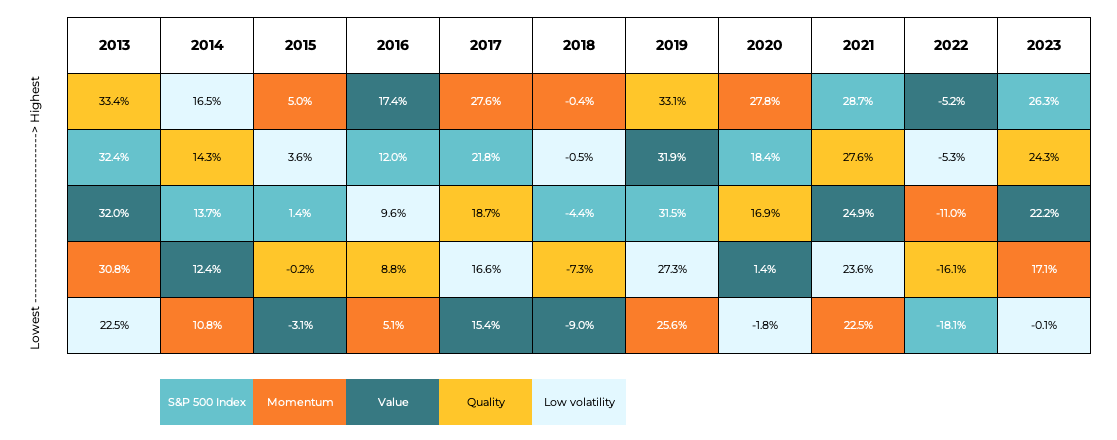
The combination of these carefully selected factors is designed to offer a potential for outperformance relative to market-cap benchmarks. While the performance of individual factors can vary significantly from year to year and may even underperform the broader market in certain periods, their aggregate effect, when combined within a diversified portfolio, is posited to drive superior long-term returns.
Historical data, such as the chart of yearly factor returns for U.S. large-cap stocks, illustrates this dynamic. The chart typically shows that the ranking of factor indexes relative to the S&P 500 fluctuates annually. However, over extended periods, the factors have demonstrated a tendency to outperform the broader market. For example, research has shown that over multi-decade horizons, factor-based strategies have delivered higher cumulative returns than broad market indexes.
It is imperative to note that past performance is not indicative of future results. The performance depicted in such charts is often based on index data and does not account for all associated costs, fees, liquidity considerations, or the specific implementation nuances of a particular portfolio strategy. The analysis provided is for educational purposes and should not be construed as investment advice or a recommendation for any specific product.
The rationale behind investing in a smart beta portfolio often centers on the belief that these factors represent persistent market inefficiencies or behavioral biases that can be systematically exploited. For investors with a higher risk tolerance and a long-term investment horizon, a smart beta strategy can offer a tactical approach to potentially enhance returns beyond what a market-cap weighted portfolio might achieve.
Risk Considerations and Investor Suitability
While the pursuit of outperformance is a primary objective, it is essential for investors to understand the inherent risks associated with smart beta strategies. These strategies often involve systematic risks that can lead to periods of underperformance, sometimes more pronounced than those experienced by market-cap benchmarks.
The dot-com collapse of 2000 serves as a stark historical example. While the S&P 500 experienced a decline of approximately 10%, the S&P 500 Momentum Index saw a more significant drop of 21%. This illustrates that while momentum can drive strong gains during upward trends, it can also lead to steeper losses during market downturns or periods of trend reversal.
Given these systematic risks, Betterment generally recommends the Goldman Sachs Smart Beta portfolio for investors who:
- Possess a High Risk Tolerance: They must be comfortable with the potential for greater volatility and the possibility of significant short-term losses.
- Have a Long-Term Investment Horizon: Smart beta strategies are typically designed to generate alpha over extended periods, and short-term fluctuations are to be expected.
- Seek to Potentially Outperform Market-Cap Benchmarks: They understand that this strategy is not simply about tracking the market but actively seeking to beat it.
The methodology behind smart beta is deeply rooted in academic finance. The concept of "factors" as drivers of return and risk has been extensively studied. Prominent researchers like Eugene Fama and Kenneth French developed influential multi-factor models that expanded upon the traditional capital asset pricing model (CAPM) by incorporating factors such as size (small-cap vs. large-cap) and value (high book-to-market vs. low book-to-market) to better explain stock returns. Subsequent research has identified additional factors like quality, momentum, and low volatility, which have also shown empirical evidence of driving excess returns.
The integration of these factors aims to construct portfolios that are not only diversified across asset classes but also diversified across these distinct sources of return. The low or negative correlation that some of these factors may exhibit with each other can help to offset constituent risks, thereby managing the overall portfolio risk more effectively. However, it’s crucial to reiterate that these correlations are based on historical data and are not guaranteed to persist in the future.
The collaborative effort between Betterment and Goldman Sachs Asset Management leverages the expertise of both firms. Betterment’s role as a digital advisor focuses on providing accessible and tax-efficient investment solutions, while Goldman Sachs Asset Management brings its deep experience in quantitative research and factor-based investing through its ActiveBeta™ suite of ETFs. This partnership allows for the creation of a sophisticated investment product that is integrated into Betterment’s user-friendly platform, complete with tax-optimization strategies.
Broader Implications for the Investment Industry
The availability of such strategies through platforms like Betterment signifies a democratization of advanced investment techniques previously more accessible to institutional investors or high-net-worth individuals. As investors become more informed and demand greater sophistication from their investment providers, the adoption of smart beta and other factor-based strategies is likely to continue growing. This trend challenges the traditional passive versus active debate, highlighting the emergence of a more nuanced and data-driven approach to portfolio construction.
The ongoing evolution of investment products also underscores the importance of investor education. Understanding the underlying principles of smart beta, the specific factors employed, and the associated risks is paramount for investors to make informed decisions that align with their financial goals and risk tolerance. The emphasis on long-term investing and a disciplined approach to risk management remains central to successful investing, regardless of the specific strategy employed.
In conclusion, the Goldman Sachs Smart Beta portfolio strategy offered by Betterment represents a significant development for investors seeking to potentially enhance their returns beyond market-cap weighted benchmarks. By systematically leveraging well-researched investment factors, the strategy aims to provide a compelling alternative for those willing to accept additional risk for the prospect of superior long-term performance, all while maintaining essential tax-efficiency features.