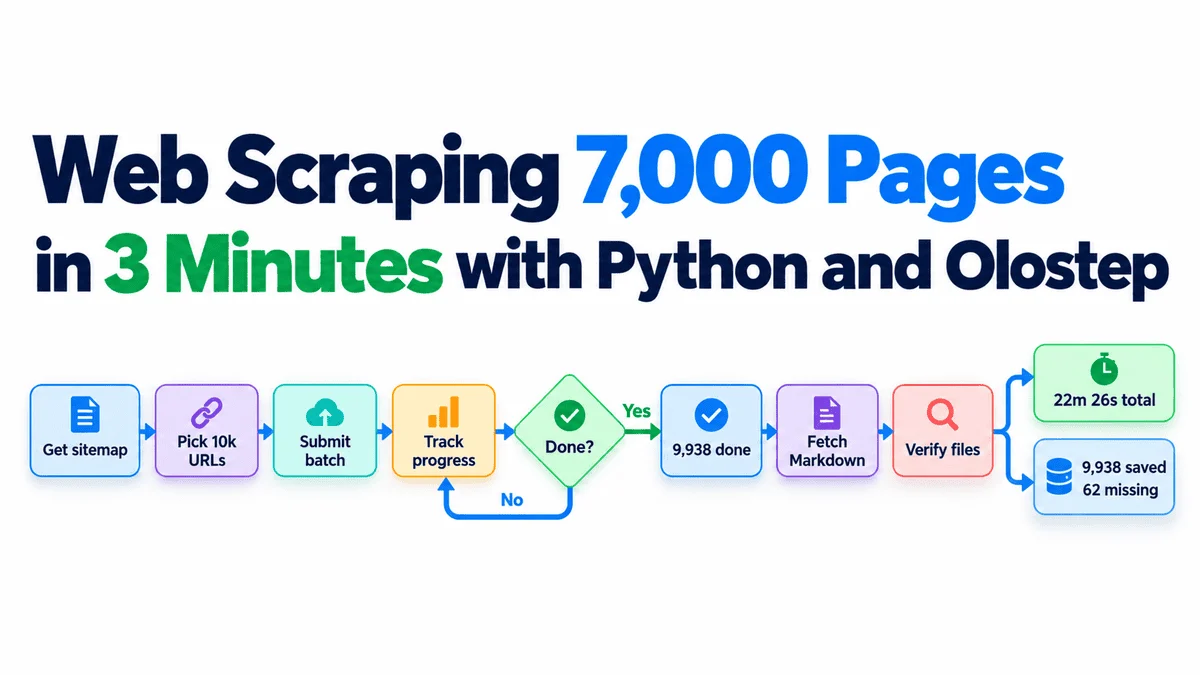
The demand for high-velocity data acquisition has reached a critical juncture as enterprises pivot toward large-scale artificial intelligence, market research, and competitive intelligence. As organizations move beyond manual or small-scale scraping methods, the necessity for robust, scalable, and verifiable web data infrastructure has become a primary technical challenge. Recent benchmarks using the Olostep Batch API demonstrate a significant evolution in this space, achieving the scraping of over 7,000 pages in less than three minutes. However, a comprehensive analysis of the full data pipeline reveals that the gap between initial ingestion speed and final data verification remains a significant operational consideration for data engineers.
The Evolution of Large-Scale Web Scraping
Traditional scraping techniques—often involving distributed clusters of headless browsers or custom-built queues—frequently struggle with the "last mile" problem: the reliability and completeness of the data set. For an enterprise, collecting 10,000 pages is not merely a task of network throughput; it is a task of error management, proxy rotation, and data transformation.
The Olostep Batch API represents an industry shift toward "scraping-as-a-service" (SaaS) infrastructure. By offloading the complexity of concurrent network requests, cookie management, and IP rotation to a specialized backend, developers can focus on the ingestion and processing phases of their data pipeline. This infrastructure is designed to bridge the gap between simple web requests and the massive data sets required for training Large Language Models (LLMs) or performing real-time price monitoring across global retail platforms.
Chronology of the 10,000-Page Experiment
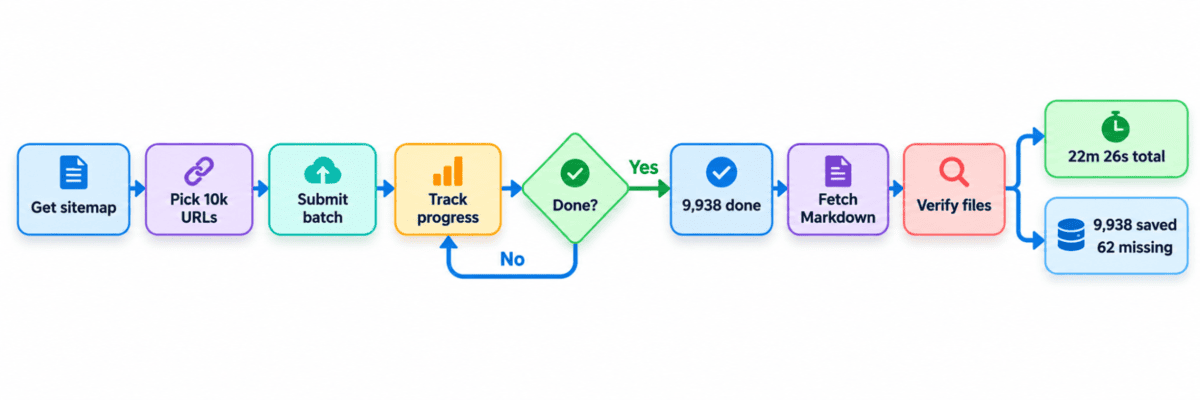
To quantify the efficiency of modern batch processing, a structured test was conducted using 10,000 unique URLs sourced from the Mozilla Developer Network (MDN) documentation. The experiment, executed using Python 3.13.15 and the Olostep SDK version 1.2.2, followed a six-stage lifecycle: environment configuration, dataset preparation, batch submission, asynchronous monitoring, mass downloading, and final verification.
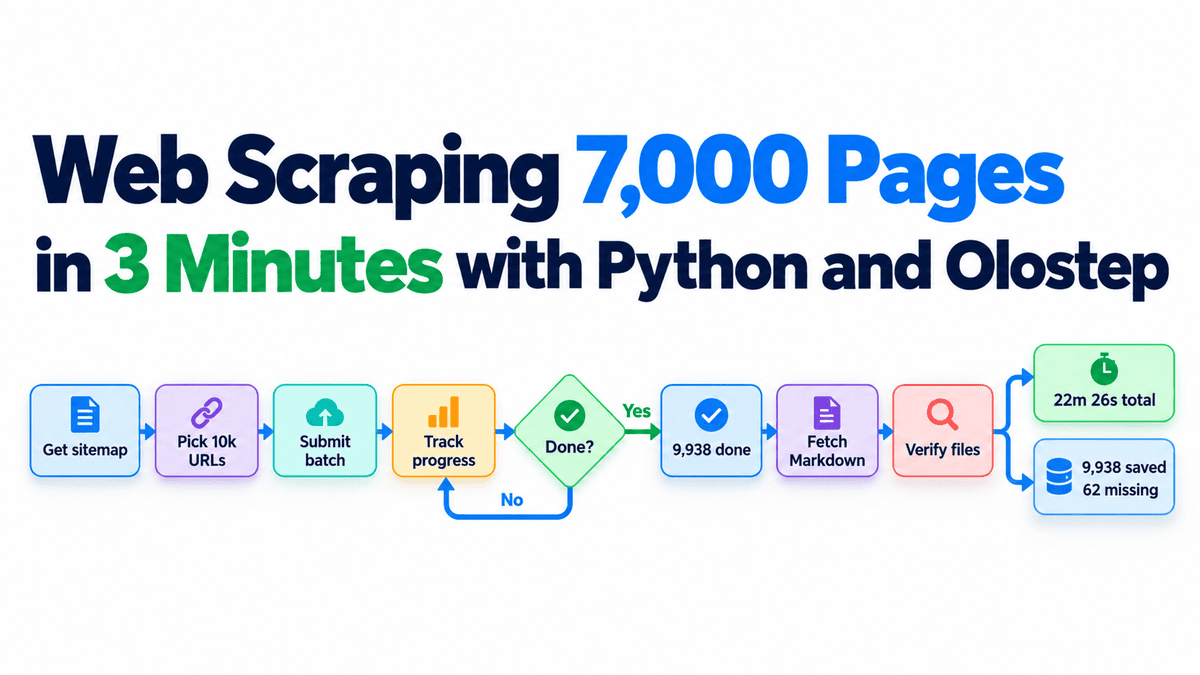
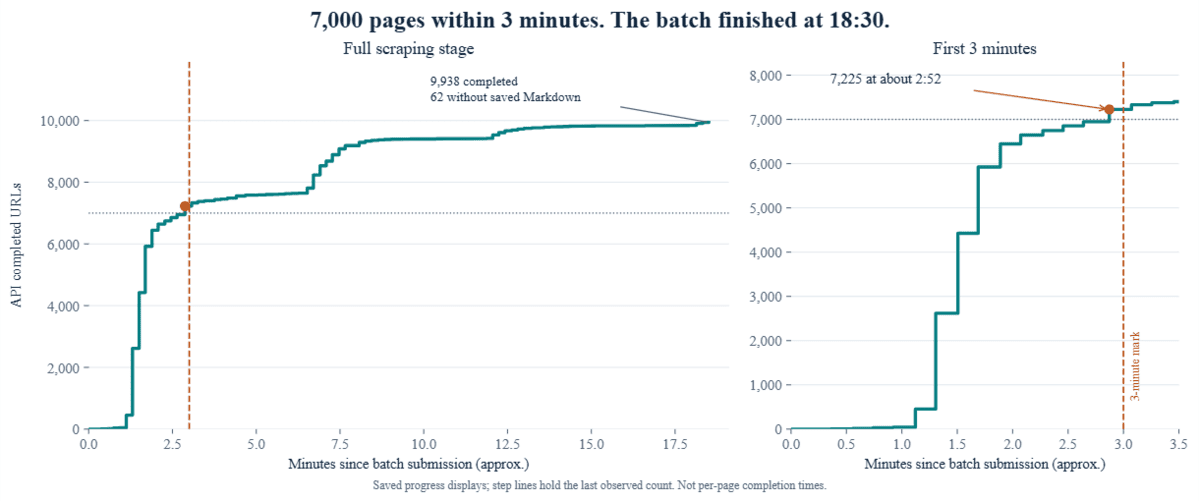
The timeline of the operation began with the parsing of the MDN sitemap, from which 10,000 unique documentation URLs were extracted and randomized to ensure a representative sample of web structures. Once the batch was submitted, the system achieved a rapid surge in performance, hitting the 7,225-page mark in approximately 172 seconds. This initial burst demonstrates the efficacy of high-concurrency request management. However, the trajectory of the processing time shifted as the batch progressed. By the time the total count reached 9,938 successfully saved files, the total elapsed time had expanded to 22 minutes and 26 seconds.
This temporal discrepancy—the rapid initial acquisition followed by a slower completion rate—suggests that enterprise-grade infrastructure likely employs dynamic load balancing. While the system optimizes for immediate results, the final percentage of the batch often faces latency due to edge-case handling, such as complex DOM rendering, server-side rate limiting, or network timeouts on specific pages.
Supporting Data and Performance Metrics
The data collected from this experiment provides a critical look at the distinction between "completed requests" and "successfully retrieved data." Out of the 10,000 requested pages, 9,938 were successfully converted to Markdown and verified, resulting in a 99.38% success rate.
The following table summarizes the performance benchmarks observed during the experiment:
| Metric | Result |
|---|---|
| Initial 7,000-page threshold | ~2 minutes 52 seconds |
| Final completion time (10,000 pages) | 22 minutes 26 seconds |
| Success Rate | 99.38% |
| Failure Rate | 0.62% (62 pages) |
| Concurrent Download Workers | 96 |
The 62 failed requests highlight the necessity for rigorous post-processing verification in any production-grade pipeline. In an enterprise environment, a 0.62% failure rate might be acceptable for a broad market research report, but it could be detrimental to a data set used for sensitive financial modeling or compliance reporting, necessitating further validation steps or automated retries.
Industry Implications and Enterprise Readiness
The transition toward API-centric scraping platforms signifies that the industry is moving away from bespoke, brittle solutions. Organizations are increasingly looking for infrastructure that provides transparency into the scraping process. Features such as the ability to track batch IDs, monitor status in real-time, and download structured formats like Markdown are becoming the standard requirements for modern data engineers.
According to platform documentation and industry feedback, the capability to process 100,000 pages in under 25 minutes for enterprise-scale workloads is now a target metric for top-tier providers. This scale is essential for sectors like retail, where pricing data must be updated frequently, and for AI firms that require high-fidelity training data from a diverse range of sources.
However, the analysis of this experiment underscores a vital lesson for developers: performance is not a single number. The "3-minute" milestone is a useful marketing metric, but the "22-minute" total duration is the operational reality. For architects building data pipelines, the focus must remain on the total time-to-completion and the robustness of the error-handling mechanisms.
Technical Challenges in Modern Web Extraction
The experiment also shed light on the technical hurdles of handling large-scale data. When processing thousands of documents simultaneously, managing the local storage of these files becomes a bottleneck in itself. The use of a semaphore-based approach with 96 concurrent connections allowed for efficient downloading, but this also requires sufficient local bandwidth and I/O capacity to prevent the machine from becoming a secondary bottleneck.
Furthermore, the "response handling" issue identified in the SDK version 1.2.2 serves as a reminder that even advanced infrastructure is subject to software iteration. Developers must remain agile, incorporating robust error-catching logic—such as the OlostepClientError_ResponseValidationFailed exception handling used in this test—to ensure that the pipeline does not collapse due to a minor, transient failure in the response format.
Future Perspectives
As web architecture continues to evolve, with more sites moving toward dynamic, JavaScript-heavy content, the role of specialized scraping APIs will only grow. The ability to abstract away the "headless browser" management—which is traditionally resource-intensive—is a significant boon to small teams and large corporations alike.
The integration of these tools into standard data science workflows, such as Jupyter Notebooks, demonstrates that complex, high-scale scraping is becoming democratized. Future developments are likely to include more granular control over proxy locations, improved support for complex authentication scenarios, and tighter integration with vector databases for immediate RAG (Retrieval-Augmented Generation) applications.
In conclusion, while the speed of modern scraping APIs is impressive, the core value for the enterprise lies in the reliability and the end-to-end auditability of the data pipeline. Achieving a 99.38% success rate on 10,000 pages is a strong indicator of platform maturity, but it remains the responsibility of the data professional to implement the verification logic that ensures the data is not just collected, but is accurate, complete, and ready for downstream consumption. As the industry moves forward, the focus will likely shift from raw speed to the consistency and quality of the extracted data, ensuring that the next generation of AI models is trained on the most reliable information available.