
At 14:06:10 UTC on Sunday, September 6, 2026, the integrity of the Liquid Network—a prominent Bitcoin sidechain operated by the Liquid Federation—was compromised, resulting in an unauthorized outflow of 3,996.01834922 BTC. The incident, which occurred through a manipulated peg-out transaction, has raised critical questions regarding the security architecture of federated sidechains and the inherent risks associated with confidential transaction protocols. The stolen funds, currently valued at approximately $320 million based on a Bitcoin market price of $80,000, have ignited a tense standoff between the federation and an anonymous entity claiming to be "whitehat" hackers.
The Anatomy of the Exploit
The breach originated within Liquid block 4,050,349. The process was initiated via SideSwap, a designated peg-out partner whose Peg-out Authorization Key (PAK) is whitelisted by the federation to facilitate the conversion of Liquid Bitcoin (L-BTC) back into native BTC. While the withdrawal was technically processed by the federation’s 11-of-15 multisig hardware modules, the legitimacy of the request was flawed at its core.
Crucially, the security failure did not stem from a stolen key or a compromised HSM (Hardware Security Module). Instead, it appears to have been triggered by a consensus-level vulnerability within the Elements software, the open-source blockchain platform upon which Liquid is built. By exploiting this bug, the perpetrator successfully minted or improperly validated a large quantity of L-BTC, which was then presented to the SideSwap service as legitimate currency. Because the SideSwap platform is programmed to honor validly signed L-BTC, it processed the request, and the federation’s watchmen—operating under the assumption that the underlying L-BTC was legitimate—signed the resulting Bitcoin payout.
A Chronology of the Incident
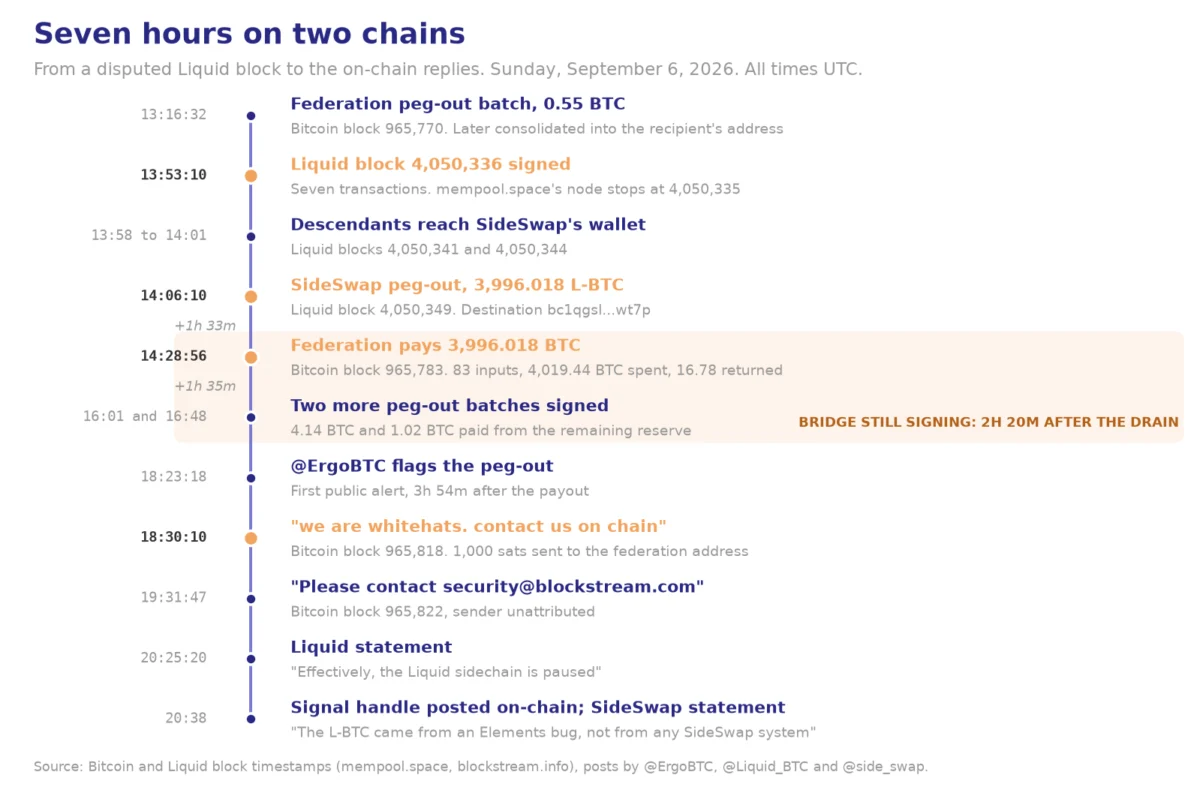
The timeline of the event reveals a sophisticated sequence of operations that left observers and the federation scrambling to identify the discrepancy:
- 13:16 UTC: An initial, smaller peg-out of 0.55 BTC was executed, potentially serving as a test of the bridge’s response mechanisms.
- 13:53 UTC: Liquid block 4,050,336 was produced. This block contained a large, suspicious confidential transaction. Notably, this block was accepted by some nodes (including those maintained by Blockstream) but rejected by others, such as the mempool.space node, signaling an immediate consensus split.
- 14:06 UTC: The primary exploit occurred in block 4,050,349, where the 3,996 BTC peg-out was finalized.
- 14:28 UTC: In Bitcoin block 965,783, the federation’s multisig wallet processed the payout to a destination address.
- 18:30 UTC: The recipient of the funds embedded an OP_RETURN message into the blockchain, stating: "we are whitehats. contact us on chain."
- 20:25 UTC: The Liquid Federation issued an official statement confirming the incident, noting that bridge operations were being suspended.
Technical Implications and the "Confidential" Dilemma
The Liquid Network utilizes Confidential Transactions (CT), a privacy-enhancing feature that hides transaction amounts using Pedersen commitments. While this is a hallmark of Liquid’s value proposition for institutional users, the incident has highlighted a significant drawback: the lack of transparency in verifying the total circulating supply.
Under normal circumstances, an explorer can track the peg-in and peg-out volume to estimate the supply of L-BTC. However, when a consensus bug allows for the illicit creation of L-BTC, the obfuscation inherent in CT prevents external auditors from immediately identifying the anomaly. This effectively meant that the "minted" coins remained invisible until they were converted into native Bitcoin, at which point the federation’s reserve was already drained. At the time of writing, the federation wallet holds approximately 197 BTC, a stark contrast to the estimated 4,200 L-BTC in circulation.
The Role of the Elements Bug
Attention has shifted to the Elements codebase, specifically a recent patch intended to fix a range proof caching issue. An August 3rd commit, authored by Blockstream engineer Byron Hambly, addressed a vulnerability where a node’s cache of verified proofs was insufficiently bound to specific assets and scripts. A pull request to integrate this fix was opened on September 4th—just two days before the exploit—and was merged hours after the theft occurred.
While Blockstream has not explicitly confirmed that this specific bug was the vector for the attack, the timing and the nature of the consensus-split observed by independent researchers strongly suggest that the network’s validation logic was out of sync. Because all fifteen functionaries operate on the same software, they were all susceptible to the same misinterpretation of the blockchain’s rules, rendering the 11-of-15 multisig security measure moot. The hardware did exactly what it was programmed to do: it verified that the request came from a whitelisted partner and that the burn was mathematically "valid" according to the flawed consensus rules.
Official Responses and the "Whitehat" Standoff
Both the Liquid Federation and SideSwap have issued statements clarifying their roles. SideSwap emphasized that its systems were not compromised, but rather that it processed a customer order based on L-BTC that the Liquid network itself had validated as legitimate. The federation has responded by disabling bridge nodes, effectively pausing the Liquid sidechain’s ability to interact with the Bitcoin mainnet.
The status of the funds remains precarious. The entity controlling the 3,998.5 BTC has remained largely silent, save for the initial "whitehat" message and a subsequent exchange of small, encrypted-style messages on-chain. While some analysts hope for a return of funds similar to previous DeFi exploits, the lack of a formal governance framework or a clear path for remediation leaves holders in an uncertain position. The federation has indicated it is attempting to reach the party via signed messages, but as of now, the funds remain unmoved in a single-signature consolidation address.
Broader Implications for Federated Bridges
The breach serves as a watershed moment for the design of custodial sidechains. It challenges the assumption that decentralized, multi-signature, and hardware-secured gateways are sufficient if the underlying consensus layer is vulnerable. The "blast radius" of this event extends to every L-BTC holder, as the current reserve-to-claim ratio is severely compromised.
Furthermore, the event exposes a critical weakness in relying on a homogeneous validation environment. Because all functionaries run identical code, a single logic error—invisible to the outside world due to Confidential Transactions—can lead to a total collapse of the peg.
As the Liquid Network works to resolve the issue, the industry is left to grapple with the tension between privacy and auditability. The incident demonstrates that while Confidential Transactions offer significant benefits for asset issuers like Tether, they also create a "black box" where systemic failures can propagate unchecked. The long-term recovery of the network will likely depend on whether the assets are returned, and more importantly, whether the federation can implement a more robust, multi-client validation system that prevents a single consensus bug from undermining the entire security of the bridge.
For now, the Liquid Network remains in a state of suspended animation. Users are unable to move their assets, and the market awaits a resolution that will determine whether the "whitehat" claim holds weight or if this incident will go down as one of the largest custodial failures in the history of the Bitcoin ecosystem. The discrepancy between the two explorers—one showing a solvent peg and the other revealing the reality of a drained reserve—serves as a permanent reminder of the fragility of bridges that prioritize speed and privacy over transparent, multi-party verification.


