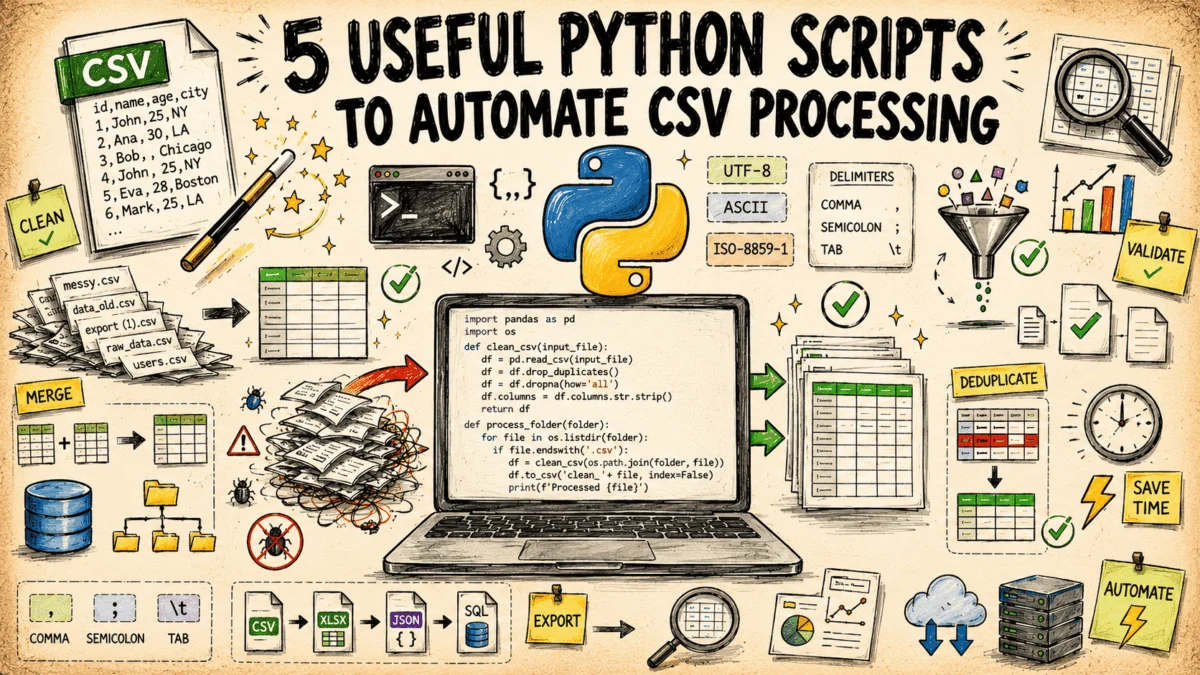
The Comma-Separated Values (CSV) format remains the de facto standard for data interchange across the global digital economy. Despite the rise of sophisticated cloud data warehouses, NoSQL databases, and complex API-driven architectures, the simplicity of the CSV file ensures its continued dominance. According to recent surveys by the Data Engineering Institute, approximately 78% of data practitioners report that CSV files constitute a primary component of their daily ingestion pipelines. However, the ubiquity of the format masks significant operational risks. Inconsistent delimiters, unexpected encoding variants, and shifting schema requirements frequently cause downstream failures that cost enterprises thousands of hours in manual remediation annually.
Historically, data professionals have relied on a fragmented ecosystem of tools to manage these files. While spreadsheet software like Microsoft Excel or Google Sheets offers intuitive visual interfaces, they are ill-equipped for files exceeding one million rows or for the automated, repeatable requirements of modern CI/CD pipelines. Conversely, full-scale data processing frameworks like Apache Spark or Pandas often introduce unnecessary overhead for minor tasks. The current industry trend, as observed in the open-source community, reflects a pivot toward lightweight, dependency-free automation. By utilizing Python’s built-in standard library—specifically modules such as csv, json, hashlib, and random—engineers can build robust, highly portable scripts that avoid the "dependency hell" associated with third-party library management.
The Evolution of CSV Utility Scripts
The necessity for specialized, lightweight processing tools has grown in tandem with the increasing velocity of data movement. In the early 2010s, data cleaning was largely a manual, ad-hoc process. By 2018, as data volumes reached the terabyte scale, the focus shifted toward high-performance ingestion. Today, the focus has settled on resilience and reproducibility. The transition from monolithic, "black-box" data tools to modular, transparent script-based workflows represents a broader movement toward "DataOps"—a methodology that applies DevOps principles to data lifecycle management.
Industry analysts suggest that the "small task" problem—where a process is too simple for an enterprise ETL tool but too repetitive for manual effort—is a major source of technical debt. By developing self-contained scripts that handle schema validation, diffing, normalization, transformation, and anonymization, developers can create a "gatekeeper" layer in their data pipelines. This layer acts as a critical quality control check, ensuring that only validated, standardized data proceeds to high-value analytics engines.
1. Rigorous Schema Validation for Data Integrity
The most common failure point in a data pipeline is the "schema drift." A downstream system expecting a decimal value in a specific column may crash if an upstream provider inadvertently inserts a text string or a null value. Traditional database systems handle this via strict typing, but CSV files—being text-based—lack these inherent constraints.
The solution is a schema validator script that operates as a pre-ingestion gate. By defining a JSON-based schema, an engineer can mandate constraints on a per-column basis. This approach is highly efficient because it utilizes the csv.DictReader class to process data in a streaming fashion. By reading the file row-by-row rather than loading the entire dataset into memory, the script can process multi-gigabyte files on hardware with limited RAM. When a validation error is detected, the script generates a detailed report, identifying the exact row and column responsible for the breach. This level of granularity is essential for debugging large-scale exports where manual inspection is impossible.
2. Precision Auditing with Row-Level Diff Tools
Data reconciliation is a persistent challenge in financial and logistics sectors, where it is critical to verify that a source file matches the data recorded in an internal system. When comparing two versions of a CSV file, visual inspection is prone to human error. The development of automated diff tools, which use primary keys to align datasets, has become a standard practice for data auditors.
These tools function by mapping file records into Python dictionaries, using a unique identifier as the key. By performing a set difference operation on the keys, the script can immediately identify which records have been added or deleted. For the remaining records, a field-by-field comparison highlights specific attribute changes. This objective output—which logs the old_value and new_value alongside the change_type—provides a clear audit trail. Such automation not only reduces the risk of oversight but also provides an auditable document that satisfies regulatory compliance requirements in sensitive industries.
3. Normalization: Standardizing the Chaos
Data provenance issues often stem from legacy systems that output files with non-standard encodings, such as Windows-1252 or Latin-1, instead of the modern UTF-8 standard. Furthermore, regional differences lead to variations in delimiters, with some systems using semicolons or tabs. These inconsistencies are the primary cause of ingestion errors in cloud-native tools like AWS Redshift or Google BigQuery.
The normalization script utilizes Python’s csv.Sniffer and binary-mode file reading to perform a "diagnostic" phase. By sampling the file, the script intelligently guesses the delimiter and encoding, effectively sanitizing the file before it hits the production environment. This process, often referred to as "Data Normalization," is an essential step in ensuring data interoperability. By stripping byte-order marks (BOMs) and standardizing line endings, these scripts ensure that disparate data sources can be unified into a single, cohesive schema.
4. Configurable Transformation Engines
In many enterprise workflows, data requires repetitive restructuring—renaming columns, filtering out PII (Personally Identifiable Information), or calculating new fields. While dedicated ETL software can perform these tasks, they are often overkill for simple CSV manipulation. A configuration-driven column transformer allows teams to define complex logic in a JSON or YAML file, separating the "what" (the transformation logic) from the "how" (the execution engine).
The use of safe expression syntax for deriving new columns ensures that the system remains secure. By avoiding the execution of arbitrary Python code, the script mitigates the risk of injection vulnerabilities. This design pattern is particularly beneficial in organizations with strict security policies where code execution in data pipelines is closely monitored. Because these transformers are lightweight, they can be easily integrated into containerized environments, allowing for rapid deployment across Kubernetes clusters.
5. Ethical Data Sharing through Anonymization
Data privacy regulations, such as the General Data Protection Regulation (GDPR) and the California Consumer Privacy Act (CCPA), have fundamentally changed how companies handle internal data. Sharing raw, sensitive data with external consultants or developers is now a significant legal liability. The sampler and anonymizer script addresses this by providing a mechanism to create safe, representative datasets.
Through "reservoir sampling," the script selects a statistically significant subset of data without needing to hold the entire dataset in memory. Once sampled, the script uses keyed hashing to mask sensitive fields. Because the hashing is consistent within a single run, the relationships between records are maintained, allowing developers to test features or debug issues without exposing real-world identities. This balance between utility and privacy is the cornerstone of modern data governance.
Broader Implications and Future Outlook
The reliance on these lightweight Python scripts reflects a maturation of the data engineering field. As organizations move away from "all-in-one" proprietary solutions, the ability to build, maintain, and share custom, modular tooling has become a competitive advantage. These five categories of scripts—validation, diffing, normalization, transformation, and anonymization—represent the essential "toolbox" for any data professional.
The implications for organizational efficiency are significant. By automating the "janitorial" tasks associated with data processing, engineering teams can reallocate their focus toward higher-level objectives, such as machine learning model development and strategic analytics. Furthermore, the use of standard libraries ensures that these scripts remain functional for years, immune to the rapid obsolescence of third-party package ecosystems.
As the volume of global data continues to grow, the ability to process CSV files with precision and speed will remain a critical skill. The modular approach described here does not just solve the immediate pain points of a single data import; it fosters a culture of technical excellence. By treating data processing scripts with the same rigor as production application code, organizations can ensure that their data pipelines remain robust, scalable, and compliant in an increasingly complex digital landscape. Ultimately, the transition to automated, script-based workflows is not merely a convenience—it is a fundamental requirement for the modern, data-driven enterprise.