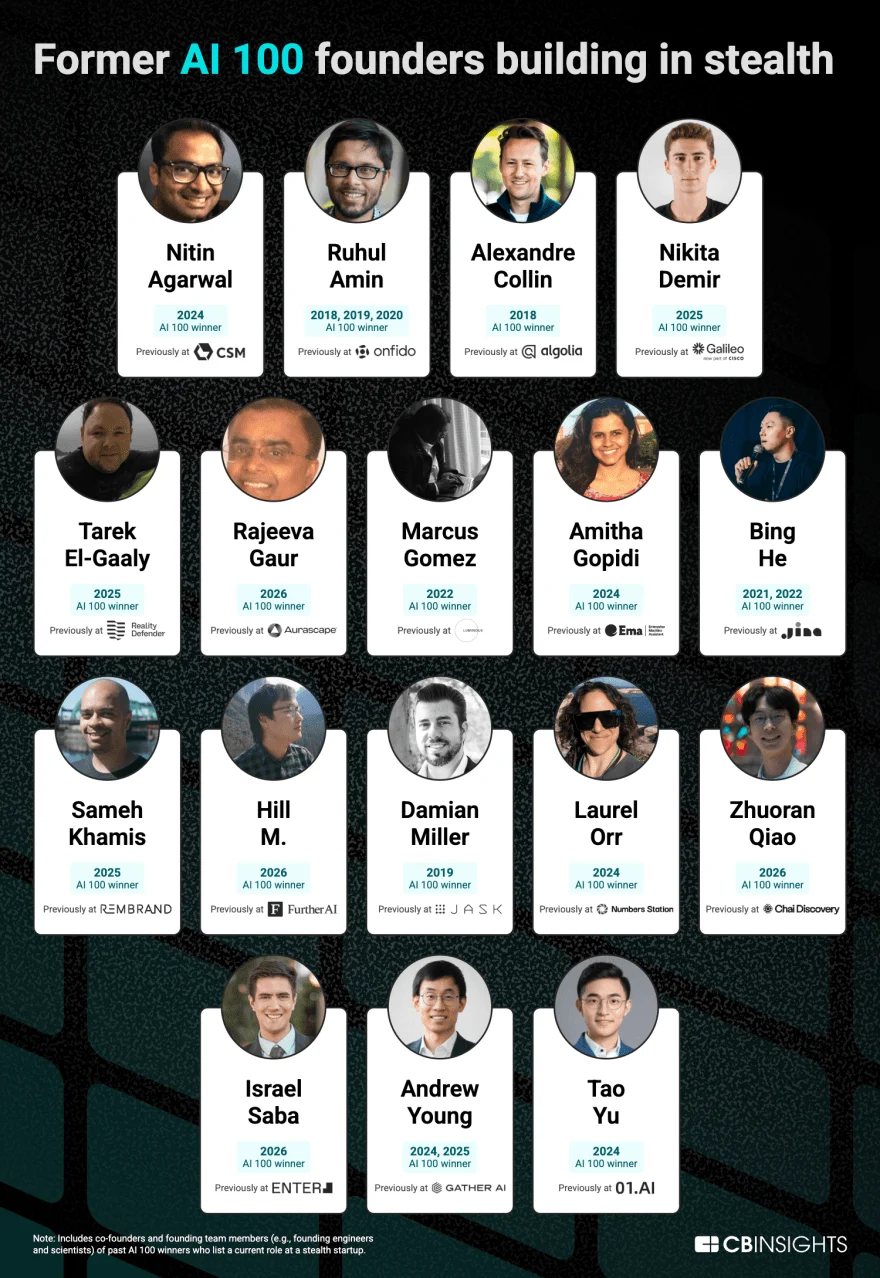
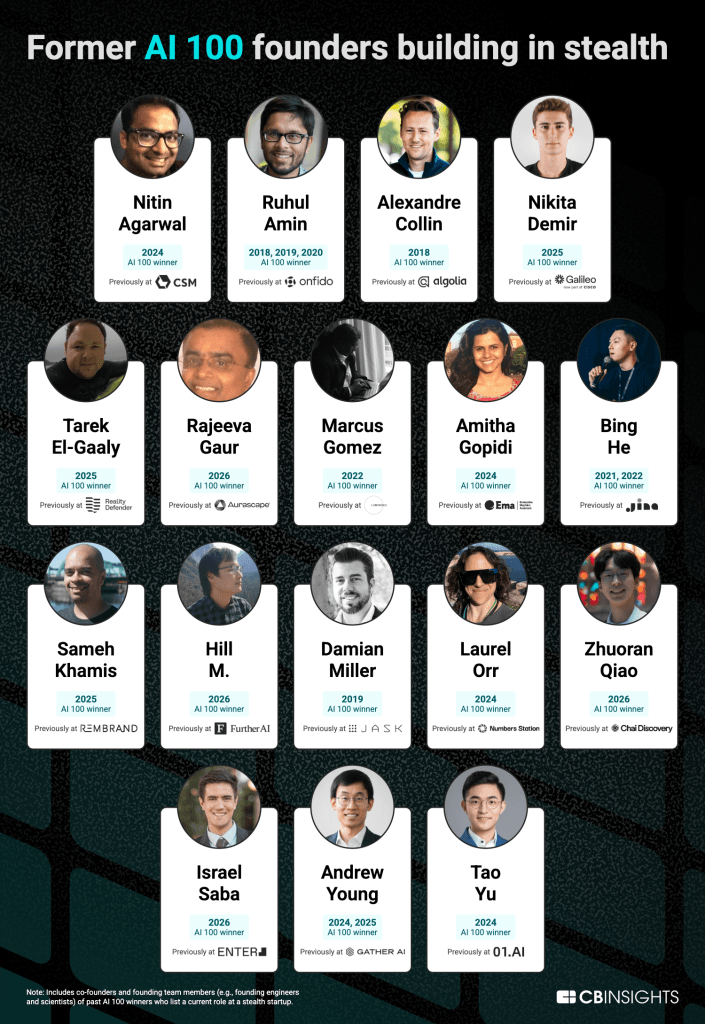
Stealth startups are, by their very nature, designed to be elusive. They operate without the fanfare of public websites, formal product launches, or widely publicized funding rounds, choosing instead to build in a vacuum of information. For market analysts and venture capitalists, these companies represent the "black box" of the innovation ecosystem. However, while the companies themselves are difficult to track, the architects behind them are increasingly transparent through their professional footprints. By analyzing a decade of data from the CB Insights AI 100—a prestigious list of the most promising private artificial intelligence companies—we have identified 17 founding team members who have transitioned from successful exits and established AI ventures into new, undisclosed projects.
The migration of these high-caliber engineers, researchers, and operators from celebrated AI unicorns to nascent stealth startups provides a unique diagnostic tool for the industry. By cross-referencing work history, academic research publications, and professional social media disclosures, it is possible to map the trajectory of these individuals and predict the next major shifts in the artificial intelligence landscape.
A Decade of Evolution: From AI 100 to Emerging Stealth
The AI 100 list has served as a bellwether for the industry since its inception. Over the last ten years, companies featured on this list have played a critical role in bringing generative AI, computer vision, and autonomous systems into the mainstream. The 17 individuals identified in this analysis represent a "second wave" of innovation. These are not novices; they are the individuals who built the technical foundations for companies like Onfido, Algolia, Galileo, and Luminous Computing.
The shift toward stealth in 2025 and 2026 marks a significant inflection point. During this period, the industry moved from the "discovery" phase of LLMs toward the "application and reliability" phase. The data suggests that these founders are no longer focused on simply building a better model; they are focused on solving the structural bottlenecks—such as data drift, spatial computing integration, and agentic autonomy—that prevent AI from being fully integrated into critical enterprise infrastructure.
Thematic Clusters: Where the Talent is Moving
Analysis of the professional backgrounds of these 17 founders reveals three primary clusters of focus: Spatial and Embodied AI, Enterprise Agentic Workflows, and Advanced Computing Reliability.
1. Spatial Computing and the Physical World
Nitin Agarwal, formerly a founding research scientist at Common Sense Machines, represents a shift toward the physical integration of AI. Having led 3D generative AI research through its acquisition by Google, Agarwal’s current work in stealth is widely expected to focus on spatial computing. This aligns with broader industry trends where AI is no longer confined to screens but is being tasked with reconstructing and navigating physical environments.
Similarly, Sameh Khamis, who co-founded Rembrand, is now applying his expertise in 3D reconstruction and computer vision—honed at NVIDIA and Microsoft—to the startup Halfpixel. The focus here is on spatial intelligence, a field that aims to move AI beyond text processing and into the realm of understanding the physical, three-dimensional world in real-time.
2. The Rise of Agentic Reliability
A recurring theme among these founders is the transition from "co-pilot" AI—tools that assist human users—to "agentic" AI, which can perform multi-step tasks autonomously. Nikita Demir, the first engineer at Galileo, is a prime example. His research at Stanford, which focused on data integrity in noisy environments, provides a blueprint for what his current stealth venture may be tackling. As businesses move toward deploying AI agents, the issue of "model reliability"—ensuring that the data feeding the model is accurate and the output is consistent—has become a top-tier challenge for the enterprise.
This trend is echoed by Rajeeva Gaur, who is applying 25 years of software engineering experience to the problem of adaptive optimization for agentic AI. The move suggests that the next generation of AI will be defined by its ability to self-correct and function within complex, unpredictable business workflows without constant human supervision.
3. Security and National Strategy
The intersection of AI and cybersecurity is another area attracting significant talent. Ruhul Amin, a pioneer in AI-driven identity verification through his work at Onfido, has transitioned to a London-based stealth project. Given his background in identity security, analysts anticipate his work will address the looming threat of AI-generated impersonation and the authentication of autonomous agents.
Marcus Gomez, the former CEO of Luminous Computing, offers perhaps the most strategic perspective. Having led the development of light-powered AI chips, his recent academic focus on the national security implications of semiconductor supply chains suggests that his new venture may move beyond software into the critical, and often bottlenecked, realm of high-end hardware infrastructure.
The Role of Institutional Knowledge
The professional trajectory of these founders highlights the "multiplier effect" within the AI ecosystem. When a founder like Bing He, who helped scale Jina AI across four international markets, pivots to a new venture in agentic AI and hardware, they bring with them a decade of experience in international strategy, technical architecture, and team scaling.
This level of institutional knowledge is rare. Unlike the first wave of AI startups, which were often academic or experimental, these new stealth ventures are being built by "serial founders." These individuals understand how to navigate regulatory hurdles, how to secure enterprise-grade data, and, crucially, how to build products that survive the transition from a research prototype to a commercialized, multi-million-dollar entity.
Market Implications and Future Outlook
The emergence of these stealth startups signifies that the "AI gold rush" is entering a more mature, infrastructure-focused stage. Investors are increasingly shifting capital away from general-purpose LLM wrappers and toward specialized, highly technical solutions that solve specific enterprise pain points.
The fact that these 17 individuals have chosen to build in stealth is indicative of the intense competitive pressure in the AI sector. In a market where intellectual property and time-to-market are the primary drivers of value, the "stealth" period acts as a strategic buffer. By operating behind the scenes, these founders are able to secure initial pilot projects—such as those reported by Amitha Gopidi in the health tech sector—before exposing their technology to the broader market.
The implications for the broader tech industry are profound. If these founders succeed, we should expect a surge in specialized AI solutions over the next 18 to 24 months. These will likely include:
- Infrastructure-ready AI: Tools that ensure model reliability in real-time enterprise environments.
- Hardware-software co-design: A new generation of computing architecture specifically optimized for agentic workloads.
- Regulated Industry Automation: AI systems that meet the stringent compliance and security standards required for healthcare, law, and defense.
Conclusion: A Quiet Prelude to a Loud Future
The data provided by the AI 100 history serves as a window into the future of the technology sector. While the 17 founders mentioned here continue to operate in the shadows, their combined experience across 3D modeling, identity security, semiconductor manufacturing, and agentic workflows provides a clear map of where the capital and the talent are heading.
The industry is shifting from the era of "what can AI do" to "how can AI be reliably integrated into the global economy." As these 17 stealth startups inevitably emerge from their incubation periods, they will likely define the next iteration of the AI 100, marking the transition of artificial intelligence from a experimental technological novelty to the bedrock of modern industrial and enterprise infrastructure. For now, the most significant developments in the field are happening in private, led by the very people who defined the last decade of the AI boom.