For two decades, the established playbook for distributing developer infrastructure centered on a familiar, yet often challenging, process: securing developer buy-in to install an SDK, integrate it into a single team’s workflow, and then orchestrate expansion across the organization. The primary hurdle in this model was invariably "developer bandwidth"—the inherent difficulty in convincing developers to adopt a new dependency, manage credentials, and implement initial API calls. However, the advent of AI coding tools like Cursor and Claude Code is fundamentally disrupting this long-standing bottleneck. With AI now contributing to a significant and rapidly growing percentage of public GitHub commits, developer infrastructure companies face a critical imperative: adapt their products for AI coding agents not as an optional enhancement, but as a strategic necessity for survival and growth.
The Evolving Landscape of Developer Tool Distribution
The traditional approach to developer tools distribution has long recognized that success hinges on minimizing friction. Pioneers like Stripe, with its famously concise seven-line integration, and Twilio, offering copy-paste quickstarts, exemplified this principle. Datadog’s one-command agent installation further underscored the importance of a seamless initial experience. The entire Product-Led Growth (PLG) movement was an optimization around this core insight: making the initial five minutes of interaction with a product "magical" to foster organic adoption and word-of-mouth referrals.
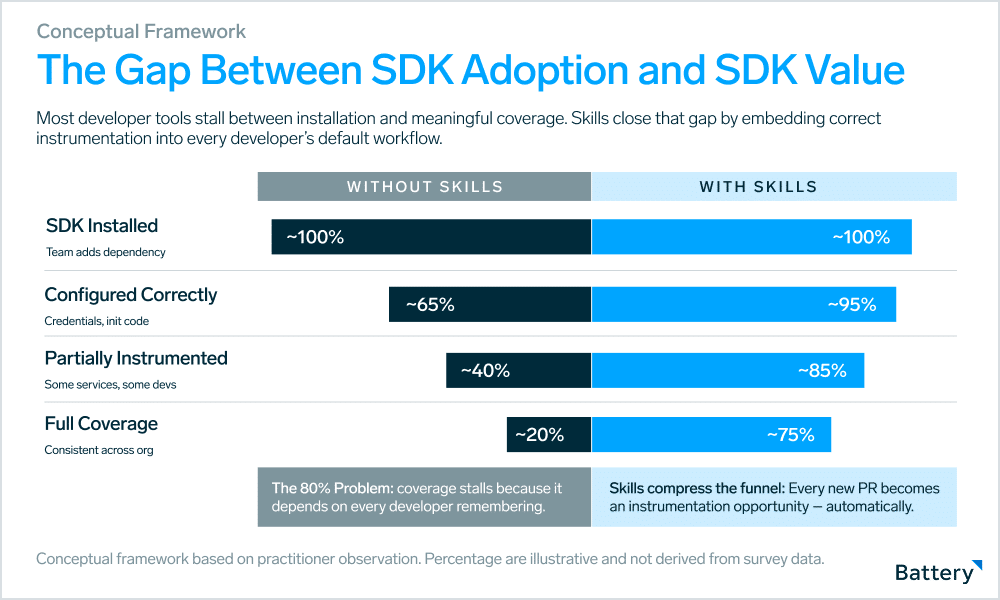
Yet, this initial success often masked a more profound challenge: expansion within an organization. While getting an SDK installed was a critical first step, achieving comprehensive adoption—instrumenting it correctly across every service, feature, and team—remained an arduous and often unglamorous undertaking. This ongoing work determined whether a tool delivered its promised value or languished at a mere 20% coverage, failing to realize its full potential.
Sudhee Chilappagari, reflecting on his experience as a product manager at Segment, highlighted these dual challenges. The first involved securing developer time and resources to install analytics.js and instrument events. The second, more complex issue, was ensuring the effectiveness of these implementations—guiding developers on what events to track and adhering to correct API syntax to deliver tangible downstream value to customers. Segment’s initial solution to the developer bandwidth problem was to simplify the installation process of analytics.js. To address the best-practices challenge, they developed "Protocols," a tracking plan product designed to enforce a "plan first, track effectively later" discipline. Further innovations like "Typewriter," a type-safety plugin, aimed to auto-complete event code, reducing the cognitive load on developers. While these were significant advancements, they necessitated the creation of entire product lines and dedicated engineering teams, underscoring the substantial investment required to bridge the gap between initial installation and effective, widespread instrumentation. This experience illustrated a broader trend: even companies strategically prioritizing this problem required immense effort, while many others saw their tools remain at partial adoption due to human inconsistency rather than technical limitations, thus never achieving their full value proposition.
The Transformative Impact of Agentic Development
The emergence of AI coding agents, such as Claude Code and Cursor, is rapidly reshaping the developer workflow. These agents are increasingly becoming the primary interface for writing and modifying code. This represents a paradigm shift, transforming the developer’s default interaction from hands-on coding to a "describe what I want, review the code" model. In this new paradigm, AI agents act as powerful intermediaries between developer intent and the codebase. Crucially, this intermediary is programmable.
With AI agents handling the bulk of code generation, the historical barrier of "developer bandwidth" effectively dissolves. The excuse of "we can’t get engineering cycles" becomes obsolete. The real unlock lies in the ability to imbue these agents with the deep, context-aware knowledge previously held by a company’s most experienced solutions engineers. The critical question becomes: can an AI agent understand a customer’s industry, ideal customer profile (ICP), goals, and desired outcomes well enough to instrument an SDK comprehensively and correctly across an entire application?
If the answer is yes, the implications are profound. This unlocks the potential for a "10x solutions engineer" for every customer account—an agent that operates on every pull request, never takes a vacation, and consistently adheres to naming conventions and best practices. This capability is powered by "agent skills." These are compact, installable context packages that educate an AI coding agent on how a specific tool operates, the desired patterns to follow, and common pitfalls to avoid. With a single command, every interaction an agent has with a codebase can be infused with deep, opinionated knowledge of an SDK. This represents a fundamentally new and powerful distribution surface, unlike anything seen in the previous two decades of developer tooling.
Amplifying Value Through Organizational Coverage
The value proposition of many infrastructure products is intrinsically tied to their coverage within an organization. Historically, achieving this coverage has been constrained by human memory and discipline, rather than technical capability. Agent skills, however, effectively dismantle these constraints.
Consider the domain of observability tools. While OpenTelemetry has seen widespread adoption across metrics, logs, and traces, its true value is unlocked by comprehensive coverage. The more of a system that is instrumented, the more coherent the traces, and the more effective the debugging becomes. This requires every developer, on every new service and endpoint, to remember to add spans, propagate context, attach the correct attributes, and configure appropriate exporters. This is less a technical challenge and more a human memory challenge.
A well-designed OpenTelemetry skill can fundamentally alter this default behavior. The AI agent, guided by the skill, would automatically instrument new HTTP handlers, wrap database calls, and propagate context across service boundaries. The developer is freed from the burden of remembering these crucial steps; the agent handles them proactively.
This impact extends beyond mere adoption metrics. For developer infrastructure products that employ usage-based pricing models—such as per-span volume, tracked events, monthly active users, or workflow executions—depth of coverage directly correlates with revenue. An account with only 20% instrumentation is generating, at best, 20% of its potential billing. Agent skills can close this gap without requiring new customer acquisition. Each pull request an agent instruments represents incremental Annual Recurring Revenue (ARR) that previously would have necessitated a dedicated sales motion.
This principle applies across a wide array of developer infrastructure categories:
-
Product Analytics (e.g., Pendo, Segment, Amplitude): While initial installation is straightforward, realizing value hinges on tagging every meaningful user interaction with precise event names, properties, and user context. This is a continuous instrumentation task distributed across all frontend developers. A skill that understands an organization’s event taxonomy can transform sporadic tagging into comprehensive coverage, directly influencing customers’ event tiers and driving automatic upsells.
-
Feature Flags (e.g., LaunchDarkly, Statsig): Best practices dictate that every new feature should be wrapped in a flag. However, friction often leads to only a fraction of features being flagged. A skill that enforces a "new feature equals flag by default" policy and understands organizational naming conventions not only boosts adoption but also subtly shifts engineering behavior, making the right thing the easy thing.
-
Authentication SDKs (e.g., Auth0, Descope): Identity verification, correct token validation, session handling, and logout logic are critical for every new route, API endpoint, or user-facing flow. Under pressure to deliver quickly, developers may shortcut these processes. A skill that enforces "every new endpoint validates identity before execution" and understands preferred SDK patterns transforms authentication from an inconsistently applied step into a ubiquitous default.
-
Authorization SDKs (e.g., Styra, Permit.io, Oso): Authorization logic is notoriously inconsistent across codebases. A skill that grasps an organization’s permission model and automatically integrates authorization at every new endpoint simultaneously enhances security posture and SDK adoption.
-
Runtime Application Security (e.g., Contrast Security, Arcjet): Runtime Application Self-Protection (RASP) tools face a similar partial-coverage challenge, with more severe consequences. A missed instrumentation point can create an unprotected attack surface rather than just a reporting gap. A skill that enforces protection hooks at every new route by default transforms RASP from a partial perimeter into a pervasive runtime fabric, where "the developer forgot" is an unacceptable security vulnerability.
-
Secrets Management (e.g., HashiCorp Vault, Hush): Every new database connection string, API key, or credential presents a potential point of failure where a developer might hardcode sensitive information instead of retrieving it from the organization’s secrets store. A skill that intercepts these moments, flagging direct environment variable access like
os.environ['STRIPE_KEY']and replacing it with a secure retrieval call likehush.get('stripe_key'), enforces hygiene precisely at the point of risk. Such hardcoded secrets can easily be overlooked during code reviews, making agent intervention critical. -
Testing Frameworks (e.g., Playwright, Testcontainers, Cypress): While testing tools are generally not difficult to install, maintaining test coverage can be challenging. Coverage often drifts, not due to a lack of developer appreciation for testing, but because test writing is frequently deprioritized under velocity pressure. A skill that generates opinionated, framework-consistent tests alongside new functions or components shifts the agent’s default output from merely delivering a feature to delivering the feature with its accompanying tests.
-
Durable Workflow Engines (e.g., Orkes, DBOS, Temporal): These tools often present steep learning curves, with opinionated APIs, subtle correctness requirements regarding determinism, and specific patterns for handling retries and failures. A skill that encapsulates this complex context ensures that developers interacting with the workflow layer, regardless of their tenure, adhere to the same robust patterns established by earlier team members.
Early Evidence of a Paradigm Shift
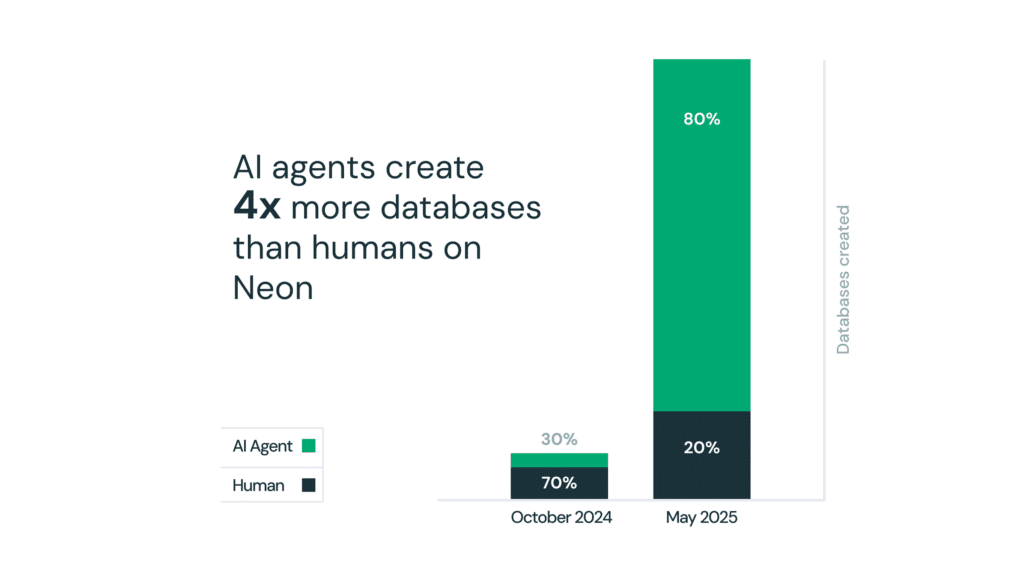
The transformative potential of agent-native distribution is already evident. Neon, a serverless PostgreSQL company, made a strategic investment in this area by publishing AI rules, developing Claude Code plugins and Cursor integrations, and releasing a comprehensive agent skills library on GitHub. The impact was remarkable: over 80% of databases provisioned on Neon were created by AI agents, a statistic so compelling it was cited as a key factor in Databricks’ $1 billion acquisition of Neon in 2025. Neon’s success was not merely in building a database but in embedding itself into the default workflows of AI agents, a distribution advantage that proved to be worth an extraordinary valuation.
A Strategic Reorientation for Competitive Advantage
The rise of agent skills signifies a fundamental shift in where competitive advantage is built within the developer tools market. Historically, companies that excelled at the initial installation and the "first five minutes" often dominated. However, if skills become the primary adoption surface, winning will increasingly depend on the depth and accuracy with which a tool’s capabilities are embedded within an agent’s context. This dynamic favors a different set of capabilities: the quality and completeness of a company’s agent skills, the trust developers place in their agent-layer recommendations, and the agility with which these skills are updated as APIs evolve.
This has significant implications for investments in developer relations and documentation. The most effective SDK documentation has always served as a form of distribution, making it easy for developers to understand and correctly utilize a tool. Agent skills represent an evolution of this concept: they are documentation that executes. Companies that proactively invest in developing high-quality, opinionated, and well-maintained skills are effectively pre-loading their adoption curve into every agent-assisted developer workflow.
Furthermore, skills act as a potent discovery channel within organizations. When a new developer joins a team and begins using an AI coding agent, the agent, equipped with relevant skills, can suggest tools and patterns already in use by the organization. This bypasses the need for manual searching or reliance on informal recommendations, enabling tools to spread virally through the agent’s contextual awareness.
Implications for Builders and Investors
For founders building developer infrastructure, the agent skill is no longer a peripheral documentation task but a core product artifact. The critical question shifts from "how do we make the first install easy?" to "how do we make every subsequent instrumentation decision effortless for every developer, perpetually?" The answer lies in developing a skill that imbues an AI agent with the same nuanced understanding of an API as a company’s most seasoned solutions engineer.
Investors evaluating developer tools companies must recognize that distribution moats are being fundamentally rebuilt. A company with a modest PLG motion but an exceptional skill embedded across enterprise accounts within agent contexts may possess a more robust expansion engine than one with a polished quickstart but limited agent-layer presence. Key metrics are evolving; coverage depth within accounts, rather than solely seat count, is increasingly indicative of durable value.
Agent skills also address critical coverage gaps that traditional PLG models struggled to penetrate. This includes retrofitting legacy codebases, where agents can systematically refactor existing uninstrumented code to meet current standards without requiring dedicated engineering sprints. It also extends to DevOps workflows, where infrastructure-as-code, CI/CD pipelines, and deployment scripts can benefit from the same pattern-enforcement logic applied to application code.
The first wave of PLG focused on removing friction at the point of installation. The current wave, driven by agentic development, is about removing friction at every code commit, indefinitely. Companies that strategically build for this second wave will be exceptionally well-positioned in the coming years. The pivotal question for founders and investors alike today is: "What is your AI coding-agent skills strategy, and when does it launch?"