The United States Department of Defense is seeking an investment of 30.3 million dollars over the next five years to develop and deploy an advanced iteration of the traditional lie detector. According to a Department of Defense budget request submitted for fiscal year 2027, the initiative, officially designated as Polygraph+ or Polygraph Next, aims to overhaul federal credibility assessment frameworks. The program focuses heavily on scoring algorithms driven by artificial intelligence and machine learning, alongside a burgeoning methodology known as standoff sensing, which facilitates physiological data collection without requiring physical contact sensors to be attached to a subject’s body.
The funding proposal, first brought to public attention by the defense publication Inside Defense, outlines a sweeping effort to modernize federal polygraph and credibility assessment technologies to elevate overall accuracy and reliability metrics. However, this financial commitment arrives amid intense scrutiny from legal scholars, civil liberties advocates, and scientific researchers who point out that the project may represent merely the latest iteration in a century-long lineage of flawed technological attempts to scientifically isolate and measure human deception.
Kyri Kotsoglou, a legal scholar at Northumbria University in the United Kingdom who specializes in the application of polygraphs within legal and justice systems, characterizes the initiative as a fundamentally flawed endeavor. According to Kotsoglou, attempting to reduce complex psychological states, behavioral nuances, and cognitive processes into a single, tangible metric is a misguided scientific approach.
Internal Tensions and the Push for Enhanced Vetting
This aggressive pursuit of modernized deception detection coincides with a period of heightened internal tension and institutional anxiety within the Pentagon. Under the leadership of Defense Secretary Pete Hegseth, the Department of Defense has increasingly relied on polygraph examinations as an aggressive mechanism to identify sources responsible for unauthorized disclosures and leaks to mainstream media organizations.
The pressure intensified dramatically in September, when the New York Times reported that approximately 50 military officers assigned to the Joint Staff were subjected to mandatory polygraph tests. This mass screening was triggered following extensive news coverage detailing the significant depletion of critical United States weapons stockpiles resulting from ongoing military engagements and strategic postures concerning Iran.
The Polygraph+ initiative is scheduled to be managed and administered by the Defense Counterintelligence and Security Agency, commonly known as the DCSA, which holds the primary responsibility for conducting exhaustive background investigations and security clearance vetting for the federal government. Budget documents indicate that the forthcoming technology will serve a dual purpose: vetting prospective civilian and military personnel prior to employment and enhancing internal threat detection protocols across sensitive defense installations.
Despite the scope of the project, the specific technological architecture and commercial partners selected for the initiative remain partially obscured. The DCSA has declined formal requests for further clarification regarding the exact specifications of the anticipated systems.
Chronology of the Pentagon Pursuit of Deception Detection
While the formal Polygraph+ budget request represents a multi-year financial commitment, the Pentagon has been laying the groundwork for next-generation lie detection technologies for several years. A review of recent defense innovation initiatives provides a clear chronological roadmap of how the military has systematically sought to integrate non-traditional sensing technologies into its security infrastructure.
In 2023, the Defense Innovation Unit, an organization within the Department of Defense tasked with accelerating commercial technology integration into the military, launched an open solicitation process. The objective was to identify and procure innovative commercial products capable of identifying human deception outside the constraints of traditional wired polygraph equipment.
Following a rigorous evaluation of available market solutions, the Defense Innovation Unit selected two distinct private sector companies to construct functional technological prototypes:
Presage Technologies, a firm asserting a proprietary capability to measure subtle fluctuations in human heart rate and respiratory patterns utilizing standard optical cameras.
Altec Research, a specialized medical sensor manufacturer that has expanded its research and development into non-contact physiological sensing systems.
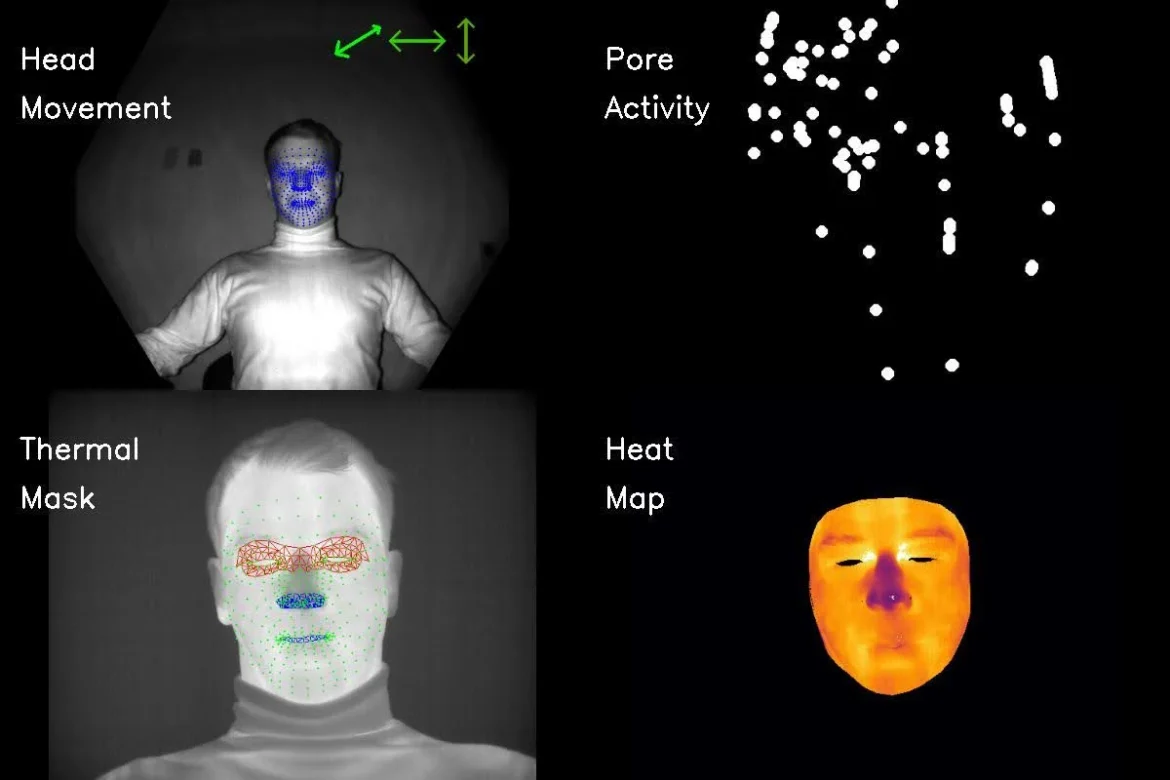
Promotional and technical screenshots released by the Defense Innovation Unit regarding Altec Research’s prototype illustrate a sophisticated tracking apparatus capable of simultaneously monitoring involuntary head movements, localized facial skin temperature variations, and microscopic pore activity associated with sympathetic nervous system responses. Despite the public release of these technological concepts, representatives for Presage Technologies, Altec Research, and the Defense Innovation Unit have consistently declined to comment on the current status or operational deployment of these prototypes.
The Science and History of the Traditional Polygraph
To understand the scale of the technological leap the Pentagon is attempting, it is necessary to examine the foundational mechanisms of current lie detection technology. The traditional polygraph has remained fundamentally unchanged since its invention in the 1920s. Modern examiners rely on a physical setup that measures blood pressure, pulse rate, respiration depth, and electrodermal activity, which essentially measures sweat production on the fingertips.
During a standard examination, practitioners establish a baseline by asking neutral or control questions, such as inquiring whether the sky is blue, and compare the physiological reactions to those elicited by target questions, such as asking whether the subject has ever committed a serious crime or espionage.

Despite the federal government administering tens of thousands of these tests annually during employee screening and security clearance renewals, the scientific community has consistently challenged the reliability and validity of the polygraph. Results generated by traditional polygraphs are rarely admissible as evidence in federal or state courts due to severe questions regarding their scientific standing.
Historical evaluations by governmental and scientific bodies have painted a consistently dim picture of polygraph efficacy. In 1983, the Office of Technology Assessment, a former analytical support agency for the United States Congress, concluded that there was extremely limited scientific evidence supporting the validity of polygraphs in personnel screening contexts. Two decades later, in 2003, the United States National Research Council released a landmark report stating that the scientific evidence base for the polygraph’s validity in detecting deception was weak at best.
Statistical Realities and Error Margins at Scale
While human beings without technical assistance typically struggle to detect deception, correctly identifying a lie only slightly more than half the time, the American Polygraph Association asserts that traditional polygraphs boast an accuracy rate ranging between 80% and 94%.
However, experts emphasize that even high theoretical accuracy rates present catastrophic problems when applied at the scale of the United States Department of Defense, which employs approximately 2.8 million active-duty military personnel, civilian workers, and defense contractors. The 2003 National Research Council report explicitly warned that deploying a screening test with an imperfect accuracy rate across a massive population inevitably results in a high absolute number of erroneous classifications. An imperfect system deployed across the entire defense apparatus could lead to the false accusation or wrongful denial of clearances for tens of thousands of loyal personnel.
Furthermore, polygraph interpretation is plagued by inherent subjectivity. Different examiners evaluating the exact same physiological chart data frequently arrive at wildly divergent conclusions. Studies have also demonstrated that individuals belonging to specific demographic and minority groups are disproportionately more likely to be incorrectly judged as deceptive due to baseline physiological variations.
Compounding these reliability issues is the susceptibility of the test to physical and mental countermeasures. Interviewees can be trained or can independently discover methods to artificially manipulate their physiological responses during control questions—such as subtly pressing a hidden tack inside a shoe or altering their breathing patterns—thereby defeating the diagnostic calibration of the machine.
Sophie van der Zee, an associate professor studying deception and credibility assessment at Erasmus University in Rotterdam, notes the fundamental flaw in the technology’s premise. If a subject understands the operational mechanics of the polygraph, they can systematically manipulate the outcome. Van der Zee argues that the primary utility of the polygraph has never been its scientific precision, but rather its psychological deterrence effect, as many subjects offer confessions before the examination even begins. However, she notes that this deterrent effect relies entirely on the pervasive societal myth that the machine is infallible.
The Quest for the Pinocchio’s Nose and Multi-Modal AI Systems
Over the past several decades, researchers and defense contractors have pursued numerous alternative strategies for lie detection, experimenting with technologies ranging from thermal imaging cameras and advanced pupil trackers to functional magnetic resonance imaging brain scans. None of these methodologies have yielded consistently reliable results when deployed outside controlled laboratory environments.
The core scientific obstacle remains unchanged: there is no single, universal physiological indicator of lying that remains consistent across all human beings under all circumstances. As van der Zee succinctly observes, science has yet to discover a true Pinocchio’s nose.
Proponents of the Polygraph+ initiative argue that artificial intelligence and machine learning could theoretically elevate deception detection by identifying complex, multi-variable patterns in physiological data that human examiners are incapable of perceiving. AI algorithms are particularly suited for multi-modal deception detection systems, which attempt to synthesize multiple concurrent physiological and behavioral measurements into a unified deception score that is significantly more difficult for a subject to game.
According to researchers, human deception involves three distinct underlying mechanisms: physiological stress, heightened cognitive load, and the conscious behavioral effort required to conceal the truth. Traditional polygraph technology successfully targets only one of these pillars: physiological stress.
The integration of multi-modal approaches is not an entirely novel concept. During the 2000s, academic researchers at Manchester Metropolitan University in the UK developed an experimental system named Silent Talker, which generated automated deception scores by analyzing facial expressions and movements captured on video footage. This research framework was subsequently integrated into iBorderCtrl, a pilot program funded by the European Union aimed at automated border screening. Simultaneously, within the United States, a research project known as AVATAR incorporated automated eye-tracking, voice stress analysis, and micro-body movement detection into a kiosk intended for border security checkpoints. Ultimately, all of these ambitious projects quietly faded from active deployment as technical limitations and privacy concerns mounted.
Implications and the Risk of Psychological Intimidation
Legal scholars and policy experts remain profoundly skeptical that combining artificial intelligence with the traditional polygraph will resolve the underlying scientific deficiencies. Kyri Kotsoglou argues that merging AI with the polygraph represents the worst possible combination, as it compounds underlying scientific invalidity with the inherent opacity and algorithmic uncertainty of machine learning models.
Even if advanced machine learning models can identify previously unobserved correlations in physiological datasets, experts emphasize that the technology remains fundamentally incapable of reliably linking those patterns to actual deception, primarily because the field lacks a verifiable ground truth.
Marion Oswald, a law professor who has collaborated with Kotsoglou on research examining the integration of polygraphs into the legal and justice systems, echoes these concerns. Oswald emphasizes that even with exhaustive historical records of past polygraph sessions, analysts cannot definitively verify whether the historical outcomes were correct. Consequently, she fears that modernizing these systems with artificial intelligence will merely perpetuate their legacy as psychological props rather than scientifically valid investigative instruments.
Oswald concludes that the sudden financial and administrative push for Polygraph+ is best understood not as a breakthrough in forensic science, but as a direct institutional reaction to the political pressures facing current defense leadership regarding leaks and internal dissent. Within this context, advanced lie detection technologies risk being weaponized primarily as threats designed to intimidate personnel, enforce institutional loyalty, and extract confessions through psychological coercion rather than functioning as legitimate tools for discovering verifiable truth.