For senior compliance decision-makers, the selection of an anti-money laundering (AML) data vendor has evolved from a routine procurement task into a high-stakes strategic imperative. In an era where financial crime risks are escalating in both frequency and sophistication, the choice of a data partner now dictates the operational efficiency, regulatory resilience, and long-term viability of a financial institution’s compliance framework. As regulatory bodies globally—ranging from the Financial Action Task Force (FATF) to the European Union’s new Anti-Money Laundering Authority (AMLA)—tighten their oversight, the traditional approach of "ticking regulatory boxes" is no longer sufficient. Today’s landscape demands a data provider that can seamlessly integrate across disparate systems, provide high-fidelity intelligence, and transform static workflows into proactive risk management engines.
The necessity for this evolution is underscored by the current state of operational fragmentation within the industry. Research indicates that a staggering 97% of financial firms now rely on two or more separate solutions for customer screening, with 53% managing between eight and ten distinct systems. This reliance on a patchwork of tools has created a "silo effect," where fragmented data sources lead to significant operational bottlenecks, high rates of false positives, and a reactive posture that leaves institutions vulnerable to emerging threats.
The Evolution of AML Data: From Static Lists to Dynamic Intelligence
Historically, AML data vendors were viewed primarily as providers of static lists—databases of sanctioned individuals, politically exposed persons (PEPs), and known criminals. However, the role of these vendors has expanded significantly. Modern AML data encompasses a vast array of information types, including adverse media, corporate ownership structures (Ultimate Beneficial Ownership), and real-time risk signals derived from global financial activities.
The primary role of a vendor is now to supply the "fuel" for sophisticated screening engines. Yet, not all fuel is of equal quality. Many institutions find themselves struggling with a "fragmented approach" where data is provided as a standalone product, requiring the institution to build its own bridges to its screening software. When the rules engines and the datasets are not inherently designed to work together, discrepancies in logic and matching criteria emerge. These misalignments are the root cause of the inefficiencies currently plaguing compliance teams, such as the inability to reconcile name variations or the failure to identify "hidden" PEP connections across different jurisdictions.
The Operational Burden of Fragmented Systems
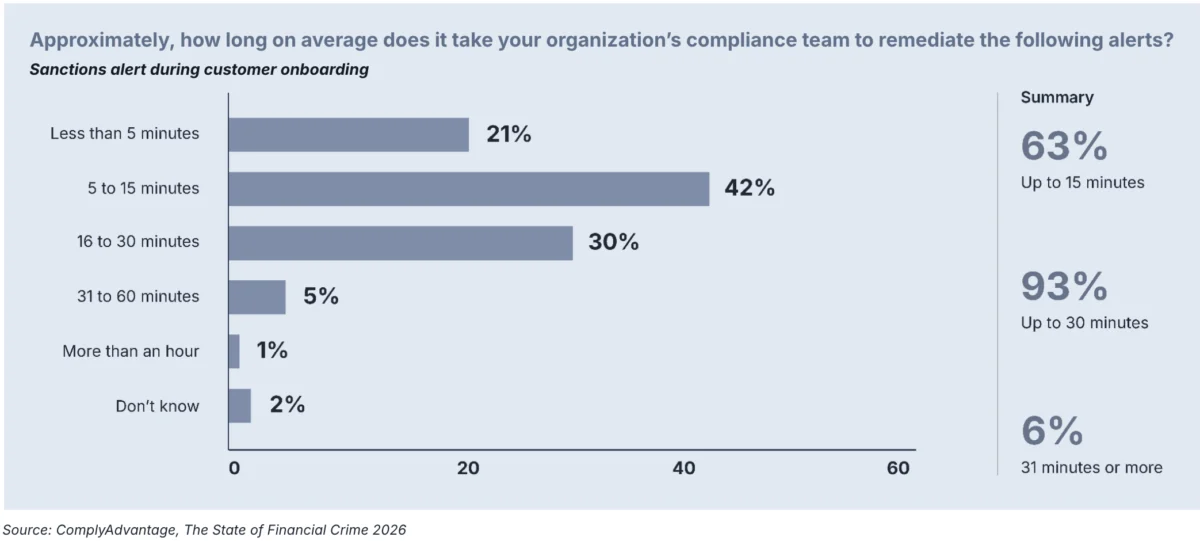
The impact of managing multiple, disjointed systems cannot be overstated. When data is siloed, compliance analysts are forced to manually bridge the gaps. Industry data reveals the cost of this friction: approximately 79% of organizations require more than five minutes to clear a single sanctions alert during the customer onboarding phase. In a high-volume environment, these minutes aggregate into thousands of hours of lost productivity and significant delays in customer acquisition.
Furthermore, the "false positive" epidemic continues to drain resources. When a screening tool lacks the context provided by a unified data profile, it often flags benign individuals who happen to share a name with a sanctioned entity. Without integrated intelligence, the burden of proof falls on the human analyst to manually verify identities, a process that is both prone to error and expensive to maintain.
Four Core Pillars for Evaluating AML Data Vendors
To navigate this complexity, senior compliance officers must prioritize four critical factors when evaluating potential data partners. These pillars shift the focus from mere data volume to the utility and transparency of that data within a live operational environment.
1. Unified and Consolidated Risk Profiles
The cornerstone of effective compliance is a "360-degree view" of the entity being screened. Rather than viewing sanctions status, PEP connections, and adverse media as separate data points, a modern vendor should provide a consolidated risk profile. This unification allows analysts to view all relevant risk factors within a single interface, ensuring that decisions are made based on a holistic understanding of the risk rather than fragmented snapshots.
Consolidated profiles also serve to drastically reduce duplicate alerts. By employing sophisticated entity resolution—the process of determining if two different records refer to the same person or company—vendors can prevent the system from triggering multiple alerts for the same individual across different datasets. This streamlining is essential for institutions looking to move from five-minute alert resolutions to near-instantaneous decision-making.
2. Continuous Learning and Algorithmic Feedback Loops
The financial crime landscape is not static; it is an arms race between criminals and compliance officers. Consequently, a static dataset is obsolete the moment it is downloaded. The most effective AML vendors today utilize machine learning (ML) and continuous feedback loops to refine their offerings.
In this model, the decisions made by compliance analysts—such as marking an alert as a "false positive" or a "true match"—are fed back into the vendor’s system as training data. This process allows the underlying algorithms to learn from real-world outcomes, improving entity resolution and search accuracy over time. According to Dan Humphry, Staff Product Manager at ComplyAdvantage, this feedback loop is a critical differentiator: "Every decision a client makes… becomes training data. This allows us to identify gaps in coverage and improve search algorithms in alignment with our contractual obligations. It’s continuous improvement, every day."
3. Flexible and Scalable Data Architectures
As financial institutions grow, their data requirements evolve. Rigid, legacy architectures that rely on manual flat-file uploads (such as spreadsheets or batch CSV files) are increasingly viewed as a liability. These outdated systems lack the agility to incorporate new data points or support real-time updates.
A modern vendor should offer a scalable, API-driven architecture that supports real-time data integration. This is particularly vital in the context of global sanctions, where lists can change multiple times a day in response to geopolitical events. A flexible architecture ensures that these changes are reflected in the institution’s screening engine within minutes, rather than days, minimizing the "window of vulnerability" between a regulatory change and a system update.
4. Data Lineage and Regulatory Transparency
In the current regulatory environment, "black box" solutions are no longer acceptable. Regulators increasingly demand transparency regarding how data is sourced, processed, and validated. This is known as data lineage.
Financial institutions must be able to demonstrate the provenance of their data during audits. A vendor that provides clear data lineage can show exactly when a data point was ingested, the original source (e.g., a specific government gazette or news outlet), and any steps taken to verify that information. This transparency not only strengthens internal audit capabilities but also provides the "explainability" required when defending compliance decisions to external regulators. Without robust attribution details, firms face significant challenges in reconciling discrepancies or justifying why a specific risk was or was not flagged.
The Strategic Shift: From Cost Center to Competitive Advantage
The implications of choosing the right AML data vendor extend beyond the compliance department. In the modern digital economy, the speed of onboarding is a key competitive differentiator. Customers—both individual and corporate—expect a frictionless experience. If an institution’s compliance processes are bogged down by manual reviews and disjointed data, the resulting delays can lead to high abandonment rates and lost revenue.
By adopting a software-as-a-service (SaaS) model that tightly couples proprietary data with an integrated screening engine, firms can transform compliance from a perceived "business blocker" into a streamlined operational asset. This integrated approach reduces the total cost of ownership by eliminating the need to maintain multiple third-party integrations and significantly lowers the labor costs associated with manual alert remediation.
A Chronology of AML Evolution
To understand the current urgency, one must look at the timeline of AML regulation and technology:
- 1970s – 1990s: Focus on the Bank Secrecy Act and physical money laundering. Data was largely manual and paper-based.
- Post-9/11: The USA PATRIOT Act and global equivalents introduced rigorous "Know Your Customer" (KYC) requirements, leading to the first generation of electronic screening lists.
- 2010s: The rise of "Big Data" and the introduction of the 4th and 5th EU AML Directives forced banks to look at Ultimate Beneficial Ownership (UBO) and adverse media.
- 2020 – Present: The digital transformation era. The explosion of fintech, crypto-assets, and instantaneous global payments has made real-time, AI-driven risk intelligence a necessity rather than a luxury.
Impact Analysis and Future Outlook
The broader impact of vendor selection is reflected in the global fight against financial crime. It is estimated that 2% to 5% of global GDP is laundered annually. As financial institutions improve their data integration, the "net" for catching these illicit flows becomes finer.
Looking ahead, the industry is moving toward "perpetual KYC" (pKYC), where customer risk is monitored continuously rather than at fixed intervals (e.g., every one or three years). The success of pKYC depends entirely on the quality of the AML data vendor. Only vendors capable of providing real-time, unified risk signals can support a transition to this more proactive model.
In conclusion, the selection of an AML data vendor is a decision that impacts every facet of a financial institution, from its regulatory standing to its customer experience and its bottom line. By prioritizing unified profiles, continuous learning, scalable architecture, and data transparency, senior compliance officers can ensure their firms are not just meeting the obligations of today, but are prepared for the complexities of tomorrow.