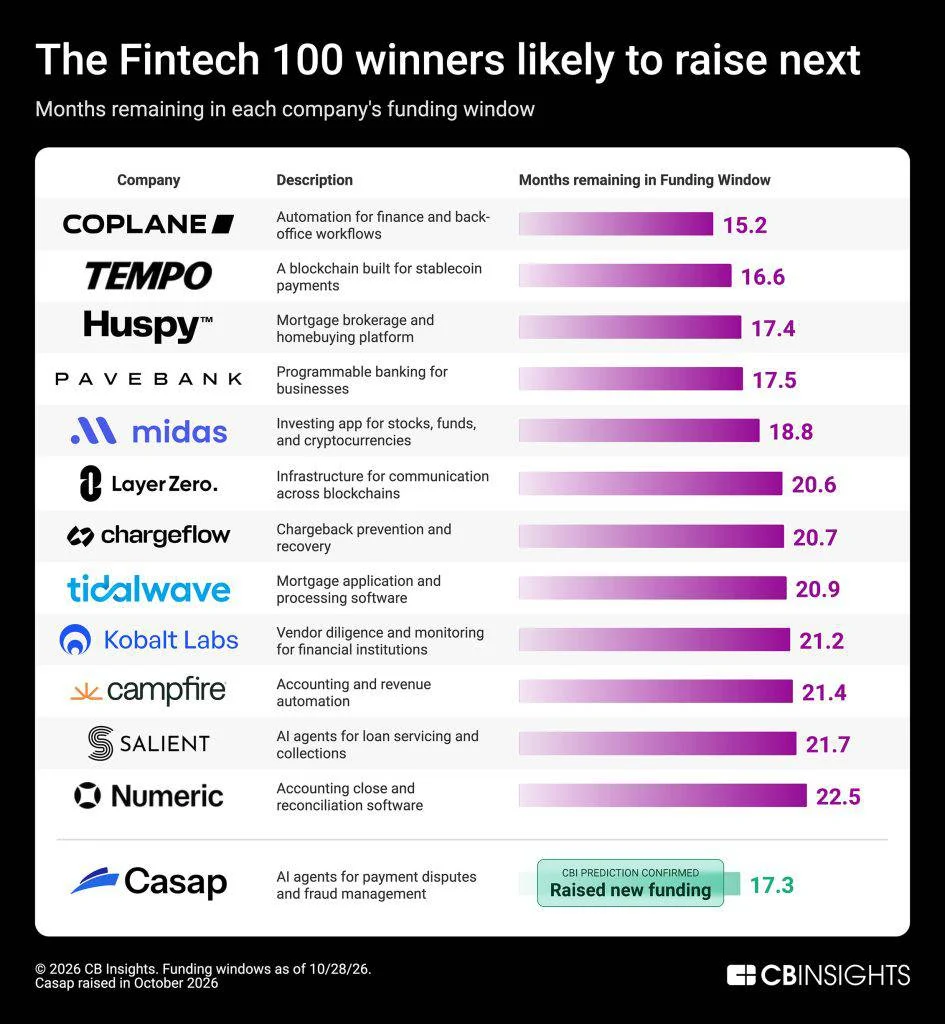
The intersection of artificial intelligence and venture capital has long been a pursuit of both data scientists and institutional investors. Recently, the efficacy of predictive modeling in identifying high-growth fintech startups gained significant validation. Following the release of the annual Fintech 100 list on October 28, 2026, the CB Insights Funding Window model successfully projected that dispute management platform Casap was primed for a capital infusion. Within hours of the list’s publication, Casap announced a $56 million Series B funding round, spearheaded by Base10 Partners. This event serves as a high-profile case study for the predictive capabilities of algorithmic analysis in forecasting corporate financial milestones.
The Funding Window model operates by synthesizing vast datasets, including historical funding timelines, macroeconomic conditions, and industry-specific growth trajectories. By benchmarking a target company against a cohort of similar-stage peers, the model generates a probability-weighted window for when a company is statistically likely to seek its next round of equity financing. The successful prediction regarding Casap highlights a broader trend: as venture capital becomes increasingly data-driven, the "gut feeling" of traditional deal-sourcing is being supplemented, and in some cases replaced, by rigorous quantitative forecasting.
The Dynamics of Fintech Capital Allocation
The fintech sector remains a focal point for global investment, yet the market has shifted toward efficiency and operational maturity. Of the 13 companies identified by the model as currently occupying their predicted funding windows, a clear pattern emerges: the majority are focused on the "plumbing" of the financial system. These firms are not necessarily consumer-facing apps; rather, they provide the backend software that powers essential operations, such as loan servicing, accounting automation, and regulatory compliance.
The recent activity underscores a maturation in the fintech ecosystem. Many of the startups flagged by the model have recently graduated from seed or Series A stages, with six of the 13 entering their predicted windows within the six weeks leading up to October 28. This suggests that for companies at this stage, the interval between funding rounds is compressing as they scale their infrastructure to meet enterprise demand. Investors are increasingly favoring companies that demonstrate clear, quantifiable utility within existing financial workflows rather than speculative, unproven business models.
Strategic Backing and Industry Integration
A notable feature of the current funding landscape is the increasing involvement of strategic corporate investors. Unlike traditional venture capital, which seeks purely financial returns, strategic investors—often incumbents within the sector—provide capital to integrate nascent technologies into their own operations.
The recent activity surrounding Casap illustrates this trend. Its Series B round saw participation from major industry players like Experian and Synchrony. This type of investment serves a dual purpose: it provides the startup with essential growth capital while granting the corporate backers early access to technology that could disrupt or enhance their existing business lines. Similarly, D.R. Horton’s investment in TidalWave and Stripe’s backing of CoPlane indicate that companies within the homebuilding and payment processing sectors are actively buying into the innovation that threatens to automate their manual processes.
For these companies, the relationship with an incumbent is often more valuable than the cash injection itself. It provides a feedback loop that ensures the product remains aligned with market needs, significantly reducing the risk of product-market mismatch during the crucial scaling phase.
Blockchain Infrastructure and the Next Wave of Finance
The model also identified three companies building infrastructure for blockchain-based finance, a segment that continues to draw significant capital despite the inherent volatility of the crypto market. Tempo, a blockchain-native payment platform founded in 2025, represents the pinnacle of this trend. Having secured a $500 million Series A round at a $5 billion valuation, Tempo demonstrates that institutional confidence in blockchain infrastructure remains robust when the underlying technology solves concrete, high-volume problems.
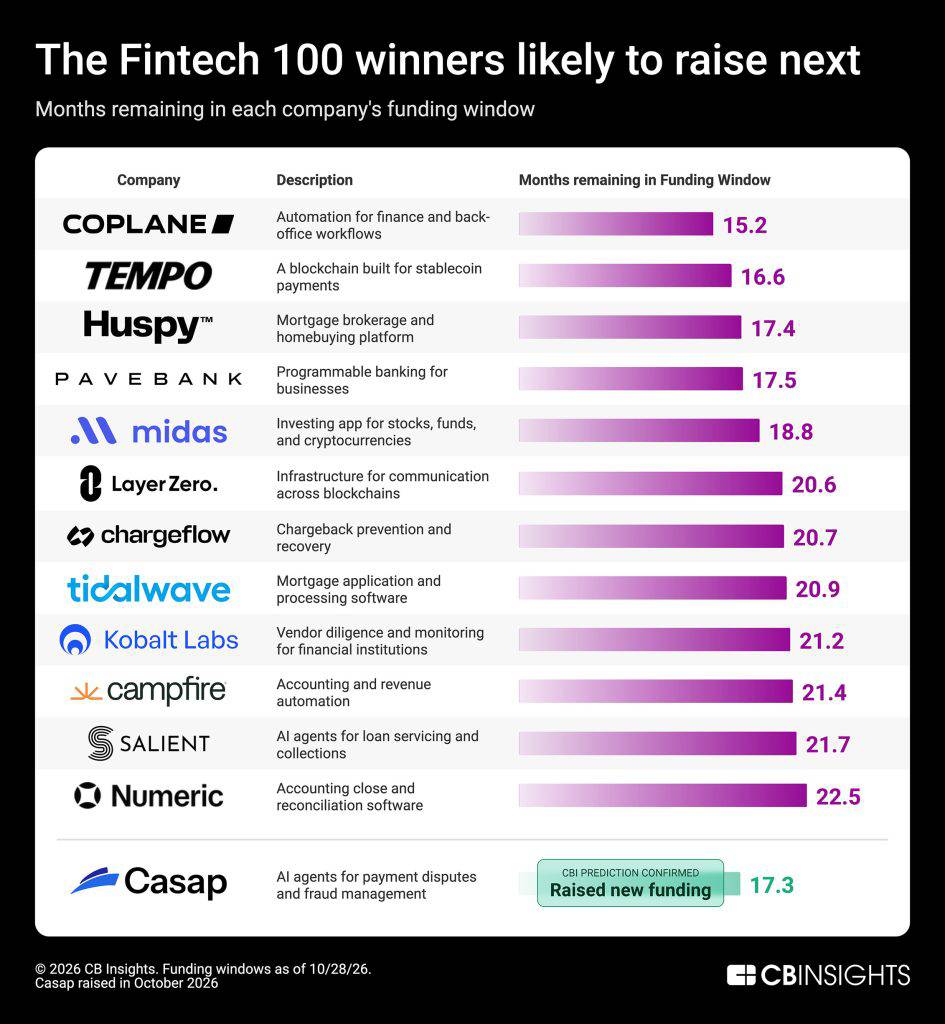
The incubation of such firms by industry giants like Stripe and Paradigm highlights the institutionalization of crypto. These investors are not looking for speculative assets; they are looking for the "rails" upon which the future of global payments will run. The investment in LayerZero by Tether, and the support for Pave Bank, further indicates a strategic push toward interoperability and programmable banking. These initiatives are designed to bridge the gap between legacy banking systems and decentralized finance, creating a hybrid environment where traditional businesses can leverage the speed and transparency of blockchain technology without abandoning regulatory compliance.
The Scale-Up Phase: Mature Fintechs
While the model monitors early-stage startups, it also tracks larger, more established firms that are nearing the threshold of their next phase of growth. Huspy, a Dubai-based mortgage brokerage, and Midas, a Turkish investing application, exemplify this segment. With headcount surpassing 1,000 employees each, these companies have moved beyond the "startup" phase and are now operating as mid-to-large-scale enterprises.
Their funding history offers a different insight into the model’s reliability. Both companies raised significant Series B capital in the summer of 2025—Huspy’s $59 million extension and Midas’ $80 million round—and both are currently being watched for potential Series C or growth-equity rounds. The data indicates that approximately 60% of companies at this maturity level go on to raise further capital, with half doing so within an 18-month window. This longevity suggests that the market for high-growth, regionally dominant fintechs is deep, even as investors apply greater scrutiny to unit economics and profitability.
Implications of Algorithmic Forecasting
The implications of these predictive models for the venture capital industry are profound. First, they democratize the ability to identify growth opportunities, potentially leveling the playing field for firms that do not have the extensive network of a Tier-1 VC. Second, they introduce a higher level of discipline into the investment process. When a model predicts a funding window, it forces the startup’s leadership team to align their product development milestones and hiring plans with that timeline, potentially reducing the incidence of "runway anxiety."
However, the use of such models is not without limitations. Markets are influenced by exogenous shocks—geopolitical events, interest rate fluctuations, and sudden shifts in regulatory policy—that a purely historical model may not fully anticipate. The success of the Casap prediction is a testament to the model’s accuracy under relatively stable conditions, but analysts emphasize that human oversight remains critical. The model acts as a signal, not a guarantee.
Looking Ahead
As of November 2026, the remaining 12 companies on the watch list continue to be monitored. For investors, the focus remains on whether these companies can maintain their growth velocity while managing the operational complexities that accompany their rapid expansion. The historical probability for these startups is favorable: for those currently awaiting their next round, roughly three out of four similar-stage companies eventually raise again, typically within 16 to 19 months of their previous milestone.
The broader lesson for the fintech sector is one of persistent demand. Despite a challenging macroeconomic environment, capital is flowing to companies that demonstrate real-world utility and clear integration with existing financial infrastructures. Whether through the automation of daily accounting tasks or the construction of blockchain-based payment rails, the companies currently in the spotlight are those that are actively rewriting the operating manual for global finance.
The continued tracking of these firms will provide further data on the accuracy of the predictive modeling used here, offering a recurring performance audit of the algorithm. As the industry moves toward 2027, the marriage of high-level predictive analytics and granular operational data will likely become the standard for both founders seeking capital and investors seeking to deploy it with precision. For now, the fintech sector remains a battleground of efficiency, and those companies that align their growth with the expectations of the market—and the predictions of the models—are the ones most likely to emerge as the next generation of financial leaders.