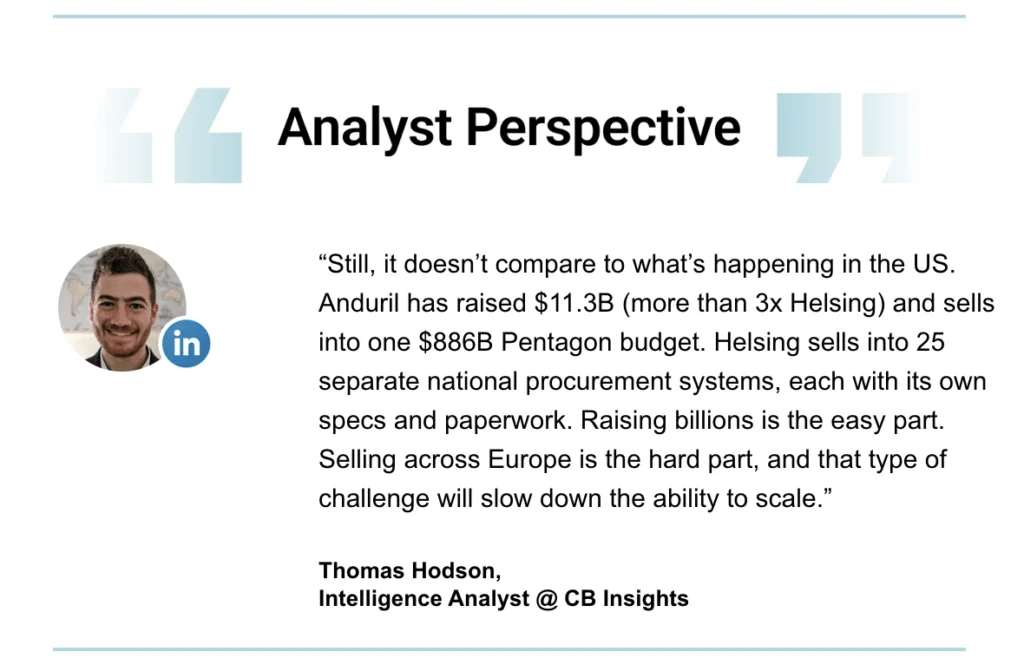
The European defense technology sector is experiencing an unprecedented surge in investment, highlighted by Helsing’s monumental $1.8 billion Series E funding round, which has established a new benchmark for private defense tech investments across the continent. This significant capital infusion, valuing the Munich-based company at a staggering $18 billion, underscores a dramatic shift in investor sentiment and the growing strategic importance of advanced defense solutions. Concurrently, the broader venture capital landscape in Q2 2026 reveals a trend of concentrated growth, with a few mega-rounds disproportionately driving overall funding figures, raising questions about the sustainability of this model for the wider startup ecosystem.
Helsing’s Historic Funding Round: A New Era for European Defense Tech
Helsing’s $1.8 billion Series E funding round is not merely a financial achievement; it represents a pivotal moment for the European defense technology industry. The investment propels the company’s total funding to an impressive $3.3 billion, positioning it as a leading global player in the development of AI-powered defense systems. This valuation and funding level would have been largely unimaginable just five years ago, a period when many European venture capital firms actively shied away from the defense sector.
Background and Investor Shifts:
Historically, European venture capital faced significant headwinds in investing in defense companies. Factors such as stringent ESG (Environmental, Social, and Governance) mandates, limitations imposed by limited partners (LPs), and a prevailing cultural aversion to technologies with direct military applications created a landscape where defense innovation struggled to attract mainstream funding. The perception of proximity to weapons systems was often viewed as a reputational risk, deterring investment.
However, the geopolitical climate has undeniably shifted. Heightened global tensions and a renewed focus on national security have compelled governments and investors to re-evaluate the defense sector. This has led to a recalcitrant but significant increase in capital flowing into defense technology startups.
Data-Driven Growth in European Defense Tech:
The statistics paint a clear picture of this burgeoning trend. In 2025 alone, European defense tech startups collectively raised $3.2 billion, marking a substantial 37% year-over-year increase. This figure is approximately three times the amount raised just five years prior, indicating a sustained and accelerating growth trajectory. Furthermore, the number of unique investors participating in European defense funding rounds has nearly tripled since 2020, demonstrating a broadening investor base and a diversification of capital sources.
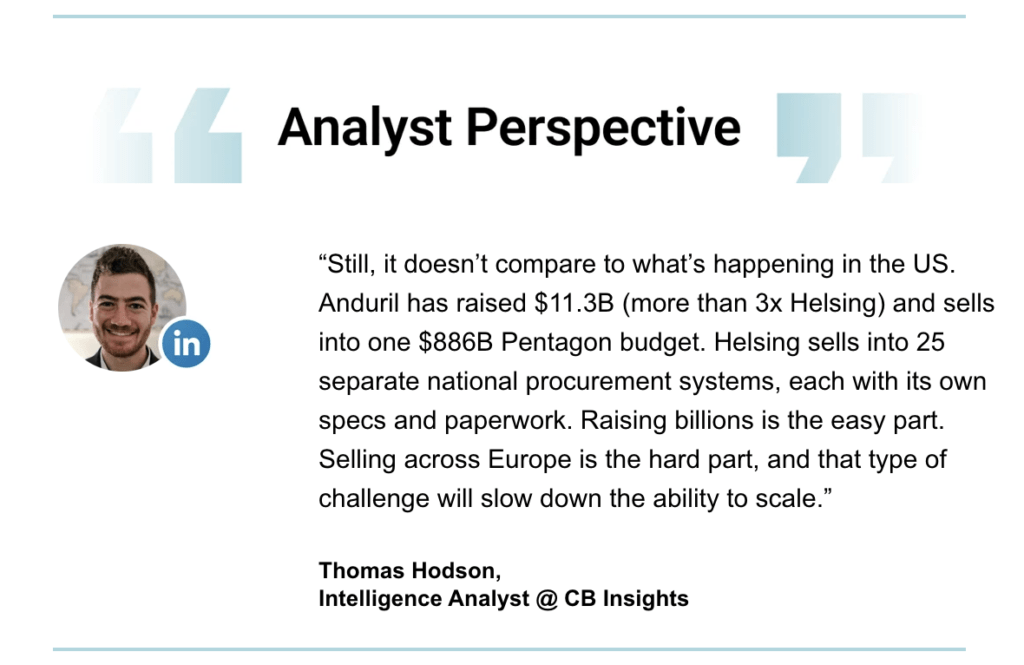
Helsing’s success is a testament to this evolving market. The company’s focus on leveraging artificial intelligence and advanced software for defense applications, including electronic warfare, intelligence, surveillance, and reconnaissance (ISR), has positioned it at the forefront of modern military technological advancements. This latest funding round is expected to accelerate its product development, expand its global reach, and further solidify its competitive edge.
Implications of Helsing’s Success:
The implications of Helsing’s record-breaking round are far-reaching:
- Validation of the Defense Tech Sector: It validates the significant commercial potential within the defense technology market, encouraging further innovation and investment.
- Catalyst for Other Startups: This success will likely serve as a catalyst for other European defense tech startups, potentially leading to increased deal flow and higher valuations across the sector.
- Geopolitical Significance: It signals Europe’s growing commitment to developing indigenous defense capabilities, reducing reliance on external suppliers and fostering technological sovereignty.
- Investor Diversification: The increased investor participation highlights a shift in risk assessment and a recognition of the strategic necessity of advanced defense technologies.
To gain a comprehensive understanding of the competitive landscape, CB Insights has identified key players in this dynamic sector. Their market map of the top 100 European AI, aerospace, and defense startups offers valuable insights into the companies shaping the future of the industry.
Q2 2026 Venture Funding: A Tale of Mega-Rounds and Concentration
While the defense tech sector experiences explosive growth, the broader venture capital market in Q2 2026 presents a more nuanced picture, characterized by significant concentration in mega-rounds. Total funding in the quarter reached an impressive $212.9 billion, marking the second-highest quarter on record. On the surface, this figure suggests a robust and thriving venture ecosystem.
However, a deeper analysis reveals that this impressive total was disproportionately influenced by a handful of exceptionally large funding rounds, often referred to as mega-rounds (typically exceeding $100 million). In Q2 2026, mega-rounds accounted for a remarkable 81% of total funding, a figure that nearly matches the record set in the previous quarter.
The Anthropic Effect:
The driving force behind this concentration in Q2 2026 was the colossal $65 billion investment in Anthropic, an artificial intelligence company. This single investment represented more than a third of all mega-round dollars raised in the quarter, contributing significantly to the overall funding total. The company’s valuation soared to $965 billion following this round, underscoring the immense investor appetite for cutting-edge AI technologies.
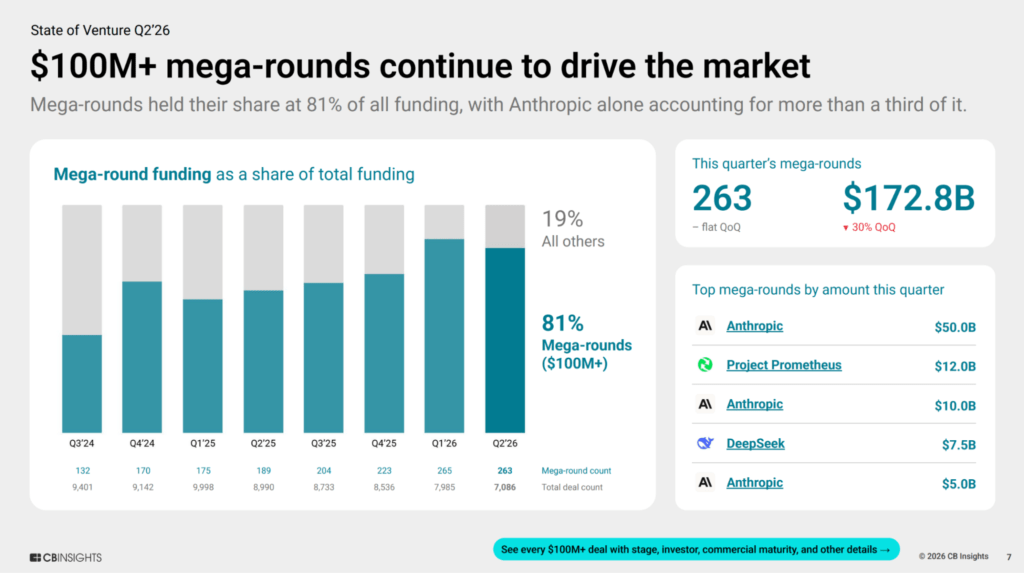
This phenomenon echoes trends observed in Q1 2026, where mega-rounds also dominated, heavily influenced by the combined investments in Anthropic and OpenAI. However, the Q2 2026 trend exhibits an even greater reliance on a single entity, highlighting a potential vulnerability in the market’s reliance on a few mega-deals.
The Squeeze on Smaller Deals:
The overwhelming dominance of mega-rounds has a ripple effect across the venture landscape. For startups operating outside of these massive capital injections, the available capital pool shrinks considerably. In Q2 2026, all other funding rounds outside of the mega-deals had to contend with the remaining 19% of the total capital raised.
This scenario has contributed to a decade-low in deal counts, indicating that fewer companies are successfully securing venture funding. Furthermore, exit activity, which includes initial public offerings (IPOs) and mergers and acquisitions (M&A), has seen a decline for the second consecutive quarter. This suggests a potential slowdown in the pace at which startups are achieving liquidity, which can impact the overall health and dynamism of the venture ecosystem.
Analysis of Concentrated Growth:
The trend of concentrated growth in venture funding raises several critical questions:
- Sustainability: Is a market heavily reliant on a few mega-rounds sustainable in the long term? A slowdown in these large deals could significantly impact overall funding figures.
- Democratization of Capital: Does this concentration hinder the ability of emerging companies with promising but less headline-grabbing innovations to secure necessary funding?
- Valuation Bubbles: The immense valuations commanded by a few select companies could create an environment susceptible to future corrections if market fundamentals do not support such valuations.
- Investor Strategy: It may indicate a strategic shift among large institutional investors to place larger bets on perceived market leaders, potentially at the expense of a more diversified portfolio approach.
The "State of Venture" report from CB Insights provides a comprehensive breakdown of these trends, offering deeper insights into the dynamics shaping the current investment landscape. Understanding these patterns is crucial for entrepreneurs, investors, and policymakers alike as they navigate the evolving world of venture capital.
HLTH USA 2026: Strategic Intelligence for Healthcare Innovation
In parallel to these significant developments in defense and venture capital, CB Insights is actively contributing to the advancement of other critical sectors. As the official Strategic Intelligence Partner for HLTH USA 2026, CB Insights has launched the "Insights Hub," an interactive dashboard designed to provide attendees with a data-driven advantage.
Empowering Healthcare Networking:
Traditional networking events at large conferences can often be unstructured and leave participants reliant on chance encounters. The HLTH USA Insights Hub aims to transform this experience by turning the question of "who should I meet?" into a strategic plan. By leveraging CB Insights’ extensive data on over 12,250 attendees, the Hub offers a personalized and efficient approach to networking.
The platform provides attendees with curated insights, highlighting key companies and emerging trends that are shaping the future of healthcare. This allows participants to identify potential collaborators, investors, and partners before even arriving at the event, maximizing their time and impact.
Registration and Partnership:
Registration for HLTH USA 2026 is currently open, with prices set to increase at the end of the month. Attendees are encouraged to secure their spots early. A special partner code, H26PAR_CBI250, offers a $250 discount, further incentivizing participation.
This initiative underscores CB Insights’ commitment to providing actionable intelligence across diverse industries, enabling stakeholders to make more informed decisions and drive innovation forward.
Conclusion
The venture capital landscape in Q2 2026 is marked by a dual narrative: the remarkable ascent of specialized sectors like defense technology, exemplified by Helsing’s record-breaking funding, and a broader trend of concentrated growth driven by mega-rounds, which presents both opportunities and challenges for the wider startup ecosystem. As geopolitical landscapes continue to evolve and technological advancements accelerate, the ability to identify and capitalize on emerging trends, whether in defense, AI, or healthcare, will remain paramount for sustained success and innovation.