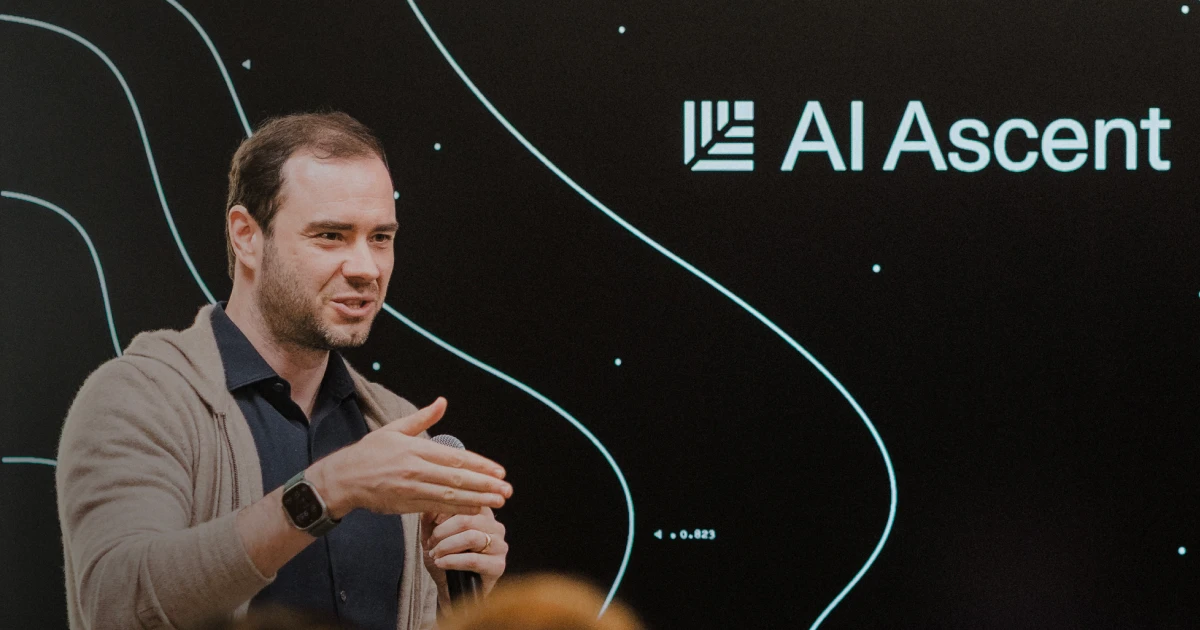
On April 20, venture capital firm Sequoia Capital hosted its fourth annual AI Ascent in San Francisco, convening more than 150 of the artificial intelligence industrys most prominent founders, researchers, and technologists. The exclusive gathering served as a high-level summit to assess the rapid maturation of generative AI, discuss structural shifts in enterprise technology, and map the trajectory of autonomous systems over the coming decade. Attendees included elite figures from across the artificial intelligence ecosystem, such as Demis Hassabis of Google DeepMind, independent researcher Andrej Karpathy, OpenAI President Greg Brockman, Boris Cherny of Anthropic, Waymo Chief Technology Officer Dmitri Dolgov, and Nvidia senior researcher Jim Fan, alongside numerous other pioneers shaping the frontier of machine intelligence.
The one-day conference arrived at a critical juncture for the global technology sector. As generative AI transitions from a period of unbridled hype and foundational model training toward large-scale commercial deployment, venture capitalists, enterprise leaders, and startup founders are increasingly forced to grapple with economic realities, infrastructure constraints, and the mechanics of enduring business models. Sequoia Capital, an early and prolific backer of generational technology companies, used the platform to provide its portfolio companies and the broader ecosystem with a strategic framework for navigating the unfolding paradigm shift.
A Paradigm Shift in Computation
The summit officially commenced with opening remarks from Sequoia partner Pat Grady, who framed the current technological epoch not as a mere incremental upgrade in processing power, but as a foundational revolution in computation. Utilizing a classic automotive metaphor, Grady asserted that artificial intelligence does not represent the breeding of faster horses, but the invention of the automobile—and emphasized that those vehicles have officially arrived at the commercial starting line.
Grady offered direct strategic advice for startup founders building applications on top of the foundational models developed by leading labs like OpenAI, Anthropic, and Google. He urged entrepreneurs to embrace what he termed the MAD framework: building robust moats from the customer backward rather than relying solely on underlying model exclusivity, designing products with high user affordance to ensure seamless adoption, and aggressively exploiting the diffusion gap—the temporal and operational lag between cutting-edge model capabilities achieved in research laboratories and the actual technology deployed within Fortune 500 enterprises.
Following Grady, Sequoia partner Sonya Huang took the stage to cast a bold vision for the immediate future of software, declaring 2026 as the definitive year of autonomous agents. Huang broke down the technological convergence that has finally enabled reliable agentic workflows, identifying three core ingredients that have matured simultaneously: advanced foundational models boasting superior reasoning capabilities, specialized software tools for executing complex tasks, and robust orchestration harnesses designed to keep autonomous agents stable, secure, and goal-oriented in production environments.
Expanding on the macroeconomic and historical significance of the movement, Sequoia partner Konstantine Buhler argued that the ongoing cognitive revolution will mirror the trajectory of the historic Industrial Revolution, albeit operating at a vastly accelerated pace and on a much larger global scale. Buhler posited that artificial intelligence is poised to replicate for cognitive and intellectual work precisely what mechanization and steam power did for manual labor centuries ago, fundamentally altering the nature of human employment, enterprise productivity, and economic value creation.
Chronology of the Summit and Key Thematic Tracks
The agenda for the fourth annual AI Ascent was structured to address both the immediate operational challenges facing software developers and the long-horizon scientific breakthroughs being pursued by deep-tech researchers.
The morning sessions were predominantly dedicated to enterprise adoption strategies, infrastructure scaling, and the transition from static chat interfaces to dynamic, multi-step autonomous agents. Industry leaders dissected the bottlenecks of enterprise integration, noting that legacy IT infrastructure, regulatory compliance, and cybersecurity concerns remain primary friction points preventing corporations from fully absorbing state-of-the-art AI models.
By the afternoon, the discourse shifted toward more speculative and deeply technical horizons. Panel discussions and keynote presentations ranged widely, covering the ultimate endgame for physical robotics and embodied AI, the cutting-edge science of data efficiency designed to train models with exponentially fewer tokens, and the theoretical physics underpinning neural network scaling laws. Notably, discussions even touched upon extreme infrastructure concepts, including the feasibility and necessity of establishing data centers in space to bypass terrestrial power grids and thermal cooling limitations.
A selection of keynote presentations and panel discussions from the event has been made publicly available via Sequoia Capitals official YouTube channel, offering researchers and technologists worldwide a window into the closed-door discussions.
Background Context and Market Dynamics
The backdrop of the 2026 AI Ascent is defined by unprecedented capital expenditure and market expectations. Over the preceding three years, global venture capital investment in artificial intelligence surged into hundreds of billions of dollars, driving rapid advancements in large language models, computer vision, multimodal synthesis, and reinforcement learning. However, as the market matures, investors and enterprise buyers are pivoting away from simple demonstration metrics toward tangible return on investment.
The concept of the diffusion gap, highlighted by Pat Grady, underscores a central tension in the current market cycle: while frontier labs routinely demonstrate superhuman capabilities in controlled benchmarks, the average enterprise is moving at a much more deliberate pace. Legacy institutions face complex hurdles regarding data privacy, proprietary data integration, hallucinations, and workforce retraining. Consequently, startups that bridge this diffusion gap by packaging raw intelligence into reliable, secure, and user-friendly enterprise workflows are capturing significant market share.
Simultaneously, the race toward artificial general intelligence (AGI) continues to drive massive investments in physical infrastructure. Semiconductor shortages, electrical grid capacities, and specialized cooling requirements have transformed the AI race into a geopolitical and industrial struggle. The presence of leaders from Nvidia, Waymo, and leading AI labs at the summit highlighted how software algorithms, hardware accelerators, and physical robotics are rapidly converging into an interconnected ecosystem.
Industry Reactions and Strategic Implications
Reactions from founders and researchers in attendance underscored a collective acknowledgment that the rules of software development are being permanently rewritten. Traditional software-as-a-service (SaaS) margins and defensive moats—such as proprietary databases or standard user interface lock-ins—are proving inadequate in a world where foundational models can generate custom applications on demand.
For enterprise buyers, the insights shared by Sequoia partners signal a mandate to accelerate digital transformation strategies. Organizations that fail to adopt agentic workflows risk operational obsolescence as competitors leverage autonomous systems to streamline supply chains, customer service, software engineering, and internal operations.
Conversely, for independent developers and early-stage founders, the summit served as both a warning and an opportunity. Building a sustainable business on top of third-party foundational models requires hyper-focus on proprietary customer data, workflow orchestration, and deep domain expertise. As the market enters the era of agents, companies that successfully orchestrate models, tools, and harnesses will likely define the next generation of global market leaders.
As the fourth annual AI Ascent concluded, the prevailing sentiment among Silicon Valleys elite was one of cautious urgency. The theoretical foundations of the cognitive revolution have been laid, the computational engines are operational, and the race to integrate autonomous intelligence into the fabric of the global economy has officially entered its most critical phase.